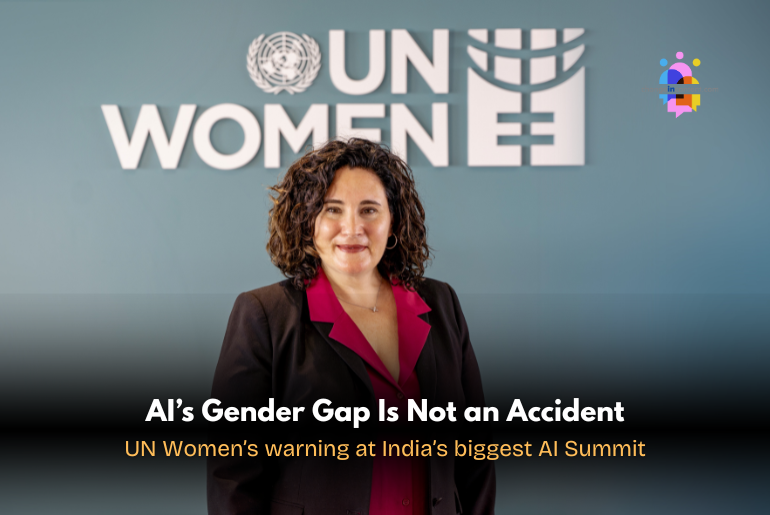
Three days into the India AI Impact Summit 2026, the conversation is no longer just about scale, speed, and shiny demos. UN Women in India AI Summit has brought the gender gap in artificial intelligence back to the centre of the room. They are asking an uncomfortable question: who gets to design the systems that will run our lives?
Since the Summit opened at Bharat Mandapam on 16 February 2026, it has drawn policymakers, global technology firms, startups, researchers, and students in huge numbers. The government has even extended the Summit’s run, underlining the sheer public interest in what India is building next.
Ethical AI at the India AI Summit: Why inclusion cannot be optional
At a high-level session held at Bharat Mandapam, actor and UNFPA India SRHR Advocate Soha Ali Khan called for ethical AI frameworks that protect and empower women. She stressed that technology does not exist in isolation and always reflects the values, assumptions, and priorities of the people who design it.
Her remarks focused on how AI increasingly impacts everyday life, from access to healthcare and welfare schemes to online safety and workplace surveillance. If these systems fail to account for women’s experiences, they can reinforce existing social gaps rather than close them.
Read more on Soha Ali Khan calls for Ethical AI to protect and empower women in a digital India.
UN Women in India AI Summit flags the gender gap in AI development
At the AI Summit, the latest data released by UN Women reports that women make up only 30% of AI professionals worldwide and hold just 16% of AI research roles. These data reveal a deep gender imbalance in one of the most powerful sectors shaping the future of work, governance, and everyday life.
Speaking at the launch of the AI Casebook on Gender and Agriculture, Christine Arab, Regional Director for Asia Pacific at UN Women, described this gap as a “design problem” with long-term consequences. She argued that when women remain absent from design teams, testing environments, and funding discussions, bias becomes the default. Fewer women building AI systems also means fewer tools that reflect women’s lived experiences, needs, and risks.
Arab pointed out that this imbalance already affects the sectors most important to women. In healthcare, biased data can lead to misdiagnosis or exclusion. At the same time, in finance, algorithms can deny credit or insurance based on flawed assumptions. In climate and agriculture, digital tools often overlook women farmers, even though they constitute a significant share of the rural workforce. In personal safety, poorly designed systems can fail to recognise or prevent online harassment and abuse.
Women, Work, and AI: The job disruption nobody is planning for
Another major concern raised at the Summit relates to women’s employment. Citing a joint analysis by UN Women and LinkedIn, Arab noted that nearly 80% of women across Asia and the Pacific work in job categories that AI will either augment or disrupt. These include administrative roles, customer service, data processing, and retail services.
On the one hand, automation could replace many routine jobs in which women make up a significant share of the workforce. On the other hand, AI could also open new roles in data management, digital services, and remote work.
The outcome depends heavily on policy choices. Without strong investment in training, reskilling, and labour protections, women may face higher unemployment and job insecurity. With the right support systems, AI could help women access better-paying and more flexible work.
AI Casebook on gender and agriculture: What “Inclusive AI” looks like
One of the most practical interventions at the Summit came through the launch of the AI Casebook on Gender and Agriculture. The casebook showcases 26 AI solutions already in use, focused on crop planning, supply chains, financial resilience, and market access.
Many of these projects target small-scale and women farmers, who often lack access to formal credit, digital tools, and climate data. These solutions demonstrate how AI can improve productivity and income when developers design systems around real community needs.
In India, women form nearly 80% of the agricultural workforce but rarely receive the same access to land ownership, credit, insurance, or technology as men. Most women farmers work on smallholdings or as informal labourers, keeping them outside formal data systems and government platforms. As a result, many digital agriculture tools fail to recognise them as primary users, even though they carry out most of the farm work. The projects featured in the casebook aim to address this gap by designing AI systems that centre women from the outset.
Christine Arab described these initiatives not as experiments but as working models that deserve public funding and institutional backing.
Can India lead on Inclusive AI standards globally?
India has one of the largest digital populations in the world, with millions of people using technology and AI in their daily lives. From online payments and government services to education apps and health platforms, AI already plays a role in how people work, learn, and access basic services.
Given this widespread use, the choices India makes today about rules, education, data use, and inclusion will not only affect its own citizens but also influence how other developing countries design their digital systems.
India also has a large pool of women in STEM education, growing startup ecosystems, and expanding digital infrastructure. If these resources align with gender-focused policy, India could become a global example of inclusive AI development.
Changeincontent perspective on issues raised by UN Women in India AI Summit
If AI is shaping healthcare, credit, agriculture, public services, and safety, then women cannot be treated like an “add-on audience” after products launch. Inclusion must move upstream into who collects data, who defines “harm,” who tests systems, who sits in governance rooms, and who gets funded.
India can lead here, but only if we treat gender as core infrastructure. We can lead by mandating gender impact assessments for high-risk AI, publishing gender-disaggregated workforce and safety metrics, funding women-led AI research and startups, and building fast, accessible skilling pathways so women are not locked out of the very jobs AI is creating.
Most importantly, stop calling bias a “bug.” When women are missing from design and accountability, bias is the product.
Closing note: Inclusive AI is the real test of leadership
The India AI Impact Summit shows that while the country moves fast on innovation, the real test lies in who benefits from it. Without women in decision-making roles, AI risks repeating old inequalities in a new digital form. If India invests in inclusion, skills, and ethical design, it can ensure that AI serves as a tool for progress rather than another source of division.
Disclaimer: The views expressed in this article are based on the writer’s insights, supported by data and resources available both online and offline, as applicable. Changeincontent.com is committed to promoting inclusivity across all forms of content. We broadly define inclusivity as media, policies, law, and history. It encompasses all elements that influence the lives of women and marginalised individuals. Our goal is to promote understanding and advocate for comprehensive inclusivity.