
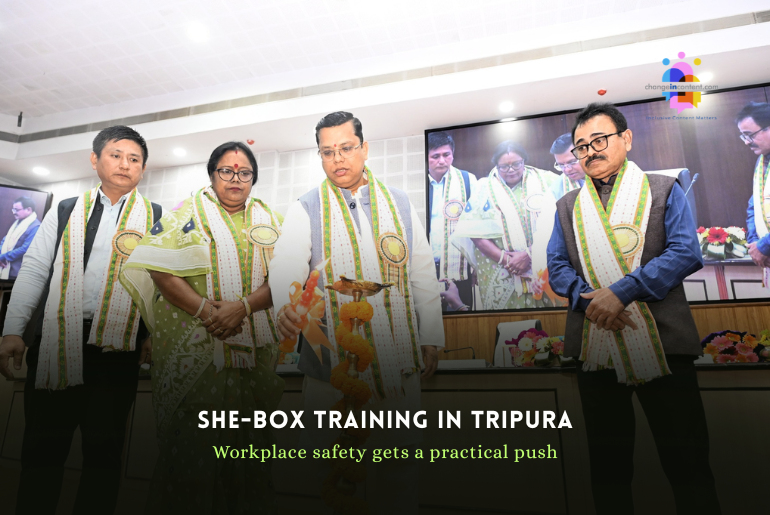
SHe-Box Training in Tripura became the centrepiece of a state-level workshop held at Pragya Bhavan in Agartala. Tripura’s Social Welfare and Social Education Minister, Tinku Roy, spoke about women’s empowerment and workplace safety as linked priorities, not separate conversations.
The training, held on Wednesday and reported on February 18, 2026, focused on how the SHe-Box portal works, what the PoSH Act expects from employers, and why women need clearer, faster routes to redressal in both organised and unorganised work environments.
What the SHe-Box Training in Tripura actually covered
The workshop was designed as a working training session, not a ceremonial event. According to the report, it trained nodal officers, HR professionals, and Internal Committee members on registering complaints on SHe-Box. It also trains them on what “legal compliance” means for organisations with 10 or more employees, and the employer’s responsibilities when a complaint is received.
The training also included awareness modules that define sexual harassment and explain the redressal process. It matters because confusion is often the first barrier women face. Even in educated workplaces, employees frequently do not know what qualifies as harassment, what documentation is required, or what timelines apply.
Why this matters: A portal is only as strong as the people running it.
The SHe-Box portal, as described in the report, is a centralised platform developed by the Ministry of Women and Child Development. It is a platform to register workplace sexual harassment complaints under the PoSH Act, 2013. The minister noted that the government has updated the portal. It now allows monitoring of complaints across organised and unorganised sectors.
That last point is crucial. A portal can exist, a law can exist. But women still get stuck when committees are poorly trained, workplaces treat complaints as reputation risks, or the process feels intimidating. Training is the missing middle layer between “we have a system” and “the system works”.
The empowerment framing: TRLM funding and SHE Marts as the wider context
Alongside safety, the event framed workplace dignity as part of women’s broader economic participation. The report quotes Tinku Roy saying Tripura schemes under TRLM have already sanctioned Rs 2,100 crore to skill and train women for sustainable livelihoods.
He also referred to SHE Marts, announced in the Union Budget 2026–27. These are positioned as community-owned retail outlets where rural women’s Self Help Groups can sell handicrafts, farm produce, and processed foods. The report links this to the Lakhpati Didi programme’s goal of helping rural women reach an annual income of Rs 1 lakh.
From a Changeincontent lens, it is worth saying plainly that economic empowerment without workplace safety is fragile. A woman cannot “participate” freely in the economy if she is expected to absorb harassment as the cost of earning.
Who attended, and why it is not a small detail
The event attendees were Tripura Commission for Women Chairperson Jharna Debbarma, Special Secretary Tapan Kumar Das, and other senior officials. The report notes participants saw the workshop as reinforcing both compliance and a larger empowerment vision.
It matters because PoSH and SHe-Box are not only HR topics. They are governance topics. When senior officials attend and committees get the training, the message travels. It shows that complaints are not “personal issues”; they are institutional obligations.
Changeincontent perspective
At Changeincontent, we track women’s safety systems for one reason. The reason is that the gap between legislation and lived reality is where women lose years of their careers. A workshop like the SHe-Box Training in Tripura is not “good optics” without measurable follow-through.
The follow-through should be to ensure trained Internal Committees, visible reporting channels, time-bound redressal, and a culture that stops treating complainants like disruptions. That is also why we have been consistently decoding what SHe-Box is and how women can use it.
Read our explainer here.
SHe-Box training in Tripura: Closing thoughts
The headline is not only that Tripura held a training workshop. The headline is that the state chose capacity-building over silence. In 2026, women do not need more posters about dignity. They need systems that respond when dignity is violated.
If SHe-Box is meant to be a national safety architecture, training sessions like this are how it becomes usable, not just available.
Disclaimer: The views expressed in this article are based on the writer’s insights, supported by data and resources available both online and offline, as applicable. Changeincontent.com is committed to promoting inclusivity across all forms of content. We broadly define inclusivity as media, policies, law, and history. It encompasses all elements that influence the lives of women and marginalised individuals. Our goal is to promote understanding and advocate for comprehensive inclusivity.
