
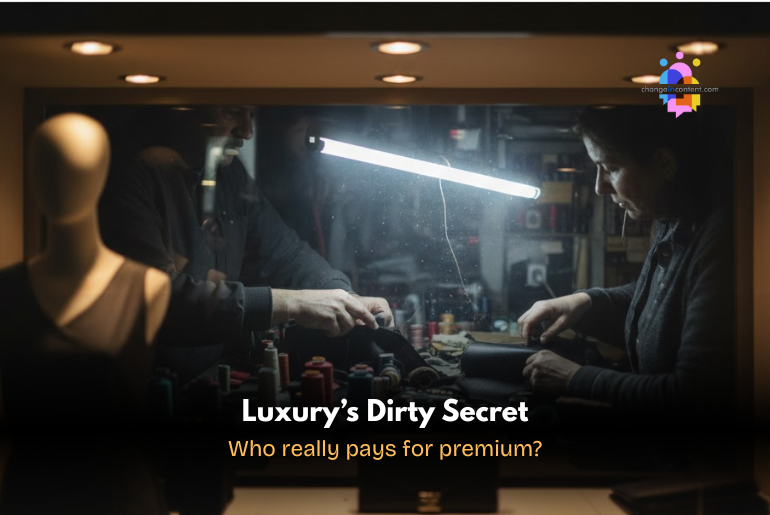
The phrase ‘exploited labour behind luxury labels’ sounds like a provocation until you look at how the industry actually runs. A single handbag can be priced like a small car, while the people stitching it together are treated like a cost to be minimised, not a craft to be respected.
A recent wave of investigations has pulled the curtain back on luxury supply chains. These investigations include allegations of underpaid labour, unsafe conditions, and subcontracting structures that make accountability feel optional. It is not about cancelling luxury or shaming buyers. It is about naming the gap between what luxury promises and what it often hides.
A pop culture mirror: When fiction looks too real
There is a new eight-episode Korean drama on Netflix called The Art of Sarah. So, the story follows the titular character, Sarah Kim, as she launches a luxury bag brand called Boudoir. She claims that European royalty has carried Boudoir bags for over a century, marketing them as ultra-exclusive, high-fashion pieces meant for the top 0.1%. One bag carries a jaw-dropping price tag of 50 million won, roughly ₹31,44,140.
In reality, undocumented workers, mostly migrant women, are making these bags in sweatshop-like spaces. The makers are paying these women barely a slice of the retail price. Sometimes, it is just one-tenth of what the brand charges the elite buyers.
The Art of Sarah may be fictional, but the exploitation of low-paid, overworked labour within luxury supply chains remains very real and continues all around us.
Exploited labour behind luxury labels: The luxury price gap explained
Luxury pricing and actual production costs often differ significantly. A report by The Wall Street Journal pointed out that Dior paid suppliers roughly $57 to manufacture a handbag that later sold in stores for about $2,780. The Milan-based label Giorgio Armani reportedly paid suppliers around $270 per bag, while retail prices reached just under $2,000. In several cases, subcontractors hired Chinese migrants and other foreign workers who earned as little as $2 to $3 an hour.
Many of these workshops rely heavily on migrant labour, especially workers who lack documentation or social protections. Countries such as India, China, and Bangladesh supply some of the largest pools of garment and leather workers in the world. They handle the stitching, finishing, and assembly that give luxury bags their polished look, yet they rarely see anything close to minimum wage.
The power of the “Made In” label
Luxury fashion also relies on geography as a marketing strategy. A bag tagged “Made in Milan” or “Made in France” still carries a certain social currency that “Made in India” often does not, even when it is the result of South Asian labourers’ craftsmanship.
There is a medium-washed leather bag from Prada priced at about $4,450. The product page listed the item simply as “Imported,” but zooming in on the product image revealed a small “Made in India” tag. Once shoppers noticed it, many openly questioned whether they wanted to spend that kind of money on a product manufactured there. Many buyers still associate European-origin labels with prestige while undervaluing the work done in South Asian factories.
When buyers place more value on the European tag than on the labour that goes into the product, brands face less pressure to talk openly about who actually makes the goods and under what conditions. Many sweatshop workers, including migrant women across South and Southeast Asia, continue to handle labour-intensive parts of production while earning only a tiny share of the final retail price.
The women stitching luxury for pennies.
Zoom in on who actually sits at the sewing tables of sweatshops. A large share of low-paid garment and leather work falls on migrant women. Asia employs the largest number of garment workers in the world, with roughly 75% of the total workforce based in the region. Out of these, an estimated 42 million are women.
Employers often prefer hiring women in garment and leather supply chains because of a long-standing gender bias in the industry. Many factory managers believe women workers are easier to control, more patient with repetitive work, and less likely to protest poor conditions or demand higher wages. Because many of these workers support families back home or lack secure documentation, they won’t push back against unfair working conditions.
The fashion industry has, over time, built a labour model that heavily exploits women’s economic vulnerability.
Changeincontent perspective
If a brand can price a product at a premium, it can also afford premium ethics. The uncomfortable truth is that luxury has mastered storytelling, but it still treats labour rights like a footnote. And when scrutiny arrives, brands often respond with the same predictable playbook: blame a supplier, promise an audit, move on.
What must change is not just “awareness” but the system. Luxury groups need traceable, public-facing supply chain disclosures (not vague ESG PDFs), living-wage commitments verified independently, and binding rules on subcontracting so factories cannot quietly pass risk down the chain.
Governments also have a role: stronger enforcement, worker protections that follow the subcontracting trail, and penalties that do more harm than good press.
Luxury is not the bag. Luxury is the story we buy to forget the hands that made it. If your brand margin depends on someone else’s poverty, it is not premium. It is predatory. ~ Saransh Jain
Conclusion: Luxury cannot stay “Premium” on cheap labour
Luxury brands will continue to sell because there will always be demand for status-driven products. The more realistic pressure point sits with transparency and awareness. When more buyers begin to ask who made the product, under what conditions, and for what pay, the conversation around value starts to shift.
Until that scrutiny becomes mainstream, the luxury business model will stay the same. Brands will keep their high profits at the top, while the labourers doing the hardest, most detailed work will continue to get the smallest share of the money their labour helps generate.
Disclaimer: The views expressed in this article are based on the writer’s insights, supported by data and resources available both online and offline, as applicable. Changeincontent.com is committed to promoting inclusivity across all forms of content. We broadly define inclusivity as media, policies, law, and history. It encompasses all elements that influence the lives of women and marginalised individuals. Our goal is to promote understanding and advocate for comprehensive inclusivity.
