
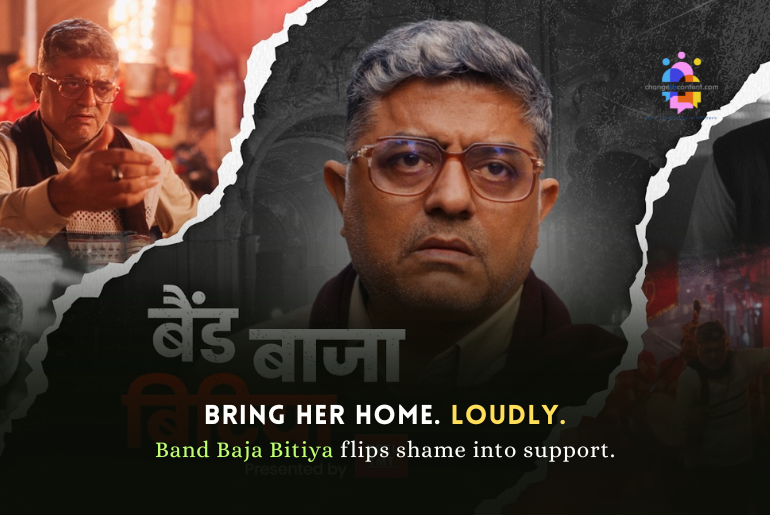
In Band Baja Bitiya, Goel TMT tells a story many Indian homes recognise but rarely confront out loud. A married daughter calls her father in distress. The people around him respond with the usual lines: adjust, compromise, it is her home now, a child will fix it. The familiar script of social comfort tries to win.
But the father chooses something else. He hires a full band-baaja troupe and walks straight into his daughter’s marital home, not to negotiate, but to take her back. Loudly. Publicly. Without shame. The campaign flips the idea of honour on its head and asks a sharper question. If a wedding procession can mark a daughter’s departure, why can’t a procession mark her return to safety?
A daughter’s home is not just her husband’s address
Goel TMT’s latest campaign, produced by The Unicorn Film and conceptualised by Wisteria Media, features actor Gajraj Rao in a story that urges families to stand by daughters facing domestic violence.
The film opens with an elderly father shaken after a call from his married daughter, who is being abused at her in-laws’ home. When he seeks advice, relatives and friends offer the usual responses. They repeat that this is her home now, that maybe having a baby will fix things, and that after kanya daan, a daughter belongs to another household. The typical “chaar log kya kahenge” mindset takes over.
[penci_video url=”https://www.youtube.com/watch?v=EECnymmNdqU” align=”center” width=”770*515″ /]
Instead of giving in to that pressure, the father makes an unexpected move. He hires a full band baaja troupe, usually booked for weddings, and marches straight to his daughter’s marital home. With drums beating and neighbours watching, he calls out to her, embraces her, and shows that she will always remain his daughter, and she always has a home to return to. He brings her back home, the band now playing even more cheerfully.
The film ends by reminding viewers that many women suffer in silence not only because abuse exists, but because families too often choose social comfort over standing by their daughters.
Band Baja Bitiya and the rise of “Reverse Baraats” in India
Several similar incidents in India have gone viral in recent years, where fathers brought their daughters home from abusive marriages. In one widely shared case, Anil Kumar, a BSNL employee, welcomed his daughter back with a full baraat complete with dancing, crackers, and loud music after she escaped an eight-year dowry harassment marriage. In another case, Prem Gupta from Jharkhand received his daughter, Sakshi, with a grand wedding-style procession after she left her husband.
These reverse baraat tell us that a daughter’s return home deserves the same celebration and respect once accorded to her during her bidaai.
Domestic violence in India: The scale, the silence, the underreporting
The National Family Health Survey–5 (2019–21) reports that 32% of married women in India have experienced physical, sexual, or emotional violence by their husbands at some point in their lives, while 6.1% reported sexual violence specifically. At the same time, dowry-related crimes continue to rise. In 2023 alone, cases registered under dowry offences increased by 14%, with more than 15,000 cases recorded nationwide and over 6,100 deaths reported throughout the year.
When the National Family Health Survey finds that nearly one in three married women aged 18 to 49 have experienced spousal violence, but far fewer cases appear in National Crime Records Bureau data, the gap suggests that many incidents never reach the police or courts. The violence exists, but it often stays within the home and outside official records.
Social stigma still discourages women from speaking openly about abuse. Families frequently urge women to adjust rather than file complaints. Many survivors fear retaliation, financial insecurity, or social isolation if they take legal action.
Smriti Irani on Band Baja Bitiya: “Violence is not culture.”
The campaign’s message feels especially relevant here. Change begins at home when families choose to stand firmly with their daughters, rather than worrying about social judgment.
As former cabinet minister Hon. Smt. Smriti Irani shared while amplifying the campaign on LinkedIn:
“Empowerment does not begin in policy alone. It begins in homes that choose courage over conformity.
May we raise sons who respect.
May we raise daughters who know their worth.
And may we build families where coming home is never a defeat, but an affirmation of dignity.“
The changeincontent perspective
A campaign like Band Baja Bitiya works because it hits the real problem. It hits the problem of abuse that survives on isolation, and isolation is often enforced by “respectable” families. We keep telling women to be resilient, but we rarely tell families to be brave. In India, the first line of protection is not a helpline. It is the home that raised her. And too often, that home chooses silence.
If organisations want to matter beyond posters and panel talks, they can borrow a lesson from this film. Make the exit practical. Build clear domestic violence support pathways at work (confidential reporting, paid leave for legal/medical needs, emergency relocation support, tie-ups with credible NGOs, and a trained internal response team).
For communities, the shift is even simpler and harder: stop treating a daughter’s return as gossip. Treat it as a safety decision. Celebration is not the point, but public support does something powerful: it tells a woman she will not be punished for surviving.
The closing thoughts
Goel TMT’s film challenges a deeply normalised silence around domestic violence. The data shows how widespread and underreported abuse remains, but the film pushes the conversation back to the most immediate line of defence: family. When homes choose dignity over social fear, returning from an abusive marriage stops looking like failure and starts looking like strength.
A daughter’s return from abuse does not signal failure. It signals courage, and it demands family solidarity. Fathers like Anil Kumar and Prem Gupta chose support over shame and celebration over silence. In a country where one in three married women reports spousal violence, that choice can save a life.
Also Read: Signs of domestic abuse in the workplace. And why you should pay attention.
Disclaimer: The views expressed in this article are based on the writer’s insights, supported by data and resources available both online and offline, as applicable. Changeincontent.com is committed to promoting inclusivity across all forms of content. We broadly define inclusivity as media, policies, law, and history. It encompasses all elements that influence the lives of women and marginalised individuals. Our goal is to promote understanding and advocate for comprehensive inclusivity.
