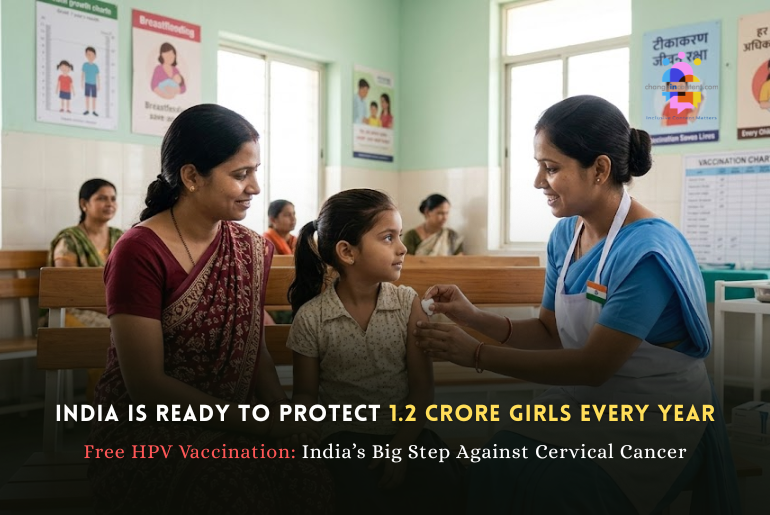
India is preparing to launch one of its most significant public health interventions in recent years. The government plans to launch a nationwide free HPV vaccination campaign aimed at reducing the burden of Cervical Cancer among women. For a largely preventable disease, the numbers in India remain devastating.
While countries across the world have already integrated HPV vaccination into routine immunisation, India has struggled. The challenges are low uptake, limited awareness, and delayed screening. With nearly 1.2 crore 14-year-old girls expected to receive the vaccine each year, the country is finally signalling that cervical cancer prevention is urgent.
India’s free HPV Vaccination campaign to prevent cervical cancer
Most HPV-related infections and cancers are preventable through timely vaccination during adolescence, followed by regular screening in adulthood. However, India still reports very low HPV vaccine uptake among girls and women. The current estimates are only about 1% to 1.3%. Meanwhile, cervical cancer remains the second most common cancer among Indian women. Hence, focused action is required now to improve protection and awareness and reduce the cervical cancer burden among women.
The vaccine in focus
India will use the Gardasil vaccine for its nationwide human papillomavirus (HPV) immunisation campaign. The vaccine protects against HPV types 16 and 18, which cause more than 80% of cervical cancer cases in the country. It also covers HPV types 6 and 11, which lead to most genital wart infections. Health systems worldwide have administered over 500 million doses of Gardasil since 2006.
Research shows the vaccine offers about 93 to 100% protection against cervical cancers linked to the HPV types it targets. India will follow a single-dose regimen, in line with current global scientific guidance and recommendations from the World Health Organisation.
The action plan
Officials will run the HPV drive as a focused campaign rather than through the routine Universal Immunisation Programme. State health teams will hold vaccination sessions on fixed days and coordinate with schools and local health workers to reach eligible girls efficiently.
Authorities will track each beneficiary through the U-WIN digital platform. The system will help health departments monitor coverage, prevent duplication, and maintain reliable records across states. The doctors will administer vaccinations only at designated government facilities, including Ayushman Arogya Mandirs (Primary Health Centres), Community Health Centres, Sub-District and District Hospitals, and Government Medical Colleges.
India has secured vaccine supplies through a global partnership with Gavi, the Vaccine Alliance. Gavi has committed 2.6 crore doses to support the campaign, and officials have already received about 1.5 crore doses. The programme will need close to 1.2 crore doses each year to cover the annual cohort of 14-year-old girls.
The cervical cancer burden in India: Why immediate action is critical
Cervical cancer remains one of the few cancers that you can largely prevent through vaccination and early screening. Even so, India reports an estimated 1,23,907 new cervical cancer cases and 77,348 deaths every year. Data also show that one in every five women in the world who develops cervical cancer lives in India, and about 25% of global cervical cancer deaths occur in the country.
Within India, cervical cancer ranks as the second most common cancer among women overall. It also stands as the second most common cancer among women aged 15 to 44 years, which highlights the risk during key working and reproductive years. Despite the availability of preventive tools, many women still receive a diagnosis at a late stage, which reduces survival chances and raises treatment costs.
Reports find that about 5.0% of women in the general population carry cervical HPV types 16 or 18 infection at any given time. These two high-risk virus types alone account for 83.2% of invasive cervical cancer cases among Indian women.
Every hour, India loses 8 women to cervical cancer that could be prevented. Every 8 minutes, a woman dies of cervical cancer in India. Over 200 women are lost to cervical cancer in India every day.
Can India eliminate cervical cancer by 2030? The WHO 90–70–90 target explained.
In 2020, the World Health Organisation approved a global strategy to eliminate cervical cancer as a public health problem. The goal requires every country to bring the incidence below 4 cases per 100,000 women. To reach this, the WHO set the 90–70–90 targets: by 2030, vaccinate 90% of girls against HPV by age 15, screen 70% of women with a high-quality test by ages 35 and 45, and ensure treatment for 90% of women with pre-cancer and invasive cancer.
About 125 countries include the HPV vaccine in their national immunisation programme for girls, and around 47 countries also offer it to boys. India has now announced a nationwide free HPV vaccination campaign, which is definitely an important step forward. However, very few girls in India have received the HPV vaccine so far, and only around 2% of Indian women have ever undergone screening. At this pace, reaching the 90% elimination target set for 2030 will remain a long challenge for India.
The changeincontent perspective
Cervical cancer is one of the rare cancers for which science has already given us the tools to prevent. When women continue to die from a preventable disease, the issue is systemic. Awareness gaps, social hesitation around reproductive health, limited screening access, and delayed policy implementation have collectively cost lives.
The free HPV vaccination campaign is not just a health announcement. It is a structural shift. But vaccination alone will not end the cervical cancer crisis. Screening must expand aggressively. Conversations about adolescent health must move beyond stigma. Schools, parents, and healthcare workers must treat HPV vaccination like any other essential immunisation, not a taboo topic.
India has taken a bold step. The next challenge is execution, awareness, and follow-through.
The closing thoughts
India’s nationwide HPV vaccination drive is a much-needed step in the right direction. Free vaccines, digital tracking through U-WIN, and yearly coverage of 14-year-old girls show that the country is finally taking cervical cancer prevention seriously. If states keep the momentum going and spread awareness, this campaign can protect millions of girls and young women.
At the same time, screening for adult women must expand much more quickly. If vaccination, awareness, and testing move together, India can stay on track toward the 2030 cervical cancer elimination goal and reduce the cervical cancer burden on women.
Disclaimer: The views expressed in this article are based on the writer’s insights, supported by data and resources available both online and offline, as applicable. Changeincontent.com is committed to promoting inclusivity across all forms of content. We broadly define inclusivity as media, policies, law, and history. It encompasses all elements that influence the lives of women and marginalised individuals. Our goal is to promote understanding and advocate for comprehensive inclusivity.