
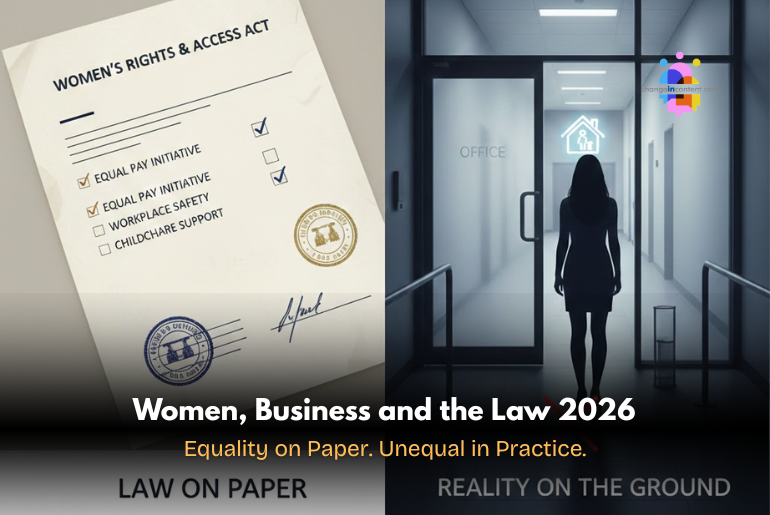
The Women, Business and the Law 2026 Report is not a comforting read, and that is precisely why it matters. The World Bank’s latest edition looks at women’s economic opportunity across 190 economies and shows something many women already know: equality often exists as a promise, not as a lived reality.
This report’s most important shift is not a new statistic. It is a new way of measuring the world. Instead of only tracking laws on paper, the World Bank now frames women’s economic opportunity through three pillars: legal frameworks, supportive frameworks, and enforcement perceptions. In other words, it asks whether rights exist, whether systems help women use those rights, and whether women can realistically expect the system to work when it matters.
At Changeincontent, we care about that distinction because women’s equality is not a slogan. It is infrastructure.
What the Women, Business and the Law 2026 Report measures, and why the “new framework” changes everything
For years, global gender policy debates leaned heavily on the idea of legal reform. Fix discriminatory provisions, update labour codes, expand protections, and progress follows. The Women, Business and the Law 2026 Report agrees that reforms matter, but it refuses to stop there. It calls out a marked imbalance between gender equal laws, the policies and institutions meant to implement them, and how enforcement is perceived in practice.
It matters because laws are only the first gate. Supportive frameworks decide whether women can walk through the gate. Enforcement decides whether the gate stays open when women face resistance.
That is why the report’s framing feels like a corrective to global complacency. It does not allow governments, companies, or societies to claim progress simply because a statute exists.
Women, Business and the Law 2026: The numbers the world should not ignore
The report’s headline messages are blunt:
- Legal equality remains out of reach for every woman. Only 4% of women live in countries close to full legal equality.
- Across the 190 economies assessed, none offers women equal economic opportunity.
- Women worldwide still enjoy only about two-thirds of the legal rights men do.
- Even where gender equal laws exist, fewer than half of the policies and institutions needed to help women exercise those rights are in place.
- Legal experts surveyed estimate that laws supporting women’s economic participation are enforced only half as much as they should be.
- Progress exists, but it is uneven: between 2023 and 2025, 68 economies enacted 113 legal reforms that strengthen women’s economic opportunities.
This mix is the story. There is movement, but the world is still running a two-speed system. It writes rights faster than delivering them.
The 10 topics where women’s economic lives are shaped, limited, or unlocked
The Women, Business and the Law 2026 Report provides data across 10 key topics shaping women’s access to jobs and entrepreneurship. It matters because women do not experience “the economy” as one big thing. They experience it as a sequence of gates: safety, mobility, pay rules, parental penalties, asset ownership, and retirement security.
The report’s framework also makes a crucial point: Safety and Childcare are not “nice to have” social issues. They are economic levers. Previous editions explicitly recognise these as core indicators within the expanded WBL 2.0 approach.
A country can claim equality in hiring, but if women cannot travel safely, cannot access childcare, or cannot count on enforcement, the labour market is not truly open.
The biggest insight: The implementation gap is the real gender gap
If you had to summarise the report in one sentence, it is this: the world is better at announcing equality than enabling it.
You can see this in every pillar.
- Legal frameworks can be strong while workplaces remain hostile.
- Supportive frameworks can coexist alongside unequal access due to awareness, cost, location, digital barriers, or stigma.
- Enforcement perceptions can remain low because women have learned, often through experience, that the burden of proof and the social costs are placed on them.
That is why the report’s emphasis on “de facto” is so important. It treats enforcement and lived reality as measurable policy outcomes, not as footnotes.
Why this is not just a women’s issue: The growth argument is real, but incomplete.
The World Bank has repeatedly linked women’s economic participation to broader prosperity. Even a related World Bank concept note underscores how parity can yield substantial gains, including estimates that GDP per capita could be substantially higher in a world with gender parity.
But the Women, Business and the Law 2026 Report quietly does something sharper than the growth pitch. It implies that growth can happen while women stay unequal unless systems are deliberately built to include women as full economic actors.
In other words, women’s equality is not just good economics. It is a test of whether the economy is built fairly.
What this means for India, even before we get to the scorecards
India’s gender conversations often swing between two extremes: celebration and despair. One week, we highlight more women entering the workforce. Next week, we ask why women are still missing from leadership, asset ownership, and secure employment.
The Women, Business and the Law 2026 Report offers a better lens. Instead of asking “Do we have laws?”, it pushes us to ask:
- Are the systems accessible beyond major cities?
- Do women in informal work have real coverage, not theoretical coverage?
- Do women trust redressal systems enough to use them?
- Do employers treat compliance as culture or paperwork?
- Do childcare, transport, safety, and enforcement work as a connected chain?
These are not abstract questions. They decide whether a woman can earn, keep earning, and build long-term security.
To connect this back to our own work, we have previously broken down how legal rights and protections for women in India are framed, and where implementation gaps often begin.
The Changeincontent perspective: Stop treating equality as legislation, start treating it as delivery
Here is what we believe this report demands from all of us.
1. For Governments: Measure delivery, not intent
If laws are enforced only halfway, the answer is not more announcements. It is an investment in enforcement capacity, awareness, accountability, and safe reporting systems. Governments should publish clear performance indicators that track whether women can actually access what the law promises.
2. For organisations: Move from compliance to credibility
Companies often ask, “Are we compliant?” A better question is, “Do women trust our systems?” A policy that women do not use is not evidence of safety. It can be evidence of fear.
3. For society: Stop outsourcing women’s equality to women
Women should not have to be experts in labour law, HR processes, and complaint timelines to access dignity at work. Systems should be designed so that women do not pay a social price for asking the system to function.
For media and publishers like us: Make the invisible measurable
The report’s biggest gift is language. It provides a clear, public framework for discussing the gaps between law and life. We intend to use that framework again and again.
Women, Business and the Law 2026: The closing thoughts
The Women, Business and the Law 2026 Report is a warning and a roadmap at the same time. It tells the world that legal equality is still not here, and that even where laws exist, systems and enforcement remain weak. It also tells policymakers and employers what to fix next: not just what is written, but what is built, funded, monitored, and trusted.
If we want women’s economic participation to be real, we have to stop treating equality as a promise. We have to treat it as a delivery problem.
Disclaimer: The views expressed in this article are based on the writer’s insights, supported by data and resources available both online and offline, as applicable. Changeincontent.com is committed to promoting inclusivity across all forms of content. We broadly define inclusivity as media, policies, law, and history. It encompasses all elements that influence the lives of women and marginalised individuals. Our goal is to promote understanding and advocate for comprehensive inclusivity.
