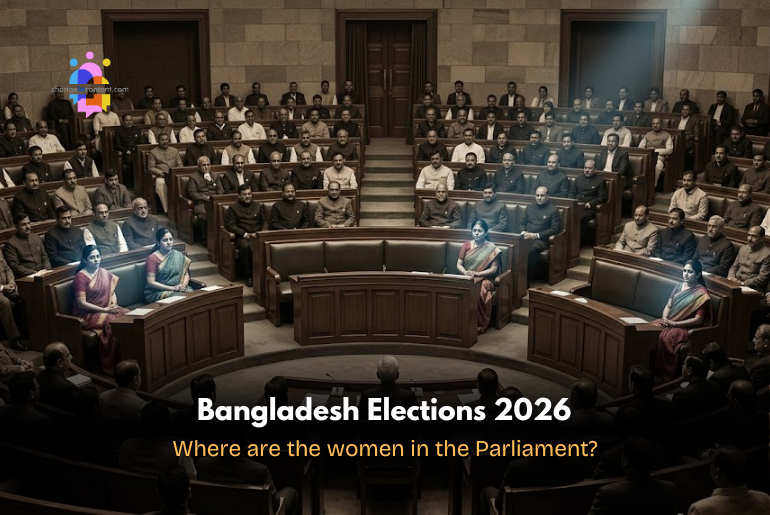
Bangladesh Elections 2026 have already been framed as a political reset. A landslide, a new cabinet, and a referendum that promises guardrails against future authoritarianism. But one detail cuts through the victory headlines and lands like a quiet alarm. Women’s direct representation in the new parliament has fallen to its lowest level in roughly a quarter century, according to multiple reports.
To those who think it is a ‘gender issue’, no, it is not. It is a governance issue. When women are missing from the room, policy does not become neutral. It just becomes incomplete.
Bangladesh Elections 2026: The result was decisive, but the message is not
The February 12, 2026, parliamentary election resulted in a sweeping victory for the Bangladesh Nationalist Party (BNP), which secured 212 of 300 seats. Jamaat-e-Islami emerged as the second-largest party with 77 seats. Voter turnout was reported at 59.44%.
This election also followed an unusually turbulent transition. Bangladesh has been navigating political aftershocks since the 2024 upheaval that ended Sheikh Hasina’s long run. It has now closed an 18-month interim phase with a new government and a push for constitutional reform.
So yes, the “big story” is power changing hands. But a country can change governments and still fail to change power.
The real shock: Women’s representation fell to a generational low
Across Bangladeshi political discourse, women’s empowerment is almost always described as a future outcome. Better schooling, more jobs, more “participation”, more “visibility”. But elections are not about future intent. Elections are about present choices.
Multiple reports on the Bangladesh Elections 2026 point to an outcome that is hard to defend in any modern democracy. Women won only a single-digit number of directly elected seats. It is the lowest in around 25 years. The political significance is not symbolic, but structural.
A parliament with very few women is more likely to do three things, even when it “means well”:
- Treat women’s issues as sectoral rather than foundational.
- Allocate women-focused portfolios and committees to the margins.
- Frame representation as “reserved” or “managed”, instead of earned and contested.
That is how democracies normalise absence. Slowly, and then suddenly.
“Reserved seats” do not solve the representation problem
Bangladesh has a system of reserved seats for women in parliament. In theory, that ensures minimum participation. However, in practice, it often creates a two-tier power structure. Directly elected MPs with constituency legitimacy, and nominated MPs whose role is easier to dismiss inside the house.
That is why several analysts and women politicians (quoted across reports) have argued that reserved seats can become ceremonial unless parties also put women into winnable constituencies and treat their campaigns as serious bets.
Reserved seats can be a bridge. They should not be an excuse.
What drives this drop in the Bangladesh Elections 2026
When women’s numbers collapse this sharply, it is rarely because women “did not come forward”. It is because the system quietly decides not to carry them.
Across coverage and commentary around these elections, three patterns stand out:
1. Party gatekeeping
Candidate selection is where representation is decided. If parties believe women are “riskier” in competitive seats, women get pushed into unwinnable contests, symbolic nominations, or internal roles that do not translate into legislative power.
2. Electability myths
Parties often claim they are simply responding to voter prejudice. But voter prejudice is not a fixed law of nature. It is shaped by what parties signal. If parties treat women candidates as exceptions, voters learn to see them that way.
3. Harassment and intimidation
Across the Asia-Pacific region, political life is often actively hostile to women. An Inter-Parliamentary Union study reported high levels of psychological violence and online abuse against women MPs and political staff. A meaningful proportion of these leaders also face sexual violence. That environment does not just harm women already in office. It also discourages the next cohort from even entering the arena.
Also Read: Combating online misogyny in politics: The role of women, media, and AI.
What this could mean for policy over the next five years
A parliament is not just a place where leaders pass laws. It is also where a government decides national priorities. When women’s presence is minimal, here is what typically gets deprioritised, delayed, or diluted:
Workforce protections that reflect women’s reality
Labour rights, protections for informal workers, maternity and childcare policies, workplace safety, equal pay enforcement, and mechanisms for redressing harassment require lived understanding and political will. Without women legislators pushing the details, policy tends to stay broad and weak.
Safety and justice reform
Sexual violence, domestic violence, child marriage, and trafficking are not “social topics”. They are state capacity topics. Enforcement design matters. Budget design matters. Monitoring matters.
Budgeting that sees women as economic actors
Women are often framed as beneficiaries rather than producers. That shows up in fiscal priorities and program architecture.
None of this means male politicians cannot champion women’s rights. It means women should not have to depend on permission to be represented.
The Changeincontent perspective: Representation is not a reward
At Changeincontent, we do not treat women’s political representation as a “nice to have”. It is infrastructure for a functioning democracy.
If the Bangladesh Elections 2026 have delivered a generational low for women MPs, then the question is not “why women did not win”. The question is simpler and sharper: Why did parties and institutions make it so hard for women to contest on equal terms?
A serious response cannot be motivational. It has to be structural:
- Parties need internal candidate quotas that apply to winnable constituencies, not just overall nominations.
- Election bodies must take online and offline harassment of women candidates seriously as electoral integrity issues, not “campaign heat”.
- Political financing rules should be transparent because “electability” often correlates with access to money and muscle.
- The media needs to stop treating women candidates as novelty profiles and start covering them as policy actors.
Democracy does not become inclusive through speeches. It becomes inclusive by design.
Conclusion: The headline is the gap, not the government
Bangladesh has begun a new chapter after a decisive election result. But the Bangladesh Elections 2026 also leave behind a blunt lesson. A country can promise women’s empowerment and still produce a parliament where women barely exist.
If that contradiction is allowed to stand, the next five years will not just be a test of reforms or governance. There will be a test of whether Bangladesh believes women belong in power, not just in policy.
Disclaimer: The views expressed in this article are based on the writer’s insights, supported by data and resources available both online and offline, as applicable. Changeincontent.com is committed to promoting inclusivity across all forms of content. We broadly define inclusivity as media, policies, law, and history. It encompasses all elements that influence the lives of women and marginalised individuals. Our goal is to promote understanding and advocate for comprehensive inclusivity.