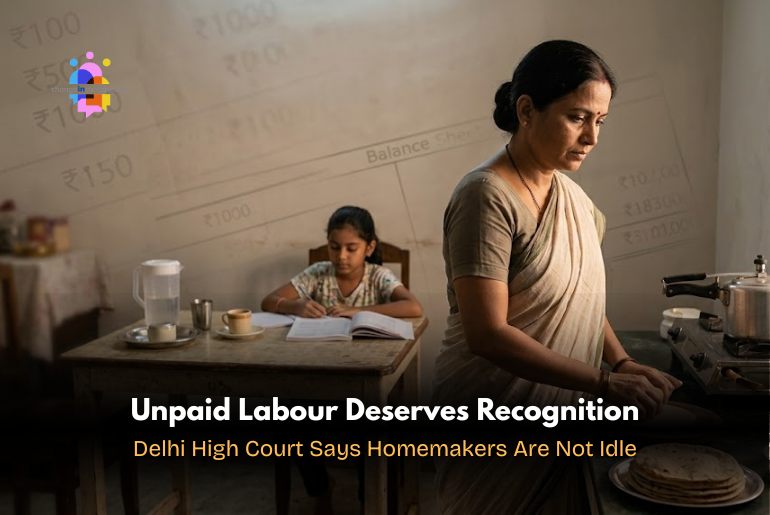
The Delhi High Court has delivered a ruling that speaks directly to millions of women whose work rarely makes it into official records. In recognising the value of unpaid labour, the court made it clear that a homemaker cannot be dismissed as “idle” simply because she does not earn a salary.
For generations, the courts (and the society) have treated domestic work as routine, expected, and invisible. Yet households function because someone plans, cooks, cleans, manages, nurtures, and absorbs daily pressures behind closed doors. The court’s observation does not create a new reality. It rather acknowledges one that has always existed.
The invisible, unpaid labour that keeps families running
In a judgment delivered on 16th February, Justice Swarana Kanta Sharma stated that while income earned outside the home appears in records, the daily efforts that keep families running often go unnoticed. She referred to responsibilities such as planning household expenses, cooking, cleaning, caring for children and elders, managing school work, and adjusting personal choices around a partner’s career.
The case arose from matrimonial disputes between a couple who were married in 2012 and lived together in India and later in Kuwait. The husband claimed that the wife chose to stay “idle” and should not seek maintenance. The court disagreed and stated that a homemaker works and supports the earning spouse’s ability to perform at work.
“A homemaker does not ‘sit idle’; she performs labour that enables the earning spouse to function effectively. To disregard this contribution while adjudicating claims of maintenance would be unrealistic and unjust,” the order read.
Justice Sharma allowed the wife’s plea and set aside the earlier orders of the magistrate and the appellate court that had denied her interim maintenance under the Protection of Women from Domestic Violence Act. The High Court directed that the wife’s claim be reconsidered with proper attention to her unpaid domestic work and her financial needs.
The economic value of women’s domestic work
The Delhi High Court has clearly stated that the law must acknowledge the economic worth of women’s work within the home. According to estimates by the United Nations Development Programme, women’s unpaid household and care work would reach about 11 trillion dollars each year if employers paid it at minimum wage rates. It is a massive financial contribution that remains outside formal pay systems.
Data from the United Nations shows that women perform about 75% of the world’s unpaid care and domestic work. Analysts also estimate that unpaid domestic work equals roughly 13% of global GDP. In India, nearly 49% of women contribute to the country’s economic output through unpaid or undercounted work.
Why unpaid care work in India still falls heavily on women
The Time Use Survey reports that among people aged 15 to 59, about 41% of women handled caregiving for household members, compared to 21.4% of men in the same age group.
Women spent about 140 minutes each day on caregiving. Men spent only 74 minutes. The survey also found that women used nearly 19.8% of their day on unpaid domestic work, while men spent just 2.7%.
While both spouses do more unpaid work after marriage, women, particularly non-working women, end up carrying the heavier share. In many homes, families expect married women to handle most daily care and housework. When a woman is already outside the labour force, this load grows even more after marriage. Over time, these duties take up large parts of her day and reduce the time and flexibility she needs to look for paid work or return to a job.
Why unpaid labour is real work, even without a pay slip
Someone has to cook meals, clean spaces, wash clothes, manage groceries, track expenses, care for children or elders, and keep daily routines on schedule. These tasks do not pause on weekends or holidays. They repeat every day, often without recognition or rest.
When one person takes charge of this long list, the rest of the family gains the freedom to focus on school, office work, or business. The household functions smoothly because someone invests time and energy behind the scenes.
The problem starts when society treats paid work as the only form of productive effort. Because domestic labour does not come with wages, many assume it requires little skill or commitment. Such a view misses the level of mental coordination, physical labour, and responsibility involved.
Changeincontent perspective
Courts can recognise unpaid labour in judgments. Society must recognise it in everyday life. Homemakers are not beneficiaries of generosity. They contribute to economic stability within households and beyond. When a woman absorbs years of unpaid care work, she often pays for it with reduced career mobility, lower retirement savings, and limited financial independence.
Legal recognition is a powerful step. But lasting change will require broader conversations around shared household responsibilities, social security protections for homemakers, pension access, and structured economic valuation of unpaid work. Domestic labour does not disappear because it is unpaid. It simply becomes invisible. Visibility is the first step toward fairness.
The closing thoughts
Women continue to spend far more time on unpaid care and household work. It often affects their earning chances and long-term financial security. The smooth running of a household depends on sustained labour, even when that labour does not come with a pay slip. Just as the Delhi High Court refused to accept the claim that a homemaker is idle, it is time for society to change this outdated view.
Disclaimer: The views expressed in this article are based on the writer’s insights, supported by data and resources available both online and offline, as applicable. Changeincontent.com is committed to promoting inclusivity across all forms of content. We broadly define inclusivity as media, policies, law, and history. It encompasses all elements that influence the lives of women and marginalised individuals. Our goal is to promote understanding and advocate for comprehensive inclusivity.