
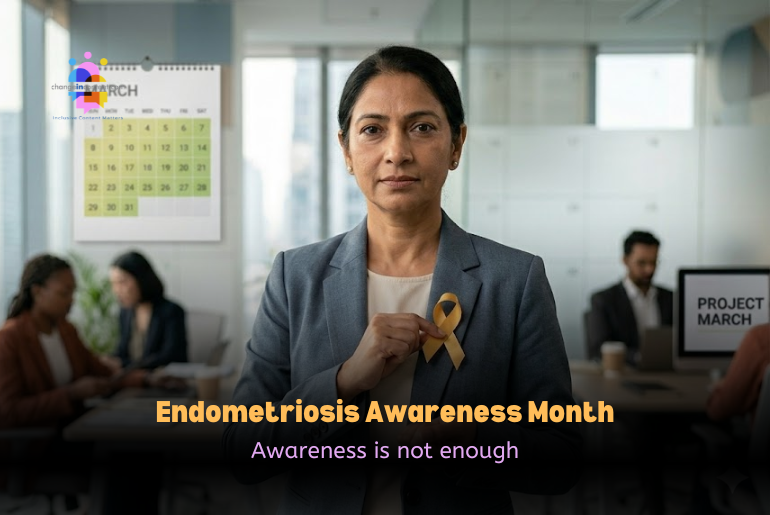
March is Endometriosis Awareness Month. That is the headline. The real story is what comes next. That is because Endometriosis is still widely missed, widely minimised, and widely normalised as just period pain. (Source: FDA)
According to the World Health Organisation, Endometriosis affects about 10% of women of reproductive age worldwide, around 190 million people. Yet the average time to diagnosis is between 4 and 12 years.
If you want a single reason this delay keeps happening, it is this. Too many women are trained to tolerate pain, and too many systems are built to doubt them.
What is Endometriosis?
Endometriosis is a long-term condition where tissue similar to the lining of the uterus grows outside the uterus. It causes inflammation and scar tissue formation. It most commonly occurs in the pelvis. However, in some people, it appears elsewhere in the body, including the abdomen and chest.
Symptoms vary widely. WHO lists severe pain during menstruation, heavy menstrual bleeding, chronic pelvic pain, infertility, and abdominal bloating and nausea. Clinical reviews also point to bowel and bladder symptoms and fatigue. That helps explain why many patients are bounced between specialities.
Medical science has not yet fully understood the cause of Endometriosis. Multiple theories exist, including retrograde menstruation, immune dysregulation, and hormonal and genetic factors. That uncertainty is part of why diagnosis and treatment pathways can be inconsistent.
Why Endometriosis is still diagnosed so late?
WHO notes that symptoms are broad and variable. At the same time, access to early diagnosis is limited in many settings, and people may not be aware of the condition. It is one reason the diagnosis timeline has remained stubbornly long.
Underdiagnosis is also measurable. Research in Denmark suggested fewer than 2% of reproductive-age women had a diagnosis recorded, despite the condition often being estimated at around 10% prevalence globally.
Then there is dismissal. A 2025 qualitative study describes medical gaslighting, where symptoms are downplayed or reframed. Medical gaslighting can reduce future care seeking and deepen shame.
It is not abstract. Endometriosis UK’s surveys and reports show that many patients attend repeated GP appointments before diagnosis. However, many of them report being dismissed or belittled.
In other words, let us not look at the awareness month as a social media campaign problem. It is an institutional design problem.
The cost of Endometriosis that most people do not count
People often discuss Endometriosis as a health condition. However, it is also an economic condition.
A 10-country study published in Human Reproduction estimated the average annual total cost per woman treated in referral centres at €9579. That is not all. These women also bear a productivity loss of around €6298 per woman, about double direct healthcare costs.
Work productivity research is even more direct. A large multicountry-study found women with Endometriosis lost an average of 10.8 hours of work per week. That is mainly due to reduced effectiveness while working rather than absence.
And in an Australian cost-of-illness study, lost productivity accounted for 83.6% of total costs among women with Endometriosis in the sample.
What does this indicate? Endometriosis is not only pain. It is lost work, lost energy, and lost career confidence.
What organisations should do this month?
That is where March can become useful.
Employers should treat Endometriosis as a workplace reality, not an individual inconvenience. Endometriosis UK’s Endometriosis Friendly Employer guidance outlines a practical framework. It focuses on leadership support, tackling stigma and culture, and clear communication.
Here is what that means in practice.
- Start with a visible support pathway. One page. Who an employee can speak to, what adjustments are possible, and how privacy is protected.
- Train managers to have one respectful conversation. Not a grand seminar. A short script, a checklist, and clear boundaries.
- Offer flexibility as a performance tool. Hybrid days, shift swaps, breaks, and the ability to step away during flare-ups. The Endometriosis Friendly Employer framework explicitly points to flexible working as a win-win when possible.
- If you are a brand, stop treating March like a sales season. Fund a clinic day. Sponsor subsidised consults. Partner with hospitals to offer community gynaecology checkups, especially for women who delay care due to cost and access. Your marketing budget can either sell another product or help someone get diagnosed earlier.
- If you are a healthcare institution, treat diagnostic delay as a metric, not a fate. WHO emphasises careful menstrual health history and symptom evaluation as a diagnostic aid. The challenge is applying it consistently.
What can women do this week?
Here is what matters for women. You are the agency, not the burden.
Track what you feel, not only when you bleed. Pain timing, fatigue, bowel or bladder symptoms, pain during sex, and its impact on work and daily life. It is the useful data for your clinician.
Prepare for the appointment as it matters, because it does. The FDA lists core symptoms and explicitly advises speaking with a healthcare provider who may use pelvic exams, imaging, or laparoscopy to evaluate.
If you feel dismissed, name the impact, not the emotion. Try language like, this pain causes me to miss work and disrupt sleep. So, I need a plan to evaluate for Endometriosis or rule it out.
If you need reassurance that dismissal is real, it is documented. Medical gaslighting has been studied in endometriosis contexts, and patient-reported experiences show how common it can be.
The Changeincontent Perspective
At Changeincontent, we are not interested in awareness that ends at a caption. We are interested in awareness that changes what institutions do.
- A month like March becomes meaningful only when it pushes system behaviour.
- Hospitals shorten diagnostic pathways.
- Employers normalise flexibility and stop rewarding silent suffering.
- Brands fund access, not slogans.
Endometriosis is not rare. It is not niche. It is one of the clearest examples of how women’s health becomes invisible when it collides with stigma and institutional inertia.
If you want to connect this conversation to workplace inclusion and policy, you can also refer to our earlier editorial on menstrual leave and workplace justice in India here.
The final thoughts
Endometriosis affects millions of women, yet the average diagnostic delay remains measured in years, not months.
So March cannot be the finish line. It should be the accountability checkpoint.
Talk about your pain. Document it. Demand a plan. And if you are an employer or a brand, choose one concrete action this month that makes diagnosis and support more accessible for real women living real lives.
Disclaimer: The views expressed in this article are based on the writer’s insights, supported by data and resources available both online and offline, as applicable. Changeincontent.com is committed to promoting inclusivity across all forms of content. We broadly define inclusivity as media, policies, law, and history. It encompasses all elements that influence the lives of women and marginalised individuals. Our goal is to promote understanding and advocate for comprehensive inclusivity.
