
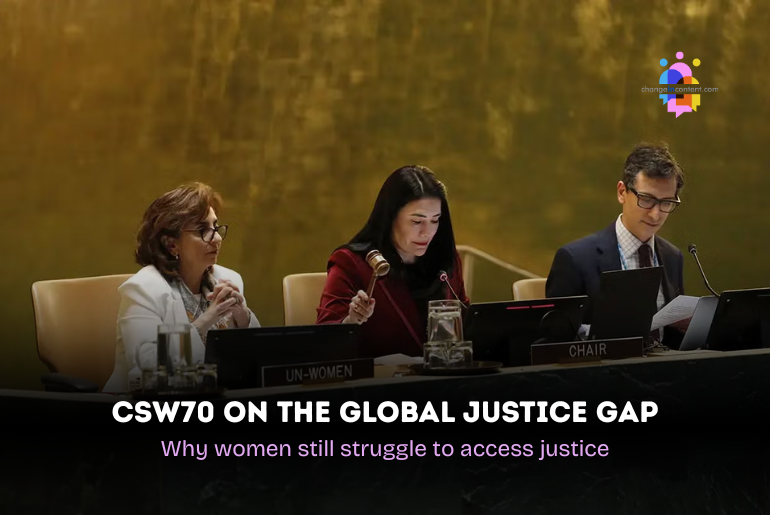
The 70th session of the Commission on the Status of Women (CSW70) opened at the United Nations Headquarters in New York with a powerful reminder that gender equality is not merely a political slogan. It is a legal and social reality that millions of women and girls are still struggling to achieve. Discussions at CSW70 placed a sharp spotlight on the global justice gap. These discussions expose how systemic barriers and gender stereotypes continue to prevent women from accessing the rights they are legally entitled to.
CSW70, taking place from 9 to 19 March, is the United Nations’ largest annual gathering focused on gender equality and women’s rights. Governments, policymakers, activists, and global organisations gather at this event to assess progress and confront the challenges that remain.
This year’s conversations revealed something deeply concerning. While laws protecting women have expanded in many countries, access to justice remains uneven. Structural inequalities, legal systems that fail to recognise gender realities, and deeply rooted stereotypes continue to undermine women’s rights across the world.
CSW70 and the global conversation on the justice gap
The Commission on the Status of Women has long served as one of the most influential global platforms for discussing gender equality policies. Established in 1946, the Commission monitors the implementation of the Beijing Declaration and Platform for Action, which remains the most comprehensive global blueprint for women’s rights.
At CSW70, leaders and advocates emphasised that justice lies at the foundation of every right to which women and girls are entitled.
During one of the UN Women press briefings, speakers highlighted that access to justice is not simply about courts or legal processes. It also includes the ability of women to report abuse, claim property rights, seek protection against discrimination, and pursue economic opportunities without legal barriers.
According to the leaders at UN Women, when women cannot access justice systems effectively, the consequences extend beyond individuals. Entire communities suffer when rights remain unprotected.
The justice gap that still exists
Despite decades of legal reform, the justice gap affecting women remains significant.
Globally, millions of women still face obstacles in accessing legal systems. These barriers include financial constraints, lack of legal awareness, institutional bias, and social stigma.
The UN Women briefing at CSW70 pointed out that many women never report violence or discrimination. That is because they believe the legal system will not support them. In some cases, women fear retaliation or social consequences.
Even when laws exist on paper, enforcement often falls short. Legal protections against domestic violence, workplace discrimination, or inheritance inequality may exist. Still, women frequently struggle to navigate the systems meant to protect them.
The justice gap, therefore, reflects more than legal shortcomings. It reveals deeper structural issues within societies.
Gender Stereotypes: The Invisible Barrier
One of the most persistent obstacles discussed at CSW70 was the role of gender stereotypes in limiting women’s access to justice.
UN Women highlighted how stereotypes influence the behaviour of institutions, legal professionals, and even communities themselves.
- In many societies, harmful assumptions continue to shape legal outcomes.
- Women reporting violence may be blamed for provoking the incident.
- Victims of harassment may be questioned about their character.
- Economic disputes involving women may be dismissed as domestic matters rather than legal issues.
These stereotypes can influence police investigations, judicial decisions, and public perceptions.
A UN Women briefing emphasised that gender stereotypes are not merely cultural beliefs but systemic barriers that shape how justice systems operate.
When justice systems fail women
The consequences of these barriers are profound.
Women who cannot access justice may remain trapped in cycles of violence, discrimination, and economic vulnerability. Lack of legal recourse also discourages others from coming forward.
Globally, gender-based violence remains one of the most widespread human rights violations. According to the WHO estimates, 1 in 3 women worldwide experiences physical or sexual violence during her lifetime.
Without accessible justice systems, legal protections become symbolic rather than effective.
Why CSW70 matters right now
The discussions at CSW70 take place at a time when many countries are reassessing their legal systems and social policies.
While international conventions and national laws increasingly recognise women’s rights, implementation remains uneven.
The event highlighted several critical priorities for governments and institutions:
- Strengthening legal frameworks that protect women and girls.
- Ensuring justice systems are accessible and affordable.
- Training law enforcement and judicial professionals to recognise gender bias.
- Challenging stereotypes that influence legal decisions.
These reforms require sustained political will and public awareness.
The role of media and public discourse
Another theme that emerged during CSW70 discussions is the role of media narratives and public conversations.
Gender stereotypes are often reinforced not only through institutions but also through cultural messaging. How societies speak about women, leadership, work, and justice shapes how institutions respond to women’s claims.
At Changeincontent, we have previously examined how public conversations around women’s rights evolve during global observances such as International Women’s Day. Changing narratives is therefore not simply a communication challenge. It is part of building a more equitable justice system.
Saransh Jain, co-founder of Changeincontent, reflects on the broader implications of the discussions at CSW70:
Justice systems cannot deliver equality if they continue to operate within outdated social assumptions. Closing the justice gap requires a lot more than legal reform. It demands that institutions, workplaces, and communities rethink the stereotypes that shape how women are heard and believed.
The changeincontent perspective
The conversations at CSW70 underline a critical truth. Gender equality cannot exist without equal access to justice.
Legal rights have expanded significantly over the past decades. Yet laws alone cannot transform societies if cultural norms and institutional practices continue to undermine them.
Closing the justice gap requires coordinated action across multiple fronts.
- Governments must strengthen legal frameworks and enforcement mechanisms.
- Judicial systems must recognise and challenge gender bias.
- Workplaces must support policies that protect women’s rights.
- Media platforms must reshape narratives that reinforce stereotypes.
Justice is not only about courtrooms. It is about whether women feel safe, supported, and empowered to claim their rights.
Closing thoughts: Justice Cannot Wait.
The discussions at CSW70 remind us that progress toward gender equality is neither automatic nor guaranteed.
The justice gap affecting women and girls is not a distant policy issue. It shapes everyday realities for millions of people across the world. When women cannot access justice systems, their rights remain theoretical rather than real.
Closing this gap requires more than international declarations. It requires institutions willing to confront systemic bias and societies willing to challenge long-standing stereotypes.
CSW70 has brought these issues to the global stage. The question now is whether the momentum will translate into meaningful change.
Disclaimer: The views expressed in this article are based on the writer’s insights, supported by data and resources available both online and offline, as applicable. Changeincontent.com is committed to promoting inclusivity across all forms of content. We broadly define inclusivity in terms of media, policies, law, and history. It encompasses all elements that influence the lives of women and marginalised individuals. Our goal is to promote understanding and advocate for comprehensive inclusivity.
