
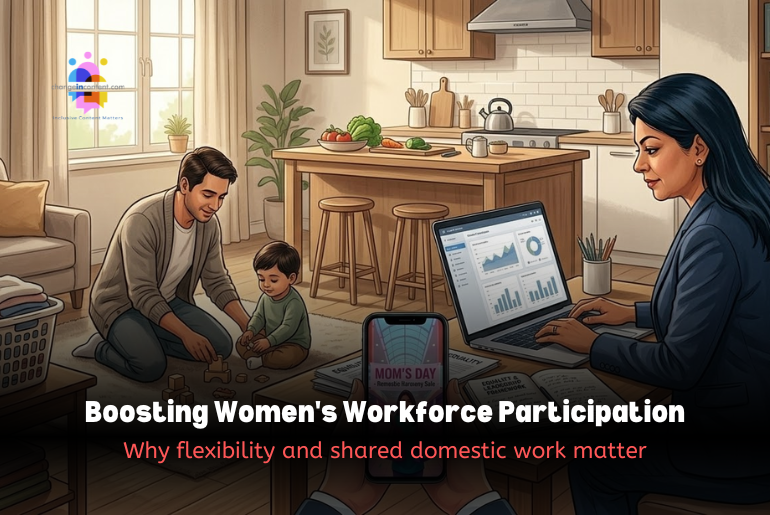
The conversation around boosting women’s workforce participation often begins with economic statistics. Governments measure labour force participation rates. Companies discuss diversity targets. Policy experts analyse employment trends. But behind these numbers lies a simpler reality.
For many women, the biggest barrier to staying in the workforce is not ambition or capability. It is the invisible weight of responsibilities waiting at home.
Across societies, women continue to carry a disproportionate share of domestic work and caregiving. Cooking, childcare, elder care, household management, and emotional labour still fall primarily on their shoulders. When workplaces remain rigid and domestic responsibilities remain unequal, many women find themselves forced into difficult choices.
They can build careers. Or they can sustain households. Too often, they cannot realistically do both.
The workforce participation puzzle
Despite significant progress in education and professional opportunities, women’s workforce participation rates remain lower than expected in many parts of the world. In India, the female labour force participation rate rose to around 35.1% in 2026, according to the Periodic Labour Force Survey. While this marks an improvement compared with previous years, it still reflects a considerable gap relative to male participation rates.
Globally, the World Bank estimates that women participate in the labour force at roughly 48-50% compared with over 75% for men.
These numbers reveal a structural imbalance. Education levels among women have improved dramatically over the past few decades. Yet this progress does not always translate into sustained workforce participation. And that is because employment systems were historically designed around male career patterns.
The invisible burden of unpaid work
One of the most significant barriers to women’s employment lies outside the workplace. Women perform more than 75% of unpaid care work globally, according to the International Labour Organisation. It includes childcare, cooking, cleaning, elder care, and other domestic responsibilities that keep households functioning.
While unpaid work is essential to society, it remains economically invisible. Yet it has a direct impact on women’s ability to participate fully in the labour market. A woman may hold a full-time job during the day. But after work, a second shift often begins. That includes homework supervision, meal preparation, household management, and so on.
Without shared domestic responsibilities, balancing career and family becomes extremely challenging.
Boosting women’s workforce participation: Why flexibility matters for women’s careers
We built traditional work structures around fixed schedules and physical presence in offices. These models assumed that employees had minimal domestic responsibilities during working hours. That assumption rarely holds true for many women.
Flexible work arrangements can significantly improve women’s ability to remain in the workforce.
Flexibility may include:
- Flexible working hours
- Remote work opportunities
- Hybrid workplace models
- Supportive maternity and caregiving policies
When employees can adjust their schedules to accommodate caregiving responsibilities, workforce participation becomes far more sustainable. However, flexibility alone cannot solve the problem if domestic responsibilities remain unequal.
The role of shared domestic work in boosting women’s workforce participation
One of the most overlooked elements in discussions about women’s employment is the distribution of domestic labour. In many households, women continue to carry the majority of caregiving responsibilities even when both partners are employed. This imbalance affects career decisions.
- Women may reduce working hours.
- Decline promotions.
- Exit the workforce temporarily.
Over time, these decisions contribute to gender gaps in income, leadership representation, and financial independence.
Therefore, encouraging shared domestic work is not only a social goal but also an economic one. When caregiving responsibilities are distributed more equally within households, women gain greater freedom to pursue professional opportunities.
What can organisations do?
Employers have an important role in boosting women’s workforce participation. Workplaces that support employees through life transitions often retain talent more effectively.
Practical steps organisations can take include:
- Introducing flexible work policies that accommodate caregiving responsibilities.
- Providing parental leave policies that encourage both parents to participate equally in childcare.
- Offering childcare support or partnerships with childcare providers.
- Training managers to recognise the impact of caregiving responsibilities on employee well-being.
- Creating workplace cultures where flexibility does not damage career progression.
These measures benefit not only women but also employees across the organisation.
What governments and policymakers must consider
Policy frameworks also influence women’s employment outcomes.
- Public investment in childcare infrastructure can significantly improve workforce participation.
- Affordable childcare allows parents to pursue professional opportunities without compromising family responsibilities.
- Education campaigns encouraging shared domestic work can also reshape cultural expectations over time.
- Policies promoting flexible employment structures can help organisations adapt to changing workforce realities.
The changeincontent perspective
At Changeincontent, we often examine how workplace structures and societal expectations interact.
Women’s workforce participation cannot be viewed in isolation from household dynamics. Economic policies alone cannot solve the challenge if domestic responsibilities remain unequal. Similarly, workplace flexibility must be accompanied by cultural shifts within families and communities.
We have previously explored related workforce trends in our article on India’s Economic Survey and women’s workforce participation.
Boosting women’s workforce participation ultimately requires collaboration between employers, policymakers, and households.
Boosting women’s workforce participation: Closing thoughts
Women’s participation in the workforce is not only a matter of equality. It is also a matter of economic growth. Research consistently shows that increasing women’s participation in labour markets strengthens productivity, innovation, and national economies.
Yet we cannot solve the challenge through employment policies alone. Flexible workplaces must become normal. Domestic responsibilities must become shared. Only when both systems evolve together can women participate in the workforce without sacrificing personal well-being or family stability.
Boosting women’s workforce participation, therefore, requires more than opportunity. It requires rethinking how societies organise work and care.
Disclaimer: The views expressed in this article are based on the writer’s insights, supported by data and resources available both online and offline, as applicable. Changeincontent.com is committed to promoting inclusivity across all forms of content. We broadly define inclusivity as media, policies, law, and history. It encompasses all elements that influence the lives of women and marginalised individuals. Our goal is to promote understanding and advocate for comprehensive inclusivity.
