
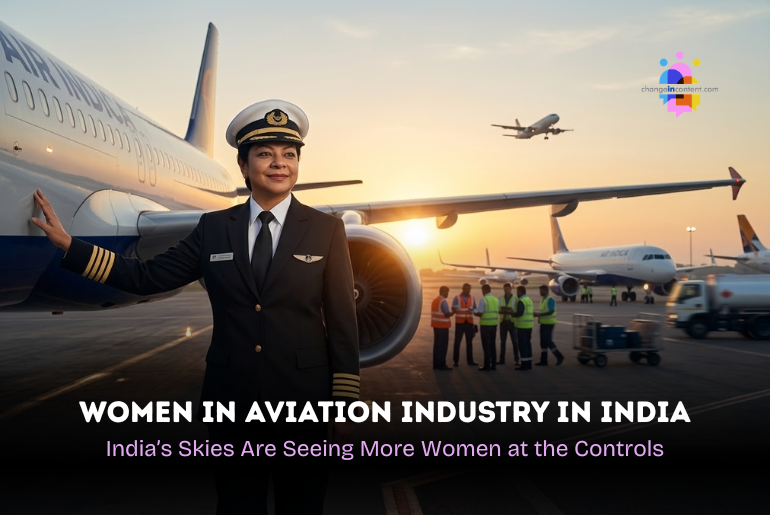
The story of women in aviation in India is no longer about rare milestones. It is becoming a steady pattern of participation across cockpits, airport operations, and leadership roles. Over the past decade, more women have entered aviation careers that were once dominated by men, particularly in commercial pilot positions.
Today, women make up 12.4% of India’s aviation workforce. That is significantly higher than the global average of 5.18%. This number places India ahead of countries such as France, Japan, and the United States in female pilot representation.
Recent announcements from airlines and airport operators around International Women’s Day offer further evidence that women’s participation across the aviation ecosystem continues to expand.
IndiGo crosses 1,000 women pilots: A milestone for women in aviation
IndiGo has become the first airline in India to employ over 1,000 women pilots, marking an important milestone for gender representation in the aviation industry. Currently, 17.5% of IndiGo’s pilots are women, which is more than three times the global average.
Across the organisation, women form a large part of the workforce. Over 45% of IndiGo’s total workforce is women, across various operational areas. At airports, more than 30% of employees are women, working in roles related to ground operations, passenger services, and airport coordination. Meanwhile, almost 25% of employees at the airline’s Operations Control Centre are women, where teams oversee flight planning, aircraft movement, and operational coordination.
More than 20% of the finance team is women, while over 15% of the digital team comprises women working on technology systems and digital platforms. Women are also part of senior management. Currently, over 23% of leadership positions at IndiGo are held by women, contributing to business and operational decision-making.
Also Read: Women’s representation at Indigo soars: 77 new women pilots and a target of 1,000.
Air India operates 9 women-managed flights on International Women’s Day.
To celebrate International Women’s Day 2026, Air India operated 9 flights, all managed entirely by women across key operational roles. Women professionals handled responsibilities across pilots, cabin crew, airport operations, and ground coordination.
Within the airline, women now account for 16% of the pilot workforce, higher than the global average for women in commercial pilot roles. In Airport Operations, female representation has grown from 24% to 31% in the last two years, with women working in roles related to ground handling, passenger services, and operational coordination.
Security departments have also seen similar progress. The share of women in security roles increased from 14% to 22% during the same period, indicating greater participation in safety monitoring and operational coordination.
Women lead key roles at the upcoming Noida Airport
Women professionals are playing an important role in preparing for the launch of the upcoming Noida International Airport. From leadership positions to technical and safety roles, women are contributing to various aspects of the airport’s development as it prepares to begin passenger services.
Roles such as Chief Operating Officer, Chief Financial Officer, and Head of Human Resources are currently led by women professionals with years of experience in aviation, finance, and management. At the same time, women are also involved in many technical and operational areas.
Around 45 women currently work across departments such as architecture, terminal design, airside compliance, operational command, regulatory coordination, and digital systems management.
Women join critical safety roles in ARFF
In addition, women are also part of the airport’s Aircraft Rescue and Fire Fighting (ARFF) unit, which handles emergency response and aviation safety. At present, 5 women serve on the ARFF team and undergo the same specialised training as their colleagues to respond to aviation emergencies.
Many were involved in engineering and safety-related work. Officials noted that 16 out of 30 engineers working on key project activities were women. Additionally, 6 women were part of the environment, health, and safety teams that monitored safety standards during construction.
By including women across leadership, technical, and operational roles, the project reflects a growing shift towards greater diversity in India’s aviation and infrastructure sectors.
The changeincontent perspective
Aviation has always symbolised ambition, precision, and technological progress. For a long time, however, the people who represented that ambition were overwhelmingly male. The growing presence of women across cockpits, control centres, and airport leadership roles shows how industries evolve when access expands.
The aviation sector offers a useful lesson for other industries. Progress happens when institutions build clear entry pathways, invest in training, and allow talent to rise through operational experience. Companies that actively support diversity often discover that capability, discipline, and performance follow naturally.
For women considering careers in sectors that still feel inaccessible, aviation provides a powerful reminder. The first step is often the hardest. Once a few doors open, many others follow. Industries move forward when talent is recognised beyond stereotypes.
Conclusion: What the rise of women in aviation means for the industry
When opportunities open up, women step in and excel across every level of the industry. From the cockpit to airport control centres, from safety teams to leadership positions, women are proving that aviation is no longer a space limited by traditional gender roles. These are exactly the kind of updates people hope to see around International Women’s Day.
At the same time, the conversation should not remain limited to a single day of celebration. True progress becomes meaningful when it continues throughout the year. In many ways, these updates show that change is happening, and with consistent effort, not just the aviation industry but all sectors can continue moving toward a more gender-balanced future.
Disclaimer: The views expressed in this article are based on the writer’s insights, supported by data and resources available both online and offline, as applicable. Changeincontent.com is committed to promoting inclusivity across all forms of content. We broadly define inclusivity as media, policies, law, and history. It encompasses all elements that influence the lives of women and marginalised individuals. Our goal is to promote understanding and advocate for comprehensive inclusivity.
