
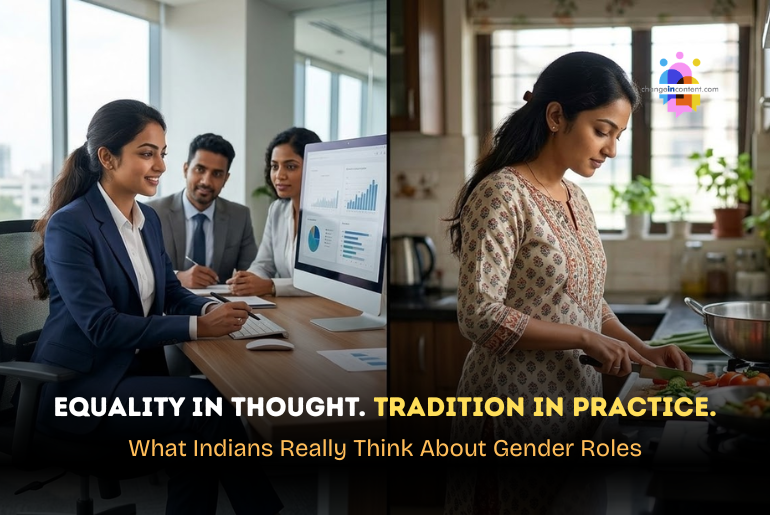
The global conversation around attitudes toward gender equality often assumes a linear path toward progress. More awareness leads to more equality. More representation leads to more inclusion. But the latest Ipsos International Women’s Day 2026 Survey challenges this assumption, especially in the Indian context.
Across 29 markets, Ipsos examined how people perceive gender equality today. India, interestingly, emerges as a country that strongly supports the idea of gender equality. However, Indians simultaneously hold on to deeply embedded expectations about gender roles within families and society.
At first glance, this appears contradictory. But a closer look reveals something more nuanced. India is not resisting gender equality. It is redefining it on its own terms.
The Big Picture: What the Ipsos data tells us
The Ipsos survey captures a global tension. While support for gender equality remains high, the understanding of what equality actually means continues to differ across regions. In India, the data present a layered reality.
A significant proportion of respondents express strong support for gender equality in principle. Many agree that women should have equal opportunities in education, employment, and leadership. There is also increasing recognition of women’s economic contributions and professional aspirations. However, this support coexists with equally strong beliefs about traditional roles.
Family structures, caregiving responsibilities, and expectations around masculinity continue to shape how we interpret gender equality in everyday life.
Attitudes on Gender Equality: Equality in principle, tradition in practice
One of the most striking insights from the Ipsos survey is the gap between belief and behaviour. Many respondents support gender equality as an idea. But when it comes to practical decisions, traditional expectations often take precedence. For example, women are encouraged to work and build careers. At the same time, the society expects them to prioritise family responsibilities.
Men are increasingly open to supporting women’s professional growth. Yet they remain socially conditioned to see themselves as primary earners rather than as equal participants in domestic work.
This duality reflects what can be described as conditional equality. Equality is accepted, as long as it does not disrupt existing social structures.
The masculinity question
The Ipsos report also touches on a critical but often under-discussed aspect of gender equality: Masculinity. In many societies, including India, masculinity continues to be linked with:
- Financial responsibility
- Authority within the household
- Emotional restraint
These expectations create pressure not only for women but also for men. Men may feel discouraged from participating in caregiving roles or expressing vulnerability. This, in turn, reinforces the imbalance in domestic responsibilities.
The result is a system where gender roles persist not because individuals actively resist change, but because social expectations make deviation difficult.
Domestic work: The silent divider
One of the clearest indicators of the gap between perception and reality lies in domestic work. While attitudes toward women working outside the home have evolved, the division of unpaid labour remains uneven.
Globally, women continue to perform a disproportionate share of unpaid care work. India reflects a similar pattern.
The Ipsos findings align with broader research showing that even when women enter the workforce, they often continue to carry the primary responsibility for:
- Household management
- Childcare
- Elder care
This creates what many researchers describe as a double burden. Women are expected to succeed professionally while maintaining traditional roles at home.
Indian attitudes on gender equality: Progress is real, but uneven
It would be inaccurate to view the Ipsos findings as a sign of stagnation. India has seen measurable progress.
- More women are entering higher education.
- More women are participating in the workforce.
- More conversations around gender equality are taking place in public and corporate spaces.
Attitudinal shifts are visible, particularly among younger demographics and urban populations. However, progress remains uneven.
- Urban and rural realities differ significantly.
- Economic class influences access to opportunities.
- Cultural norms continue to shape behaviour in ways that data alone cannot fully capture.
The corporate layer: Where policy meets culture
For organisations, the Ipsos findings offer an important insight. Gender equality is not only about policies. Companies may introduce:
- Equal pay frameworks
- Diversity hiring targets
- Flexible work policies
But if employees continue to operate within traditional social expectations, the impact of these policies may be limited. For example, flexible work policies may exist, but women may still feel pressure to overperform professionally to counter perceptions of reduced commitment. Similarly, leadership opportunities may be available, but caregiving responsibilities may limit women’s ability to pursue them.
That is where workplace culture becomes critical to further improve attitudes on gender equality.
The Indian Paradox
India’s position in the Ipsos survey highlights a paradox. There is strong verbal support for gender equality. Yet structural and cultural realities continue to shape outcomes. This paradox is not unique to India. But it is particularly visible here because of the country’s diversity.
India is not one uniform society. It is multiple realities coexisting at the same time. At Changeincontent, we have explored similar themes in our analysis of global gender equality trends. Read more here.
Understanding these layered realities is essential if policy and organisational interventions are to be effective.
Attitudes toward gender equality: What needs to change
The Ipsos findings suggest that the next phase of gender equality in India requires deeper engagement. Awareness alone is no longer enough. The focus must shift toward:
- Redistributing domestic responsibilities
- Redefining masculinity
- Creating workplace cultures that support both men and women
- Encouraging open conversations about gender roles
Policy, corporate action, and social change must move together.
The changeincontent perspective
The Ipsos survey does not reveal a failure of gender equality. It reveals a transition.
India is not resisting change. It is negotiating it. The challenge lies in moving from aspirational equality to lived equality. That requires uncomfortable conversations.
- About who does the unpaid work.
- About how workplaces measure performance.
- About what society expects from men and women.
Until we address these questions, equality will remain partial.
Conclusion: Progress without disruption is not enough
India’s attitudes toward gender equality are evolving. But evolution without disruption can only go so far.
The Ipsos survey shows that belief in equality exists. What remains is the willingness to reshape systems that prevent it from becoming reality. Because equality is not defined by what we say we support. It is defined by how we live, work, and share responsibility.
Disclaimer: The views expressed in this article are based on the writer’s insights, supported by data and resources available both online and offline, as applicable. Changeincontent.com is committed to promoting inclusivity across all forms of content. We broadly define inclusivity in terms of media, policies, law, and history. It encompasses all elements that influence the lives of women and marginalised individuals. Our goal is to promote understanding and advocate for comprehensive inclusivity.
