
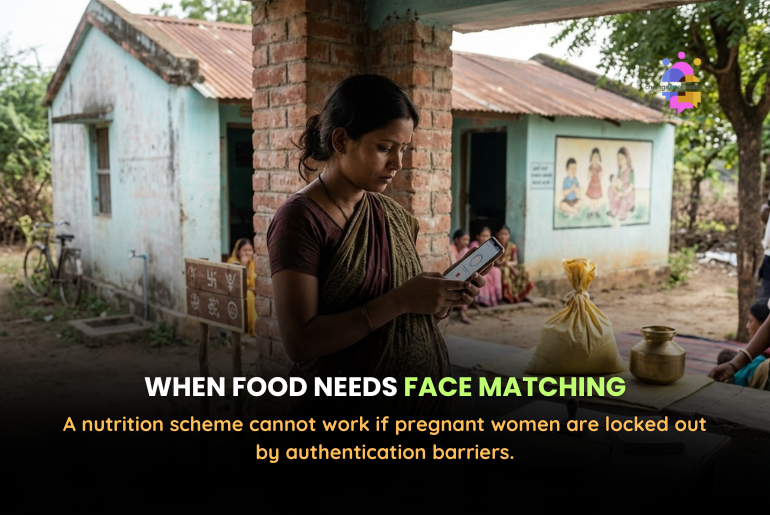
The Government of India launched the POSHAN Abhiyaan to improve nutrition delivery for some of India’s most vulnerable groups. That includes pregnant women, lactating mothers, and young children. But in many places, access to Take-Home Ration is now being filtered through facial recognition and OTP-based verification, turning a welfare entitlement into a digital test.
Since July 1, 2025, facial recognition through the Poshan Tracker has been mandatory for Take-Home Ration distribution. The government argues that the system improves transparency and reduces duplication.
The problem and the concern
The problem is that welfare systems do not operate in ideal conditions. Pregnancy changes bodies. Rural connectivity is uneven. Personal phone ownership among women is far from universal. Aadhaar-linked numbers are often registered under the names of husbands or other family members.
Anganwadi workers and researchers warned early that this model could exclude the very women the scheme aims to support. It is especially true when repeated OTPs, failed scans, buffering, and network issues become part of something as basic as collecting food.
How POSHAN Abhiyaan authentication failures are disrupting access to nutrition
The Ministry of Women and Child Development proceeded with the system despite workers’ unions raising concerns. They pointed out that pregnancy, illness, and ageing can change facial features, making it harder for the system to recognise women correctly. These concerns did not receive sufficient attention during the rollout.
Why is OTP-based access failing many women?
OTP verification adds another step that many women struggle with. In rural areas, many women do not have personal phones. Their Aadhaar-linked numbers are often registered under husbands or other male family members.
By the end of 2025, government data showed that nearly half of eligible beneficiaries had not received rations through the system. Out of 4.73 crore eligible beneficiaries, 4.51 crore (over 91%) had completed initial documentation and were waiting for facial authentication as of 31 December 2025. However, only 2.79 crore (52.7%) successfully received rations through the facial recognition system.
That means nearly half of the eligible beneficiaries still did not receive rations through the mandatory authentication route. Authentication failures meant many pregnant women, nursing mothers, and even young children got left out. A welfare scheme intended to provide basic nutrition is now blocked because the system cannot verify them.
Why POSHAN Abhiyaan is increasing travel burden and field-level work
Pregnant and lactating women often cannot travel long distances to anganwadi centres. Health conditions, lack of transport, and daily responsibilities make regular visits difficult. Yet, the system expects them to show up in person for facial verification to receive rations.
In many cases, anganwadi workers step in and go door-to-door to complete the process for them. It adds to their workload and slows down distribution. Instead of making access easier, the system adds more steps for both beneficiaries and anganwadi workers.
Policy design vs real-life access
At a policy level, welfare systems need to match how people actually live. Access to phones, the internet, and up-to-date documents remains uneven across the country, especially for women in rural households.
Many women do not own personal phones, and their Aadhaar-linked numbers are often registered under husbands or other male family members. That means even basic steps like receiving an OTP or updating details depend on someone else’s availability. It also shows why the gap in mobile phone access between men and women needs urgent attention.
Why we must not treat pregnancy like a stable biometric condition
The policy design also raises concerns about the technology that we are using. If a system cannot handle expected and natural changes, such as those during pregnancy, it cannot be the only method for verifying identity.
Gender bias here does not come from a direct intention to exclude women. It comes from ignoring how women’s lives and bodies actually work. When designers and policymakers build systems without considering these differences, the outcome becomes unequal.
Women face a higher chance of authentication failure. They may need to make repeated visits, depend on others, or even lose access to essential services. Men, who are less likely than women to face such changes in appearance, move through the same system with fewer obstacles.
That is also why food and energy insecurity often intersect in deeply gendered ways, as we explored earlier in our article on how the LPG Crisis in India could quietly become women’s burden.
The changeincontent perspective
A welfare scheme does not become inclusive just because it is digitised. In fact, when authentication becomes stricter than access, technology can end up performing exclusion at scale. That is the real policy warning here.
POSHAN Abhiyaan must support women during one of the most nutritionally critical stages of life. If a pregnant woman’s changing face, a missing OTP, a shared phone, or a weak signal can stand between her and food, then the system is not merely inefficient. That misaligns with the realities it claims to serve.
It is not an argument against accountability. It is an argument against designing accountability in ways that punish the beneficiary. A fair welfare system must always include fallback options: offline verification, local exception handling, manual override, and non-digital alternatives when the primary system fails.
If policymakers continue to treat authentication accuracy as more important than food access, then exclusion stops being an accidental side effect and starts looking like a policy choice.
The closing thoughts
A method that works smoothly for one group but fails another cannot be considered fair. Welfare schemes are meant to reach people in need, especially during critical times like pregnancy. For that to happen, both policy and technology need to account for real-life conditions. Otherwise, the system continues to exclude the very women it is supposed to support.
Disclaimer: The views expressed in this article are based on the writer’s insights, supported by data and resources available both online and offline, as applicable. Changeincontent.com is committed to promoting inclusivity across all forms of content. We broadly define inclusivity in terms of media, policies, law, and history. It encompasses all elements that influence the lives of women and marginalised individuals. Our goal is to promote understanding and advocate for comprehensive inclusivity.
