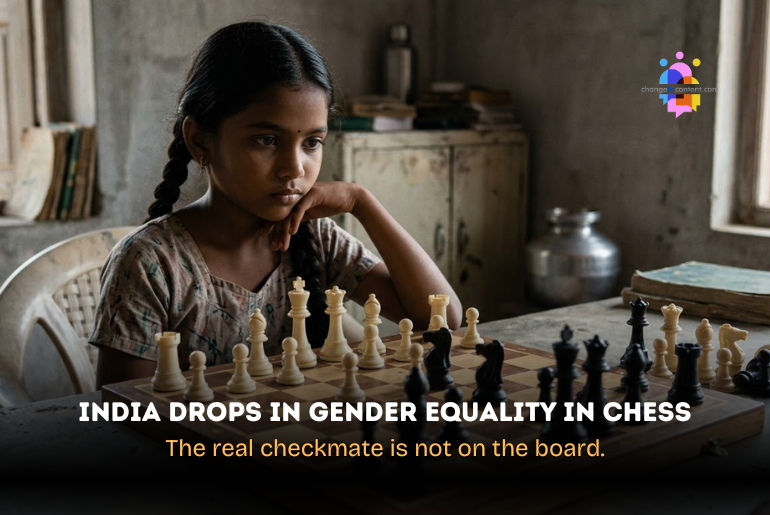
The latest rankings of the Gender Equality in Chess Index (GECI) have placed India a notch lower than before. While the numerical drop may appear marginal, the implications are anything but marginal. For a country that has produced some of the brightest chess minds in the world and is witnessing a surge in grassroots participation, this decline signals a deeper imbalance that one cannot ignore.
At first glance, India’s chess ecosystem appears vibrant and expanding. Young prodigies are emerging, international performances are improving, and the game itself is enjoying renewed cultural relevance. Yet, when you see it through the lens of gender equality, a different story begins to emerge. One where participation, recognition, and opportunity are not distributed as evenly as the surface narrative suggests.
We do not see this as a story of failure. It is a story of uneven progress. And more importantly, it is a reminder that a nation cannot separate excellence in sport from equity within it.
What the Gender Equality in Chess Index (GECI) measures
The Gender Equality in Chess Index, released by FIDE in collaboration with academic researchers, evaluates countries’ performance across multiple dimensions of gender parity in chess.
The Gender Equality in Chess Index evaluates how countries perform in terms of gender representation and parity in chess. It does not merely count participation but looks at a combination of factors that together shape the ecosystem.
- The proportion of female players relative to male players
- Representation of women among top-rated players
- Rating gaps between male and female players
- Retention and progression of women in competitive circuits
In essence, the index attempts to answer a simple but powerful question. Are women being given equal space to grow, compete, and succeed in chess?
Where does India stand in the Gender Equality in Chess Index in 2026?
India’s position in the 2026 index reflects a troubling imbalance. The country now ranks 25th in the world. Eswatini, a new entrant on the list, has taken the 24th spot. The broad outcome is clear:
- India has slipped in ranking compared to 2023
- It now stands behind countries with significantly smaller chess ecosystems
- The gender gap at higher competitive levels remains wide
More importantly, India’s performance indicates that growth at the grassroots level has not translated into elite representation. That is the core issue. While Indian chess has made progress, we are not keeping pace with other nations that are investing more deliberately in gender parity.
India’s decline in the Gender Equality in Chess Index: What changed
India’s drop in ranking is not the result of a sudden deterioration. It reflects a slower rate of improvement compared to other countries.
One of the most cited reasons is the persistent gap in female participation at higher competitive levels. While India has a strong base of young female players entering the sport, the number of women progressing into elite competitive tiers remains limited. That creates a pipeline issue where early interest does not translate into sustained professional careers.
Another contributing factor is the rating gap between male and female players. India continues to have a wide disparity in average ratings, particularly at the top levels. This gap is not merely a reflection of talent but also of opportunity, exposure, and access to high-level competition.
Additionally, tournament representation plays a role. Women’s participation in open tournaments remains lower. At the same time, while necessary, separate women’s events often limit cross-competition exposure, which is critical for growth.
Countries that improved their rankings have actively focused on increasing female participation in mixed tournaments. They are creating stronger support systems for women at advanced levels.
The participation paradox
India’s chess story presents a paradox. At the grassroots level, participation among girls is rising. Schools, academies, and state-level initiatives have introduced chess to a broader audience. Hence, the gender gap at entry levels is gradually narrowing. However, as the competition intensifies, the drop-off becomes visible. Fewer women continue into professional circuits, and even fewer reach elite global rankings.
This attrition is not unique to chess. It reflects a broader pattern observed across sports and professional domains in India, where early inclusion does not always translate into sustained representation. The reasons are layered. Social expectations, limited financial support, lack of mentorship, and fewer visible role models all contribute to this drop-off.
Structural gaps that continue to persist
To understand India’s position in the Gender Equality in Chess Index, it is important to look beyond participation numbers and examine structural realities.
- First, access to high-quality coaching and training environments remains uneven. While top male players often benefit from sustained investment, sponsorship, and exposure, female players frequently face constraints that limit their progression.
- Second, visibility and recognition play a crucial role. Media coverage, sponsorship deals, and public narratives continue to favour male players. It affects not just current players but also the aspirations of young girls considering the sport.
- Third, financial sustainability remains a challenge. Chess, unlike some mainstream sports, requires long-term investment in travel, coaching, and tournament participation. Without institutional support, many promising players struggle to sustain their careers.
At Changeincontent, we have previously explored similar patterns in sports through the lens of revenue and recognition gaps. Read more here.
The global context: Why other countries are moving ahead
We must also understand India’s drop in the GECI ratings in the context of global progress.
Countries that have improved their rankings have adopted targeted interventions. These include structured mentorship programmes for women, financial incentives, increased participation in mixed competitions, and deliberate efforts to reduce rating gaps through exposure.
Some federations have also focused on creating long-term development pathways for female players rather than short-term participation boosts. The difference lies not in intent but in execution.
Beyond the board: What this really means
The Gender Equality in Chess Index is not just about chess. It reflects how systems either enable or limit women’s growth in competitive environments.
Chess, often seen as a purely intellectual sport, is expected to be immune to physical or structural biases. Yet, the data show that even here, gender disparities persist. It reinforces an important insight. Equality is not automatic, even in spaces that appear neutral. We must build it deliberately.
The uncomfortable question: Is the system the only problem?
There is another side to this conversation that most people often avoid. If participation at the entry level is increasing, what is stopping more women from continuing? We are not just placing responsibility on individuals. However, it is vital to understand the full picture. Some of the factors include:
- Lack of long-term career clarity in chess
- Financial uncertainty in pursuing the sport professionally
- Limited institutional pathways compared to academic or corporate careers
In many cases, chess becomes an early pursuit but not a sustained one. That is where systemic support must meet individual aspiration.
The changeincontent perspective
India’s drop in the Gender Equality in Chess Index is not a reflection of failure. It reflects incomplete progress.
The country has successfully expanded access. That is the first step. The next step is far more difficult. It requires building systems that ensure women not only enter the sport but also stay in it, compete, and succeed at the highest levels. That means:
- Investing in long-term development, not short-term participation
- Creating equal exposure to competitive environments
- Building financial and institutional support structures
- Normalising women’s presence at the top
More importantly, it requires a shift in how we define success. Representation is not just about numbers at entry levels. It is about presence at the top. Until these changes happen, rankings will continue to reflect the gap between potential and reality.
Conclusion: The real checkmate is not on the board
India’s chess story is one of brilliance, ambition, and global recognition. But the Gender Equality in Chess Index reminds us of a different game being played in parallel. One where the challenge is not strategy, but structure.
The question is not whether India can produce world-class women players. It already has. The question is whether it can create a system where that becomes the norm, not the exception.
Disclaimer: The views expressed in this article are based on the writer’s insights, supported by data and resources available both online and offline, as applicable. Changeincontent.com is committed to promoting inclusivity across all forms of content. We broadly define inclusivity in terms of media, policies, law, and history. It encompasses all elements that influence the lives of women and marginalised individuals. Our goal is to promote understanding and advocate for comprehensive inclusivity.