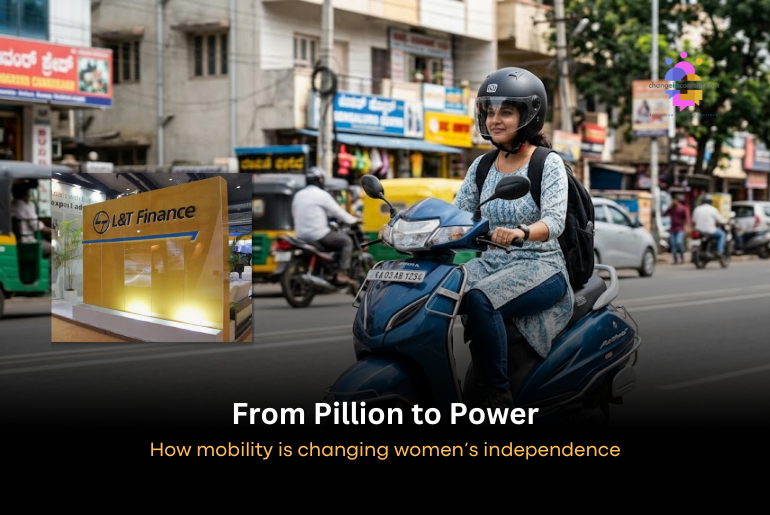
The Pillion Rider to Rider is not just the name of a corporate initiative. It is a reflection of a larger shift. A shift that sits at the intersection of mobility, independence, and access. In a country where millions of women still depend on others for basic mobility, the ability to ride a two-wheeler is not merely a skill. It is access to education, work, and agency.
Recently, L&T Finance (LTF) concluded its ‘Pillion Rider to Rider’ programme in Hubballi, Karnataka, in partnership with Aatm Nirbhar, a social enterprise focused on women’s mobility training. The initiative trained over 100 women, equipping them not just with riding skills but with licenses, safety awareness, and a pathway to independence.
At a time when financial inclusion and mobility often intersect (and sometimes collide), it becomes important to examine such programmes beyond the headline. For context, we have previously explored the risks embedded in financial access models in our article on microfinance debt traps.
What the ‘Pillion Rider to Rider’ program actually does
At its core, the programme aims to transition women from passive commuters to independent riders. But the structure of the initiative goes beyond basic training.
Participants underwent:
- Hands-on two-wheeler training using beginner-friendly models
- Road safety and traffic regulation modules
- Support in obtaining official learner’s licences
- Certification upon completion
This layered approach is important. Many similar programmes fail because they stop at skill-building. Here, the inclusion of licensing and safety education ensures that the outcome is usable in real-world conditions.
The programme was conducted at K.L.E. Society’s Jagadguru Gangadhar College of Commerce in Hubballi. It is an institution with a long-standing academic presence and access to young women at a critical stage of entering the workforce.
Why mobility is not a small issue for women
Mobility remains one of the most understated barriers to women’s participation in the workforce.
In many parts of India:
- Women depend on family members or unsafe public transport
- Travel distance becomes a deciding factor in education and employment
- Safety concerns dictate daily decisions
A two-wheeler changes that equation. It allows:
- Flexible commute timings
- Access to opportunities beyond immediate geography
- Reduced dependency on male family members
The shift from “pillion rider” to “rider” is therefore symbolic, but also deeply practical.
The scale and business context behind the initiative
While positioned as a CSR initiative, the programme also aligns closely with L&T Finance’s broader business ecosystem.
According to company disclosures:
- Q3 FY26 two-wheeler finance disbursements: ₹3,217 crore
- Year-on-year growth: 33%
- Total book size: ₹13,913 crore (10% YoY growth)
LTF’s two-wheeler financing business is one of its key verticals. By enabling first-time women riders, the company is indirectly expanding a future customer base while also positioning itself as an enabler of access.
Jinesh Shah, Chief Executive – Urban Secured Assets & Third-Party Products at LTF, stated:
Our role extends far beyond traditional lending; we are the architects of enablement. The ‘Pillion Rider to Rider’ initiative serves as a powerful testament to our commitment to driving mobility and empowering the next generation.
This dual lens (social impact and strategic alignment) is not uncommon in corporate initiatives today. The question is whether the impact sustains beyond the programme.
What the programme gets right
There are a few aspects where the initiative stands out:
- It addresses a real, everyday barrier: Policy discussions often ignore mobility, yet it directly affects access to work and education.
- It combines skill and legitimacy: Training without licensing is incomplete. This programme ensures women can legally ride.
- It integrates safety education: Road safety is not an afterthought, but part of the core curriculum.
- It targets young women at transition points: By focusing on students, the programme influences long-term behavioural and career outcomes.
Where the larger questions remain
While the initiative is meaningful, it also opens up broader questions:
1. Can this scale beyond 100 women?
India has millions of women who face mobility barriers. The current scale remains limited.
2. What happens after training?
Do these women:
- Purchase vehicles?
- Get financial support?
- Continue riding regularly?
The transition from training to sustained usage is critical.
3. Are rural and informal segments included?
Most such initiatives remain urban or semi-urban. The need is often higher in rural India.
4. Does mobility translate to employment?
The ultimate goal is not just riding. It is access to economic participation.
The Changeincontent perspective
At Changeincontent, we see mobility not as a standalone issue, but as a foundational layer of inclusion. You can:
- Offer jobs
- Build policies
- Create financial products
But if a woman cannot physically reach those opportunities safely and independently, the system is incomplete.
Initiatives like ‘Pillion Rider to Rider’ signal intent. But the next step must be integration:
- Linking mobility programmes with employment pipelines
- Providing financial access for vehicle ownership
- Expanding reach to underserved geographies
Because empowerment is rarely a single intervention, it is a chain of access.
Conclusion: ‘Pillion Rider to Rider’ is a start, not the finish line
‘Pillion Rider to Rider’ shows what happens when we treat mobility as empowerment, not convenience.
It is a strong beginning. But the real impact will depend on scale, continuity, and integration with larger systems. If India wants more women in the workforce, in education, and in leadership, then mobility cannot remain optional. It must become foundational.
Disclaimer: The views expressed in this article are based on the writer’s insights, supported by data and resources available both online and offline, as applicable. Changeincontent.com is committed to promoting inclusivity across all forms of content. We broadly define inclusivity in terms of media, policies, law, and history. It encompasses all elements that influence the lives of women and marginalised individuals. Our goal is to promote understanding and advocate for comprehensive inclusivity.