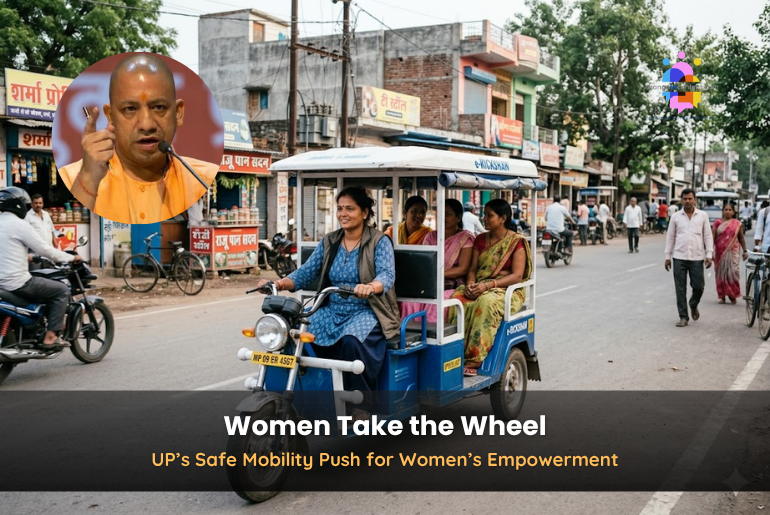
The government of UP (Uttar Pradesh) launched the ‘Safe Mobility Program’ as a targeted intervention to improve women’s safety while generating livelihood opportunities. The initiative focuses on training and equipping women from Self-Help Groups (SHGs) to operate e-rickshaws across selected districts. That positions them as both transport providers and micro-entrepreneurs.
The government has already introduced the programme in districts such as Ayodhya, Gorakhpur, Varanasi, Kaushambi, and Jhansi. Moreover, the government plans to expand it to cities including Lucknow and Prayagraj. At its core, this initiative attempts to solve two persistent issues in India’s mobility landscape. These issues are ‘unsafe public transport for women’ and ‘limited income opportunities in rural and semi-urban regions.’
What is UP’s Safe Mobility Program?
The Safe Mobility Program is designed as a state-backed initiative under the Uttar Pradesh State Rural Livelihoods Mission (UPSRLM), with technical support from Development Alternatives. (Source: DD News)
The programme operates on a simple but effective model:
- Women from SHGs are identified and trained
- They are provided with e-rickshaws
- They are supported with licensing and operational skills
- They become independent mobility providers in their regions
Unlike conventional transport schemes, this initiative is not merely about infrastructure. It is about ownership.
By placing women in control of mobility services, the programme directly addresses the demand for safer transport options for women and girls. It is especially beneficial in areas where public transport remains inconsistent or unsafe.
Scale, reach, and early impact of UP’s Safe Mobility Program
The numbers emerging from the initial rollout provide a clearer picture of the programme’s scale and intent.
- 1,000+ e-rickshaws planned under the initiative
- 119 women are already operating as entrepreneurs
- 629 women trained in driving and operations
- 244 women were issued driving licences
These figures indicate that the programme is not at the conceptual stage. It is already operational and expanding.
More importantly, early data suggest that women participating in the programme are earning an average of over ₹3 lakh annually. That positions them as primary contributors to their household income.
This shift, from informal labour to structured income generation, is significant.
Mobility as a safety intervention
The Safe Mobility Program by the UP government is also being positioned as a response to a long-standing concern of women’s safety in public transport. In many parts of India, mobility is not just about access. It is about risk.
By introducing women-driven e-rickshaws, the programme creates:
- A safer commuting option for girls travelling to schools
- A more secure alternative for working women
- Greater comfort for women travelling alone
The design of the programme acknowledges a simple but often ignored reality: Who operates transport systems can directly influence how safe they feel.
Economic empowerment through mobility
Beyond safety, the programme is equally focused on livelihood creation. Women participating in the initiative are not being positioned as drivers alone. They are being developed as small-scale entrepreneurs.
It includes:
- Asset ownership (e-rickshaws)
- Skill development (driving, maintenance, operations)
- Financial independence (direct income streams)
This approach aligns with broader government efforts to strengthen SHGs as engines of rural economic growth. By linking mobility with income generation, the programme creates a multiplier effect:
- Increased household income
- Greater financial decision-making power for women
- Local economic circulation
District-level rollout and expansion plans
The programme’s phased rollout indicates a strategic approach. Currently active districts include Ayodhya, Gorakhpur, Varanasi, Kaushambi, and Jhansi.
Planned expansion areas include Lucknow, Prayagraj, Mirzapur, Bhadohi, Sonbhadra, Deoria, Lakhimpur Kheri, and Sitapur. This gradual expansion allows the government to test operational efficiency while scaling impact.
How it fits into India’s larger mobility and gender narrative
India has seen multiple initiatives aimed at improving women’s mobility, particularly in urban areas. However, rural and semi-urban mobility remains under-addressed.
The Safe Mobility Program stands out because it:
- Integrates safety with employment
- Targets underserved geographies
- Builds on existing SHG networks
We explored a similar approach to mobility-led empowerment in the Ama Su Vahak Scheme in Odisha. What makes the UP programme notable is its scale and its focus on creating a structured ecosystem rather than isolated interventions.
The Changeincontent perspective
At Changeincontent, we see mobility as more than movement. It is access. Access to education, work, healthcare, and opportunity.
The Safe Mobility Program reflects an important shift in policy thinking, moving from protection-based approaches to participation-based models. Instead of asking how to “protect” women in unsafe systems, the programme asks:
What happens when women become part of the system itself? That shift matters.
Because we cannot achieve true inclusion by adding safety measures alone. It requires redistributing control.
Conclusion: UP’s Safe Mobility Program signals a shift
The Safe Mobility Program by the UP government is not just a transport initiative. It is a structural intervention. By placing women at the centre of mobility systems, the programme attempts to address safety, employment, and access in a single framework.
The real test, however, will lie in its scale, sustainability, and replication.
If executed effectively, this model has the potential to redefine how states approach women’s mobility, not as a problem to be solved, but as an opportunity to be built.
Disclaimer: The views expressed in this article are based on the writer’s insights, supported by data and resources available both online and offline, as applicable. Changeincontent.com is committed to promoting inclusivity across all forms of content. We broadly define inclusivity in terms of media, policies, law, and history. It encompasses all elements that influence the lives of women and marginalised individuals. Our goal is to promote understanding and advocate for comprehensive inclusivity.