
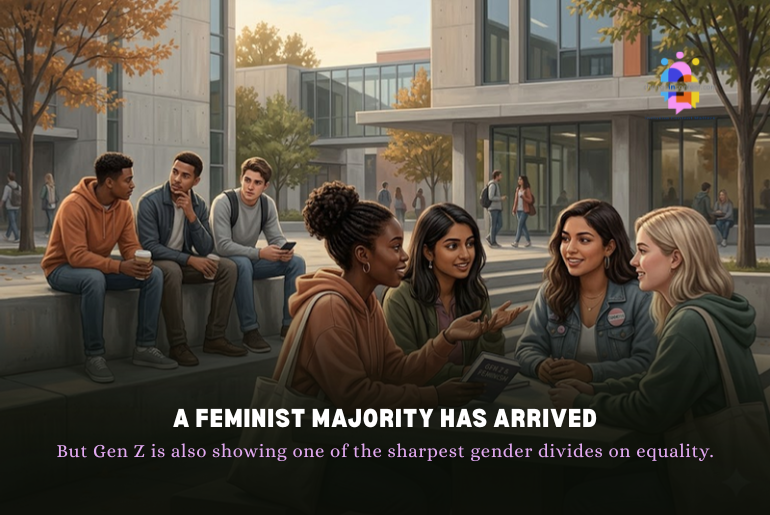
For decades, feminism has been discussed as a movement, a backlash, a label, or a point of debate. What is new now is the scale of identification. The latest cross-country data suggest that Gen Z women have become the first generation to be a feminist majority, with more than half identifying as feminists. That is a notable shift, not only because of the number itself, but because it signals how differently younger women are positioning themselves in public conversations about power, rights, and fairness.
At the same time, the news is not one-directional. The same studies point to a sharper divide within Gen Z itself. That divide is especially between young women and men on feminism, gender roles, and whether equality efforts have gone too far. That makes this moment more complex than a simple story of progress. It is also a story about growing ideological distance within the same generation.
Tracing back to the history of the Feminist Movement
The feminist movement itself has grown over time. The first wave is usually traced back to around 1848, linked to the Seneca Falls Convention in New York. Historian R. B. Rose, in Feminism, Women and the French Revolution (1994), also points to the French Revolution as an early moment when women began participating in politics in a more organised way.
It was not until the 1960s and 70s that the second wave began. The Civil Rights Movement and protests against the Vietnam War influenced it. However, it is only now that women stand out as the first generation where a majority openly identify as feminists.
For a deeper look at how feminism has evolved, read our piece on feminism over the years, waves and impact.
How Gen Z women became the first feminist majority
The latest Ipsos and King’s College London study across 30 countries found that 54% of Gen Z women identify as feminist. At the same time, only 45% of millennial women, 39% of Gen X women, and 40% of baby boomer women identify as feminists. Additionally, 68% of people across all surveyed countries said that gender equality matters to them personally. That shows broad support even among those who do not use the label.
Another survey by EduBirdie polled 2,000 Gen Z individuals aged 21 to 28. The survey examined their views on gender equality in the workplace and how these views differ between men and women. It found that 83% of Gen Z women consider themselves at least somewhat feminist. At the same time, 59% of Gen Z men would describe themselves the same way.
Gen Z has a big gender gap when it comes to views on feminism.
Even with more Generation Z women identifying as feminists, views within the same generation do not always align. On whether they call themselves feminist, about 53% of Gen Z women say yes, compared to 32% of Gen Z men. That is a 21-percentage-point difference. This gap is larger than what we see among millennials and Gen X, where fewer people differ this much on the same question.
For millennials, the numbers are 46% for women and 32% for men, a 14-percentage-point gap. For Gen X, it is 37% for women and 29% for men, an 8-point difference.
Views on gender roles also show differences. On the question of whether a man who stays at home to care for his children is “less of a man,” 19% of Gen Z women agreed, while 28% of Gen Z men said the same. This 9-percentage-point difference is more than double that seen among millennials and Gen X on the same issue.
Questions around whether men are being expected to do too much to support equality, or whether efforts toward women’s rights have gone too far. That also reflects similar disagreements within this generation.
There is also a higher sense of division between genders among Gen Z. About 59% of respondents in this group said they feel there is higher tension and divide between men and women in their country. That compares to 54% of millennials, 47% of Gen X, and 40% of baby boomers.
The cost of Gen Z’s divide on feminism
When a large section of young men and women see feminism, gender roles, and rights differently, it becomes harder to find common ground on basic issues like work, care roles, and fairness. It can also lead to more pushback, where efforts toward equality are misunderstood or seen as one-sided. The fact that 59% of Gen Z already feel there is tension between men and women. The rise to 76% in countries such as South Korea shows that this divide is a cause for concern.
Policies, workplace changes, and social attitudes all depend on some level of shared understanding. When that is missing, even small steps forward can face resistance. It also creates space for misinformation. Ideas about feminism get misrepresented as something extreme or one-sided, instead of being understood as a push for fairness in everyday life. When there is no shared understanding, it becomes easier for confusion and misinformation to spread. For example, 1 in 3 Gen Z men and 1 in 5 Gen Z women believe the gender pay gap is a myth.
Closing this gap will require more direct conversations, especially among young people. There is a need to move beyond labels and focus on what equality looks like in real situations, whether it is equal pay, shared care work, or safety. Education, media, politics, and public discussions all have a role in making these issues easier to understand without turning them into opposites. The goal is not to make everyone agree on everything, but to build enough common ground so that progress does not stall.
The Changeincontent perspective
What makes this moment interesting is not only that Gen Z women are the first feminist majority. It is that the majority has arrived at the same time as a sharper split over what equality means. That tension matters because progress becomes harder to sustain when younger men and women are no longer working from even a loosely shared understanding of fairness, care, work, and power.
The issue, then, is not only whether more young women are claiming to be feminists. It is whether public conversation can still hold enough common ground to move institutions forward.
That is where the challenge becomes cultural, not only political. If feminism keeps getting flattened into caricature while real concerns like pay, safety, unpaid care, and workplace equality remain unresolved, then misinformation will continue to do more work than understanding. That is why the next phase cannot rely on labels alone. It has to make equality legible in everyday life.
The feminist majority is real, but so is the tension around it.
Gen Z marks a moment where more women than ever openly identify as feminists. However, that shift sits alongside a noticeable divide within the same generation. Support for gender equality exists, yet differences in how it is understood, discussed, and applied continue to create friction between young men and women. The shift we are seeing now has potential, but what comes next depends on whether that momentum can turn into a shared direction.
Disclaimer: The views expressed in this article are based on the writer’s insights, supported by data and resources available both online and offline, as applicable. Changeincontent.com is committed to promoting inclusivity across all forms of content. We broadly define inclusivity in terms of media, policies, law, and history. It encompasses all elements that influence the lives of women and marginalised individuals. Our goal is to promote understanding and advocate for comprehensive inclusivity.
