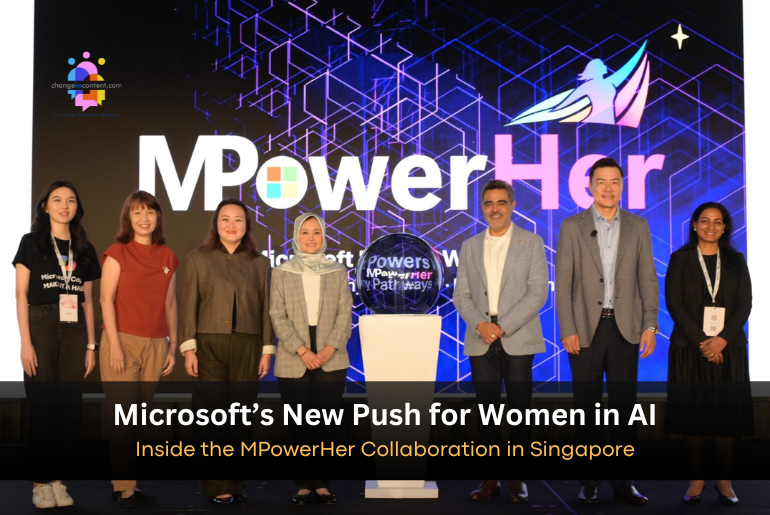
Microsoft Singapore announced the MPowerHer Collaboration on 9 April 2026 as a new initiative to help women build practical AI and digital skills through a partnership-led model.
Led by Microsoft Singapore and launched with SG Women in Tech, Mums@Work, and Code; Without Barriers, the programme aims to support women across different life and career stages. These stages include graduates, adult learners, mid-career switchers, returners, caregivers, and women building their own ventures.
The announcement was made at Microsoft Public Sector Solutions Day and launched by Minister of State for the Ministry of Digital Development and Information, Mdm Rahayu Mahzam. On the surface, the programme is about skilling. But the structure of the initiative suggests something broader.
Microsoft Singapore is not positioning MPowerHer as a standalone training campaign. It describes the program as a navigation and enablement platform that helps women access training, mentorship, networks, and real-world project experience in ways that can translate into employment and participation in Singapore’s digital economy.
What is the Microsoft Singapore MPowerHer Collaboration?
For anyone searching for the basics first, the answer is clear.
The Microsoft Singapore MPowerHer Collaboration is a women-focused AI and digital skills initiative launched in Singapore on 9 April 2026. It is led by Microsoft Singapore and delivered with three ecosystem partners: SG Women in Tech, Mums@Work, and Code Without Barriers.
The programme aims to help women gain practical technology skills, mentorship, and connections that can support entry, re-entry, or progression in the digital workforce. It is open to the combined 80,000-plus members of the partner communities. It is also open to women across Singapore.
This initiative is not simply another coding bootcamp. The official announcement describes MPowerHer as a platform that integrates and amplifies existing national and ecosystem programmes.
In practical terms, that means it is trying to reduce fragmentation. Instead of asking women to independently identify the right course, community, mentorship opportunity, and employment pathway, the programme aims to bring several of those pathways together under one umbrella.
Why is Microsoft Singapore pushing this now?
Microsoft’s timing is not accidental. The launch of MPowerHer came just days after the company announced a broader S$5.5 billion investment in cloud and AI infrastructure and ongoing operations in Singapore between 2025 and 2029, alongside new Microsoft Elevate programmes for students, educators, and nonprofits.
That broader context matters because MPowerHer appears to sit within Microsoft’s larger push to shape the talent side of Singapore’s AI future, not only the infrastructure side.
This framing is visible in the language used by Microsoft Singapore Managing Director, Wee Luen Chia. He said the initiative reflects Microsoft’s mission to empower every person and every community to achieve more with technology and AI. It also ensures that the workforce driving Singapore’s AI future is inclusive, skilled, and confident.
That wording makes the company’s position clear. MPowerHer is a workforce-readiness programme aligned with the AI transition, rather than a corporate social-impact side project detached from economic strategy.
Microsoft Singapore’s MPowerHer: The program structure
The strongest feature of MPowerHer is that it appears to combine multiple forms of support rather than treating learning as a one-step event.
According to the official announcement, participants will be able to:
- Attend in-person and virtual sessions on AI fundamentals, the use of Copilot, building AI agents, low-code and no-code development, and design thinking.
- Access Microsoft Learn resources online.
Beyond that, the programme includes mentorship, team-based projects grounded in real-world use cases, career-readiness support, and an ongoing community mechanism called MPowerHer Circles.
That design is important because the major challenge in women’s digital skilling is rarely just access to a single course. It is the drop-off that follows isolated training.
A woman may complete a programme but still lack confidence, networks, portfolio evidence, or employer visibility. By combining foundational learning with applied work and community continuity, the initiative aims to close the gap between training and actual labour market relevance.
Who is MPowerHer designed for?
The programme’s target audience is intentionally broad, and that is one of its more notable features. The official release says MPowerHer is for women across Singapore’s ecosystem. That includes adult learners, graduates, mid-career switchers, returners, women seeking roles in the public sector and in SMEs. It is also for “mumpreneurs” building their own businesses.
The inclusion of women returning after a career break, along with women balancing caregiving and entrepreneurship, signals that the programme is not only addressing early-career pipeline concerns. It is also addressing continuity and re-entry, which remain major barriers for women in technology careers.
That is where the involvement of partners matters.
- SG Women in Tech brings an established digital talent and leadership network.
- Mums@Work brings relevance to caregivers and women returning to work.
- Code Without Barriers brings existing community infrastructure focused on women in technology, AI, and cloud.
Microsoft’s own Code Without Barriers platform says its mission is to empower women in technology through skills, mentorship, and opportunities. It lists a substantial regional footprint across 15+ countries, more than 3,600 mentees, 64+ MOU partners, and 373+ jobs and internships.
What each partner appears to add to the MPowerHer collaboration by Microsoft Singapore
The official partner quotes help explain the intended shape of the ecosystem.
Dorcas Tan of SG Women in Tech positioned MPowerHer as a way to equip girls and women with practical AI skills and strong networks across stages. That ranges from students and early-career professionals to those pivoting in tech.
Mums@Work founder Sher-li Torrey framed the issue differently, stressing that women caregivers and mumpreneurs should not be left behind in an AI-driven economy. She describes the collaboration as a route to confidence, employment, entrepreneurship, and long-term growth.
These statements matter because they show the programme is not speaking to a single version of the “woman in tech” story. It is trying to recognise multiple forms of workforce distance: the woman who is entering tech, the woman who left and wants to return, the woman who is digitally underconfident, and the woman trying to build something of her own.
Why the Microsoft Singapore MPowerHer Collaboration may matter beyond Singapore
Inclusion in tech is no longer only about representation numbers. Increasingly, it is about whether women can access the part of the labour market now being reshaped by AI.
If AI adoption expands quickly while women remain underrepresented in both skills and opportunity, the next phase of the digital economy could reproduce old gaps in newer ways. That is one reason this programme is worth watching closely.
The announcement’s reference to national goals on inclusive workforce development, AI readiness, and sustained participation by women in the digital economy suggests that MPowerHer is trying to address this risk directly.
Instead of treating women’s digital participation as a long-term aspiration, it is linking it to immediate labour market needs, practical AI familiarity, and ecosystem navigation.
That connects closely with a question we have already explored at Changeincontent in our article on women in AI and the structural barriers that continue to shape underrepresentation.
What companies elsewhere should notice
There is an important lesson here for companies beyond Singapore.
Many organisations say they want more women in AI and tech, but their interventions remain narrow. They either fund a learning module, run a one-day event, or celebrate women in technology without building sustained pathways into work. The MPowerHer model appears more serious. That is because it links training with mentorship, projects, career readiness, community continuity, and ecosystem partnerships.
That approach is especially relevant now because the AI economy is moving too quickly for isolated interventions to have lasting value. Companies that want more inclusive talent pipelines will need to invest not just in access to skills but also in navigation, confidence, transitions, and networks. Women do not simply need a course. Many need an ecosystem.
The Changeincontent perspective
At Changeincontent, we see the MPowerHer initiative by Microsoft Singapore as an example of what more companies should be learning to do. The strongest part of the initiative is not the brand value or even the course content. It is the recognition that inclusion in the AI economy requires infrastructure around people, not just tools around technology.
That said, the future test of any programme like this lies in outcomes. The real questions will be practical ones.
- How many women complete the pathways?
- How many convert learning into jobs, projects, leadership opportunities, or entrepreneurship?
- How well are women returning from career breaks supported?
- How durable the community becomes.
- And whether the model can continue to include women who are often hardest to reach, not just those already close to tech ecosystems.
If more companies want to follow Microsoft’s lead, they will need to go further than announcing upskilling ambitions. They will need to build pathways that are flexible, credible, community-backed, and responsive to real-life barriers.
The closing thoughts on MPowerHer by Microsoft Singapore
The MPowerHer collaboration by Microsoft Singapore is not simply another skills announcement in a crowded AI news cycle. It is a signal about what more serious inclusion might look like when a company combines scale, partnerships, labour-market relevance, and community design.
In a moment when AI readiness is becoming a national and business priority, the programme makes a clear argument: the future digital economy will only be sustainable if more women can access it with confidence, support, and practical routes into work.
That is the larger significance of this story. Not just that Microsoft Singapore has launched a new initiative, but that it is trying to answer an increasingly urgent question. What does it take to ensure women are not merely present in the AI era, but prepared for it?
Disclaimer: The views expressed in this article are based on the writer’s insights, supported by data and resources available both online and offline, as applicable. Changeincontent.com is committed to promoting inclusivity across all forms of content. We broadly define inclusivity in terms of media, policies, law, and history. It encompasses all elements that influence the lives of women and marginalised individuals. Our goal is to promote understanding and advocate for comprehensive inclusivity.