
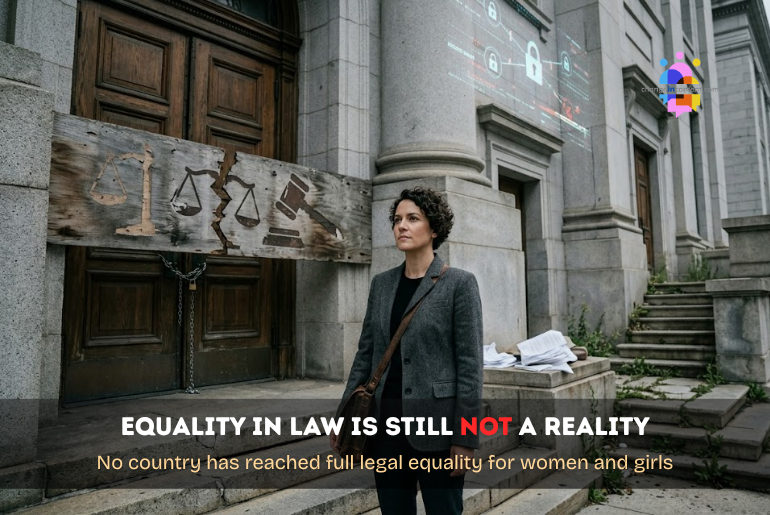
Legal equality for women and girls should no longer be an aspirational ideal in 2026. It should be a baseline. And yet the latest global picture shows that women and girls are still expected to live under laws, institutions, and justice systems that do not fully protect them from violence, discrimination, pay inequality, and exclusion.
UN Women’s recent warning that no country has achieved full legal equality is not only a moral indictment. It is also a reminder that legal reform has moved far more unevenly than public rhetoric suggests. According to UN Women, women globally hold only about 64% of the legal rights men do, and in Europe and Central Asia, the figure is about 75%.
What makes this more serious is that the gaps are not confined to a single region or issue. They stretch across sexual violence, child marriage, pay equity, public participation, workplace rights, and digital abuse. In other words, the problem is not that women and girls lack rights in one narrow corner of the law. The problem is that legal systems across the world still fail to recognise and protect the full conditions of women’s lives.
Why legal equality for women and girls is still nowhere near complete
Across countries, legal systems still leave major gaps when it comes to protecting women and girls. A report by the United Nations highlights that in 54% of countries, rape laws are not based on consent. That means many forms of sexual violence may not even have legal recognition. In close to 75% of countries, the law still allows girls to be married before adulthood.
Pay inequality also continues through legal loopholes. 44% of countries do not have laws for equal pay for work of equal value. When it comes to pay transparency, which could help reduce wage gaps, the rate is 0%.
Even basic legal safeguards are missing in many places. Only 50% of the 16 countries studied have laws that promote gender equality in public life. Only two countries have taken steps to address discrimination in the workplace or to ensure equal economic opportunities for women.
No strong laws against digital abuse
Recent reports suggest that nearly 16%-58% women have faced technology-facilitated abuse. They can range from online harassment to cyberstalking and the non-consensual sharing of private images. Even then, no country in Europe and Central Asia has achieved full legal equality for women and girls. Moreover, the region still lacks comprehensive protection in areas such as digital abuse and violence against women.
Laws on digital abuse remain limited, and domestic violence is still not fully criminalised in several countries. According to World Bank data, fewer than 40% of countries have laws protecting women from cyber harassment or cyber stalking. This leaves 44% of the world’s women and girls, around 1.8 billion, without access to legal protection.
A new UN framework exists, but legal equality for women and girls still depends on action.
Across regions, there is a growing pushback against earlier commitments on gender equality. Several countries are revising laws and policies in ways that restrict the rights of women and girls. These revisions will limit women’s participation in public life and reduce accountability for abuse. Despite decades of advocacy, no country has yet achieved full legal equality between women and men.
What CSW70 actually adopted
At CSW70 in March 2026, governments reached agreed conclusions focused on strengthening access to justice for all women and girls. That includes repeal of discriminatory laws, stronger legal responses to violence, and better access to legal aid. The idea is to reform justice systems to make them more accessible.
It was adopted at the 70th session of the Commission on the Status of Women, convened by the United Nations, which brings together governments, civil society, and international agencies to review progress on gender equality.
The framework is not legally binding, but it is likely to influence national policy directions and funding priorities in the coming years. It also connects to broader commitments under the 2030 Sustainable Development Goals.
Why implementation remains the real battleground
The gap, however, lies in implementation. Similar commitments have existed before, but uneven enforcement, limited resources, and lack of political will have slowed progress. Whether this framework leads to measurable change will depend on how governments translate these commitments into law, institutions, and everyday access to justice.
This also connects with what we explored in our earlier piece on CSW70, the justice gap, and gender stereotypes, where the promise of access to justice was already being tested against the deeper biases built into legal systems.
Conclusion: Legal equality for women and girls will remain incomplete until justice systems actually deliver
From gaps in recognising sexual violence to the absence of protection against digital abuse, the issue runs across multiple areas. It continues to affect everyday access to safety, work, and justice for women and girls. The fact that women still hold only a fraction of the legal rights that men do shows that progress has been uneven and incomplete.
The framework adopted at the Commission on the Status of Women’s 70th session sets out a direction, but its impact will depend on how countries act on it. Without concrete legal reforms, better enforcement, and sustained investment in justice systems, these commitments are unlikely to change outcomes on the ground.
Disclaimer: The views expressed in this article are based on the writer’s insights, supported by data and resources available both online and offline, as applicable. Changeincontent.com is committed to promoting inclusivity across all forms of content. We broadly define inclusivity in terms of media, policies, law, and history. It encompasses all elements that influence the lives of women and marginalised individuals. Our goal is to promote understanding and advocate for comprehensive inclusivity.
