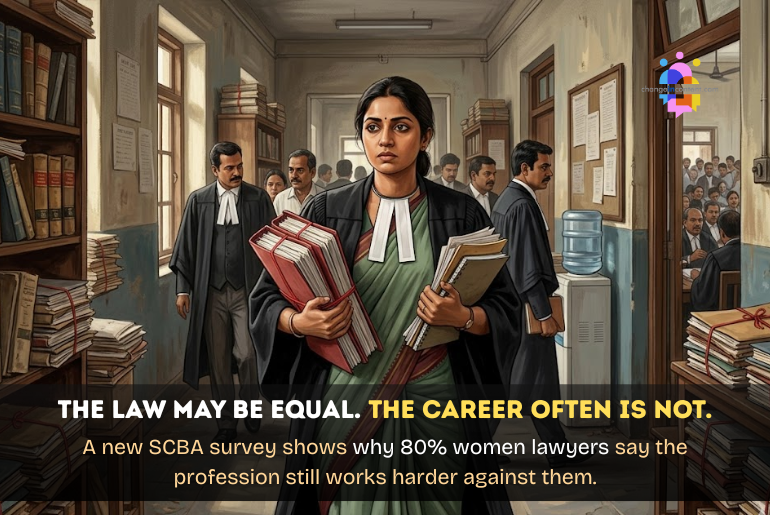
Women remain a minority in India’s legal profession (only 15%). The gap does not only show up in numbers. It appears in who advances, who gets visibility, and who is expected to carry more to stay in the race.
The law is supposed to be a profession built on merit, argument, and access to justice. But for many women in India, the experience of building a legal career looks far less equal than that promise suggests. The latest SCBA survey on Female Lawyers vs Male Lawyers brings that imbalance into focus with unusual clarity.
More than 8 in 10 women respondents said their professional journey has been harder than that of their male counterparts. That immediately raises a larger question: if women are entering the profession, why does the path still feel so uneven once they are inside it?
That is what makes this survey important. It does not reduce the issue to a single dramatic incident or a single workplace policy. Instead, it maps a profession in which difficulty accumulates through everyday structures. These structures include work allocation, pay, networking, government appointments, access to leadership, burnout, childcare, and the silent expectation that women must somehow keep proving they belong.
The result is not only a harder career. It is a profession that still seems better designed for men to move through with fewer obstacles.
About the survey
A national survey by the Supreme Court Bar Association, based on responses from 2,604 women legal professionals, shows just how steep that journey still is for many women at the Bar.
The survey, titled Documenting Voices of Women Legal Professionals in India, points to ongoing barriers in infrastructure, networking, leadership opportunities and work-life balance, even as more women join the Bar.
- As many as 81.3% said their careers have been more difficult than those of their male peers.
- Among them, 41.1% described their experience as “much harder.” They point to the everyday hurdles and biases they face at work.
- Nearly 63.7% said they had, at some point, felt discouraged from continuing in the profession.
Female lawyers vs male lawyers: Why career growth still tilts towards men
Women have had the right to practise law since the Legal Practitioners (Women) Act, 1923, yet equal progress still feels out of reach. The survey shows how career growth tilts in favour of men at key stages.
- About 53.9% said it is easier for men to secure a senior designation. Just 1.7% felt women had that advantage.
- As many as 64.5% said they have never held any designated government position.
- Not a single respondent had served as Attorney General, Solicitor General or Additional Solicitor General at the Supreme Court level.
- More than half, 55.5%, said appointments to government panels favour men.
At the same time, women lawyers clearly want change: 59.4% supported minimum representation on legal services panels. 67.28% backed mandatory policies to ensure women are appointed as panel counsel and law officers.
Leadership within the Bar also remains out of reach for many. Around 64.7% said women do not get equal chances in Bar leadership. Many pointed to the lack of women’s networks (65.5%), along with time and financial pressures (52.6%), family expectations (48.4%) and an aggressive election culture (38.1%) that keeps them out.
No networks, no cushion
For most women, the legal profession begins without any built-in support. A majority, 83.1% of women, identified as first-generation lawyers.
Work itself does not come easily.
- Around 60% said limited opportunities remain a major issue.
- Another 42.8% cited networking problems, while 40.2% cited pay gaps.
- Networking becomes harder, too. About 72.3% said gender has affected their ability to build professional connections.
Even then, women build their practice across fields. Many work in civil law (71.3%), family law (65.4%) and criminal law (64.5%). However, 56.9% said gender stereotypes around these areas have limited their access at some point.
Building a career without basic support
Many women work without even the basic setup needed for a legal practice.
- Only 19% said they have offices within walking distance of courts.
- Another 12% said they have no office space at all. High rent (45.4%) and lack of steady income (37.5%) make it hard to set up, especially in the early years.
- About 24.2% said they are still new to the profession.
- 20.3% cited family responsibilities, and 8.2% cited safety concerns.
The gaps go beyond office space.
- Around 75% said they do not have access to paid legal databases.
- About 77% women lawyers work without clerical staff.
- More than half (56%) lack stable internet access or proper devices.
- Around 21% said they have no professional resources at all.
Some changes have helped. About 65.3% said technology and e-courts have made work easier. At the same time, 34.4% said they have experienced or seen gender bias in institutions.
Work does not end in the courtroom.
For many women, work and home pressures overlap.
- About 71.5% said marriage has affected their careers.
- Among them, 44.7% faced minor difficulties, while 26.8% faced major ones.
- Work-life balance (30.1%) and financial instability (29.6%) remain the most common concerns.
Support at key moments often falls short.
- Among those who asked for childcare support, 42.7% reported not receiving it.
- More than half (55.2%) found it difficult to get matters deferred during childbirth.
- Family responsibilities limited opportunities for 30.3% of respondents.
- Only 18.9% felt that having children helped their careers.
The pressure builds over time.
- About 84% said they faced burnout or work-related stress at least sometimes in the past year.
- Among early-career lawyers, that number rises to 94.4%.
- Around 59.2% said they are not confident that complaints would be handled fairly.
About 50.9% said they were satisfied with their careers, while 35.3% remained neutral and 13.8% were dissatisfied. Even with these challenges, many women continue in the profession, though often with mixed feelings.
The Changeincontent perspective
What makes this survey significant is that it does not describe a profession where women are absent. It describes a profession where women are present, qualified, and working, yet still encounter a structure that appears easier for men to navigate. That distinction matters. The problem is not entry alone. It is progression.
If women continue to face greater difficulty with networking, institutional support, appointments, childcare, fee negotiations, and access to leadership, then the profession cannot continue to describe itself as neutral simply because the doors are technically open.
The solutions here are practical, not abstract. Women need stronger access to mentoring, better infrastructure near courts, fairer work allocation, clearer routes into government panels, real childcare support, and institutional processes they can actually trust when bias or harassment occurs.
Legal workplaces also need to stop treating burnout and persistence as private women’s problems. A profession that speaks for justice cannot keep normalising inequality within its own corridors.
Female lawyers vs male lawyers: The closing thoughts
Women have entered the legal profession in large numbers, but the path ahead still comes with extra hurdles at every step. From getting work to moving into senior roles, the gap shows up again and again.
The survey highlights areas that need attention, such as fair access to opportunities, better support in the early years, childcare and maternity support, safer workplaces, and more space for women in decision-making roles. Without these changes, many will continue to face the same roadblocks, no matter how many enter the profession.
Disclaimer: The views expressed in this article are based on the writer’s insights, supported by data and resources available both online and offline, as applicable. Changeincontent.com is committed to promoting inclusivity across all forms of content. We broadly define inclusivity in terms of media, policies, law, and history. It encompasses all elements that influence the lives of women and marginalised individuals. Our goal is to promote understanding and advocate for comprehensive inclusivity.