
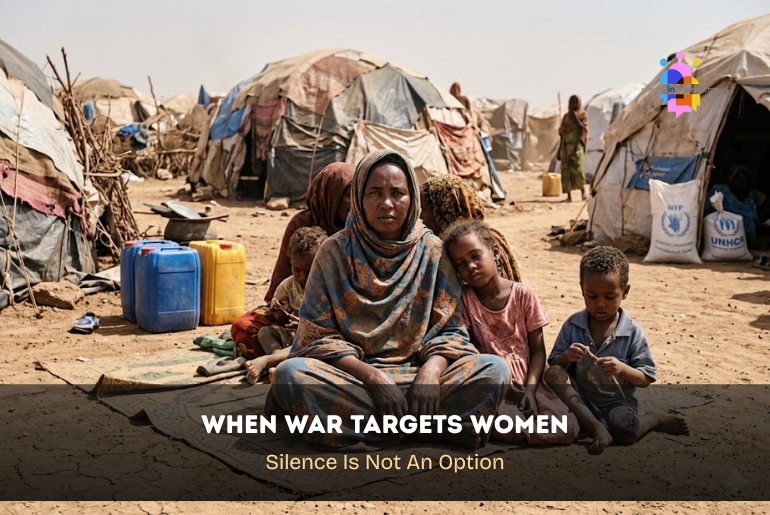
The war on women in Sudan has evolved into one of the most brutal and underreported humanitarian crises of our time. What began as a political conflict has transformed into a systematic assault on women and girls. That is where sexual violence is not incidental but strategic. According to UN Women, the number of women and girls requiring support after experiencing gender-based violence has quadrupled since the war began.
We do not see it as a mere statistic. It is a reflection of a war where women’s bodies have become battlegrounds. Where survival is uncertain, and dignity is under constant threat. And yet, even in the midst of this devastation, women are not just victims. They are responders, negotiators, and the backbone of fragile humanitarian systems that continue to function against all odds.
The war on women in Sudan is systemic, not sporadic
To understand the depth of the crisis, it is important to move beyond isolated incidents and recognise the pattern.
Sexual violence in Sudan is not random. It is coordinated, repeated, and increasingly embedded into the mechanics of war. Women are being attacked in their homes, during displacement, while seeking food, water, or medical aid. The intent is to instil fear, assert control, and dismantle communities from within.
According to UN Women’s 2026 Gender Alert:
- Sexual violence cases have doubled in the last two years
- They have quadrupled since the start of the war
- Two-thirds of frontline responders reported a sharp increase in 2025
- Half reported further escalation in 2026
This escalation reflects something deeper than conflict. It reflects impunity. When violence becomes predictable, it is no longer chaos. It is a design.
Displacement, hunger, and violence: A triple crisis for women
We cannot separate the war on women in Sudan from the broader humanitarian collapse.
Today:
- Over 4.3 million women and girls are internally displaced
- 17.1 million people require humanitarian assistance
Displacement exposes women to heightened risks.
- Camps lack basic security.
- Access to healthcare is limited or nonexistent.
- Food scarcity forces women into unsafe environments where exploitation becomes a survival risk.
The intersection is brutal.
Violence increases when systems collapse. And systems collapse faster when countries exclude women from rebuilding them.
Beyond physical harm, the psychological impact is severe. Survivors often have no access to trauma support, legal recourse, or safe reporting mechanisms. Silence becomes survival.
Women-led organisations: The invisible backbone of survival
While global systems struggle to respond, women-led organisations in Sudan are quietly holding communities together.
According to UN Women:
- These organisations are reaching nearly 20 million people
- They provide food, medical care, and psychosocial support
- They mediate conflicts and negotiate humanitarian access in high-risk zones
It is not auxiliary work. It is frontline leadership. Yet, the same organisations face severe constraints:
- 99% report operational challenges
- 85% have faced funding cuts in 2025
- One in five women workers reports direct threats
This contradiction is striking. The most effective responders are the least supported.
The war on women in Sudan and the cost of global inaction
The international response has been slow, fragmented, and underfunded.
Despite clear evidence, funding for gender-based violence response remains inadequate. Legal systems are either inaccessible or non-functional. Perpetrators operate with near-total impunity.
There is also a glaring absence of women in peace negotiations. For three years, Sudanese women have had no meaningful representation in official peace talks.
Seeing it as just exclusion would be an error, as it is a strategic oversight. We explored similar patterns in another conflict here. Across regions, the pattern repeats. Women carry the burden of war but are excluded from shaping peace.
Why sexual violence in war must be treated as a security issue
One of the biggest failures in global response is the framing of sexual violence. It is a humanitarian concern. We must treat it as a security and policy issue.
Because:
- It destabilises communities
- It prolongs conflict cycles
- It destroys trust in institutions
- It undermines long-term recovery
When sexual violence is used as a weapon, responding to it becomes central to ending the war itself.
Ignoring it does not neutralise the threat. It strengthens it.
What needs to change: From awareness to action
The solutions are not unknown. They are simply not implemented at scale.
1. Protection must be immediate and non-negotiable
Countries and organisations must prioritise safe shelters, access to healthcare, and secure reporting mechanisms in all conflict zones.
2. Enforce accountability
Without legal consequences, violence will continue. International cooperation is critical for investigating and prosecuting crimes.
3. Funding for women-led organisations must increase
These organisations are already delivering results. Scaling them is not a choice. It is a necessity.
4. Include women in peace processes
No negotiation can deliver sustainable peace without the participation of those most affected.
5. Prioritise long-term rehabilitation
Support cannot end with an immediate response. Survivors need sustained access to mental health care, economic opportunities, and social reintegration.
The Changeincontent perspective
At Changeincontent, we believe the war on women in Sudan is not just a regional crisis. It is a global reflection of how systems fail women in moments that matter most.
The data is clear. The stories are undeniable. What remains missing is urgency.
If the world continues to treat sexual violence as a side effect of war, we will never be able to address it at its root. If women-led organisations continue to operate without adequate funding, the most effective solutions will remain underpowered.
It is no longer just about awareness anymore. It is about priorities. Because every delayed response is not neutral, it is a decision to allow the crisis to deepen.
Conclusion: The war on women in Sudan will not end without confronting it directly
The war on women in Sudan is not hidden. It is documented, reported, and widely known. What is missing is decisive action.
Women are not just surviving this war. They are leading responses, rebuilding communities, and holding systems together. And yet, they remain unprotected, underfunded, and excluded.
Ending this war is not just about ceasefires and negotiations. It is about dismantling the systems that allow violence against women to persist without consequence.
Because peace cannot exist where women are unsafe, and no war can truly end until this one does.
Disclaimer: The views expressed in this article are based on the writer’s insights, supported by data and resources available both online and offline, as applicable. Changeincontent.com is committed to promoting inclusivity across all forms of content. We broadly define inclusivity in terms of media, policies, law, and history. It encompasses all elements that influence the lives of women and marginalised individuals. Our goal is to promote understanding and advocate for comprehensive inclusivity.
