
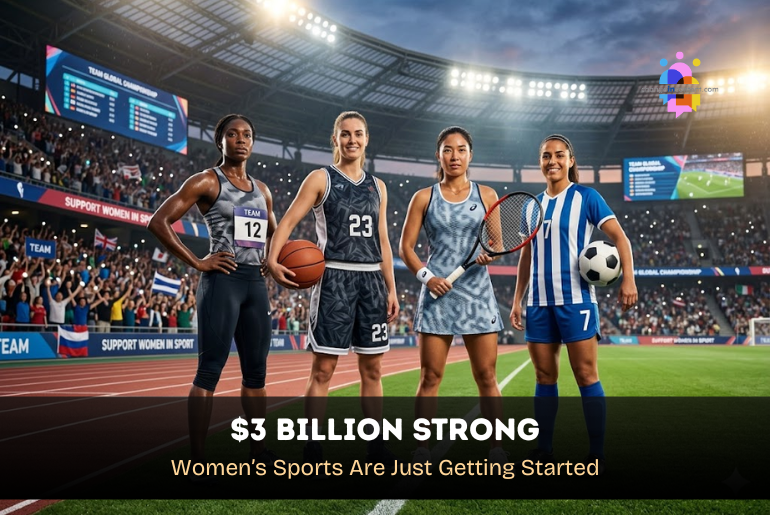
Women’s elite sports are entering a defining moment. According to a new report by Deloitte Global, the global revenues from women’s elite sports are expected to reach at least US$3 billion in 2026. That marks a significant leap in commercial value, visibility, and global interest.
That is not just growth. It is validation.
For decades, women’s sports have been underfunded, under-marketed, and underestimated. Now, audiences, sponsors, and broadcasters are rewriting that narrative. But while the numbers are promising, they also expose a deeper reality. Growth is happening, but equity is still catching up.
Women’s elite sports revenue boom: What the $3 Billion milestone means
The Deloitte report highlights a clear shift in how women’s elite sports are perceived and monetised.
The headline figure is powerful. But the breakdown tells the real story. According to Deloitte’s Game Changers: Unlocking the Potential of Women’s Sports:
- Global revenue (2026): $3 billion+
- Growth since 2022: 340%
- Commercial revenue: $1.4 billion (45%)
- Matchday revenue: $911 million (30%)
- Broadcast revenue: $765 million
These numbers are critical.
For years, the argument was that women’s sports lacked commercial viability. The data now dismantles that claim. Sponsorships, media rights, and ticket sales are all rising. Fans are not just watching. They are investing time, attention, and money.
Key takeaway: This is not a one-off spike. It is sustained growth driven by demand.
Why women’s elite sports are finally growing at scale
The rise of women’s elite sports is not accidental. It is the result of multiple forces converging at the same time.
1. Audience demand has changed
Fans are no longer passive consumers. They actively seek diverse, authentic sporting experiences. Women’s sports offer competitive intensity without the over-commercialisation seen in some men’s leagues.
2. Brands are rewriting their playbooks
Sponsors are recognising the value of associating with purpose-driven narratives. Women’s sports offer strong engagement, loyalty, and brand alignment with inclusion.
3. Media coverage is expanding
Broadcasters are investing more in women’s leagues, leading to better production quality, wider reach, and increased visibility.
4. Athletes are building personal brands
From social media influence to global endorsements, women athletes are becoming powerful individual brands, driving viewership and revenue.
5. Matchday experience is evolving
The jump to $911 million in matchday revenue shows that stadium attendance is rising. Fans are showing up.
6. League expansion
North America alone has launched multiple new leagues since 2020. Europe is restructuring existing systems. Emerging markets are catching up.
This growth is structural, not seasonal. And that is how industries grow, not through hype, but through infrastructure.
The sports that drive women’s elite sports forward
Two sports dominate the current revenue landscape:
- Football (Soccer)
- Basketball
Each of these sports is expected to contribute 35% of the total global revenue.
- Global investments, independent league structures, and increasing institutional support drive football’s rise.
- Basketball, especially in the United States, benefits from strong legacy systems and media partnerships.
Individual sports like tennis and golf are also evolving through collaborations that amplify athlete visibility and monetisation.
The geography of growth: Who is leading and who is catching up
- North America: $1.6 billion (54%)
- Europe: $434 million (14%)
These regions dominate due to early investments and established ecosystems. But the real story is in emerging markets. Countries like India are witnessing a cultural shift.
India’s moment: The rise of women’s sports at home
India is quietly becoming a powerful contributor to the women’s elite sports narrative.
The success of the Indian Women’s Cricket Team, coupled with the rise of the Women’s Premier League (WPL), has changed perceptions.
- Parents are beginning to see sports as a viable career for girls.
- Young athletes are finding role models.
- Brands are starting to invest.
The WPL, in particular, has done something significant. It has created visibility at scale. Packed stadiums, strong viewership, and commercial interest are all signals of a maturing ecosystem.
For a country like India, this is not just about sport. It is about social change.
What this means for women’s participation in sports
The rise of women’s elite sports is not just about revenue. It has a direct impact on participation. When visibility increases:
- More girls see sports as a viable career
- Families are more likely to support athletic pursuits
- Schools and institutions invest more in training infrastructure
Representation creates aspiration. Aspiration creates participation. But for this cycle to sustain, access must improve.
The gap that still exists in women’s elite sports
While women’s elite sports are growing, the gap remains significant. We explored these gaps in detail here. The $3 billion figure is impressive. But it also highlights how much potential remains untapped.
Key challenges:
- Pay disparity compared to men’s sports
- Limited media coverage in many regions
- Inconsistent investment across leagues
- Short career spans due to a lack of support systems
- Media coverage still heavily favours men’s sports
- Sponsorship deals for women athletes are often lower in value
- Infrastructure and grassroots investment remain uneven
The danger lies in assuming that growth equals equality. It does not.
Growth without structural change can plateau. And when it does, the gap widens again.
What needs to change now
If women’s elite sports are to scale truly, the next phase of growth must focus on systems, not just numbers.
1. Equal investment in grassroots development
Talent pipelines start early. Without investment at the grassroots level, growth at the elite level cannot be sustained.
2. Better pay structures
Athletes need financial security to focus on performance. Pay parity may take time, but minimum standards must improve.
3. Consistent media coverage
Visibility cannot be event-based. Regular coverage builds audience loyalty.
4. Corporate backing beyond sponsorships
Companies must invest in long-term partnerships, infrastructure, and athlete development programs.
5. Policy-level support
Governments must create frameworks that ensure equal access to facilities, funding, and training.
Women’s elite sports and the business case for inclusion
For businesses, the rise of women’s elite sports is not just a social opportunity. It is a commercial one.
- Higher engagement rates compared to some men’s leagues
- Stronger emotional connection with audiences
- Better alignment with diversity and inclusion goals
Brands that invest early are likely to benefit the most. It is not charity. It is a strategy.
The Changeincontent perspective
At Changeincontent, we see women’s elite sports as one of the clearest examples of what happens when inclusion meets opportunity.
The growth to $3 billion is not surprising. What is surprising is how long it took.
Women athletes have always had the talent, discipline, and audience appeal. What they lacked was consistent support.
Now that the ecosystem is beginning to respond, the responsibility is clear.
Do not treat this as a trend. Build it as a system because you cannot measure the real win in revenue alone. You can only measure it in access, opportunity, and long-term equity.
Conclusion: Women’s elite sports are worth $3 Billion today. Their real value is much higher.
The rise of women’s elite sports to a $3 billion industry is a milestone worth celebrating. But it is not the finish line. It is the starting point.
The next phase will determine whether this growth becomes sustainable or remains uneven, because the future of sports will not be just about performance. It will be about participation.
And when more women step onto the field, the game does not just grow. It changes.
Disclaimer: The views expressed in this article are based on the writer’s insights, supported by data and resources available both online and offline, as applicable. Changeincontent.com is committed to promoting inclusivity across all forms of content. We broadly define inclusivity in terms of media, policies, law, and history. It encompasses all elements that influence the lives of women and marginalised individuals. Our goal is to promote understanding and advocate for comprehensive inclusivity.
