
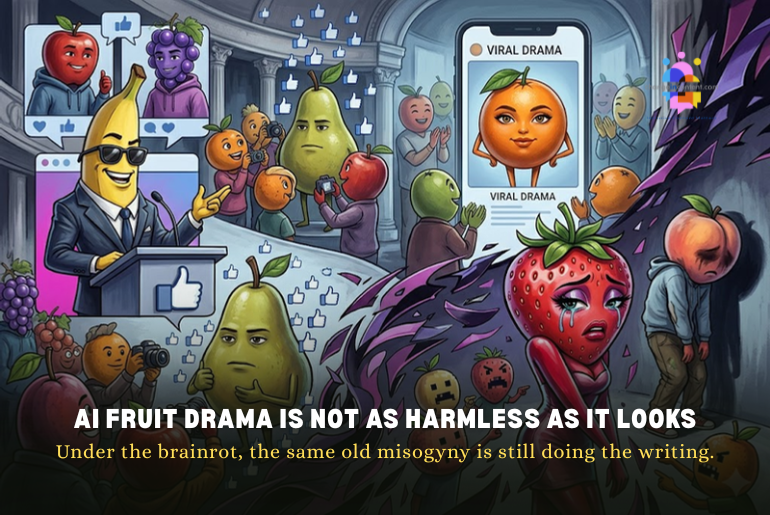
You scroll for a minute, and suddenly the internet is full of seductive strawberries, gym-bro bananas, cheating fruit wives, and self-sacrificing fruit dads. That is the world of AI Fruit Drama right now. It is surreal, addictive, low-effort, impossible to ignore, and somehow already familiar in all the worst ways.
What looks like meaningless brainrot quickly reveals something less harmless. The women-coded fruit characters are sexualised, mocked, blamed, and repeatedly written into the same old roles that the internet has been serving up about women for years.
That is what makes this trend worth taking seriously. AI fruit dramas are not important because fruit-shaped soap operas are high art. They are important because they show how quickly generative content absorbs and reproduces gendered assumptions as entertainment.
The format is absurd. The thinking behind it often is not. And when this kind of misogyny arrives dressed as a joke, a trend, or a “viral format,” it gets normalised far more easily than people admit.
The AI Fruit Drama is repeating the same old sexism in a new format.
It doesn’t take any critical thinking to get what these AI fruit dramas are doing. The women are almost always written into the male gaze, pushed into the same stereotypes, and placed in the worst possible roles. The hot young fruit woman is stealing someone else’s husband. Or the money-minded orange fruit wife walking out. The cheating partner with a baby that isn’t her husband’s.
Recent commentary on the trend has pointed to recurring female-coded characters such as “Strawberina” being written into cheating, manipulative, or hypersexualised roles. She is often a part of the love triangles.
Now look at the male fruits. The AI Fruit Drama shows it as a single dad doing everything for his kids. He’s the young guy chasing ambition. And he is the glow-up story, going from fat to fit, rags to riches, or the well-dressed, put-together man.
How manosphere storylines slip into “joke” content
All these storylines match ideas from manosphere spaces, especially incel circles. In that red pill content, there’s a misogynist’s way of looking at relationships. It frames men as the ones who do everything right, who provide, who stay loyal. In contrast, it frames women as opportunistic, as people who chase money, status, or looks, and then leave once they get it.
When you see this over and over again, even as just content, even if you know it’s exaggerated or fake, repeated exposure makes it normalised and makes it seem like this is just how things are.
Women against women, on loop
Now, you might think it changes when there are no male characters, when it’s just female characters. It doesn’t.
The story simply redirects the tension. Instead of men versus women, it becomes women versus women. These videos show women as jealous, petty, violent, and constantly plotting. And the visual part matters too. The characters stay sexualised.
Even when these videos cast women in roles meant to command trust or respect, such as doctors or teachers, they still turn them into villains. The AI drama does not show a Woman Fruit Doctor saving lives; it shows her swapping babies for money. The fruit teacher isn’t guiding students; she’s shown as racist or abusive.
Not just a tool, a mirror with no filter
AI itself isn’t inherently harmful. It’s not sitting somewhere deciding to create misogynistic content on its own. It responds to prompts, what people ask it to create, based on instructions given by people. And very often, those instructions come from a man who already carries these ideas.
Why are there still so few restrictions on the kind of content AI can generate? Why does it keep producing sexist, misogynistic, and violent portrayals of women without any pushback built into the system?
What weak moderation still fails to catch
If AI can easily generate content that sexualises women, paints them as manipulative, or places them in abusive scenarios, then it shows there are gaps in how these systems are being trained and moderated. It suggests that recognising misogyny, especially when it shows up in subtle or “entertainment” formats, is still not taken seriously enough.
It also makes you question how AI is trained. If it can still create content that is sexist or violent towards women, then it hasn’t really learned to understand what is wrong with it.
All this technology, and we’re still here, watching an anthropomorphic fruit woman get slut-shamed, berated, and reduced to the male gaze, as if nothing has changed.
Read next: Combatting online abuse against women: What needs to change, and what you can do today.
The Changeincontent perspective
What makes this AI Fruit Drama worth analysing is not its artistic value. It is what the trend exposes about how sexism survives even inside content that pretends to be too ridiculous to matter.
The internet is very good at disguising ideology as humour, and AI fruit drama is a perfect example of that trick. The format is unserious, but the scripts often are not. Female-coded characters are still sexualised, punished, distrusted, and written through familiar patriarchal fantasies. Conversely, male-coded characters are more often the ones with ambition, sympathy, and moral complexity.
That is also where the technology question becomes impossible to avoid. If generative systems can so easily produce entertainment that humiliates women, eroticises them, or reduces them to misogynistic caricatures, then the issue is not only what users want. It is also what platforms tolerate, what moderation fails to catch, and how it treats little subtle misogyny as a serious harm vector.
AI fruit drama may look like a joke, but jokes repeated millions of times become part of the culture.
Conclusion: AI Fruit Drama feels trivial until you notice what it keeps teaching
We’ve already seen the damage with deepfakes and other forms of AI misuse targeting women. And yet, here we are again, with a different format, same thinking, and still no real change. It raises a bigger concern about what these systems are being trained on, and whether they are being taught to recognise and limit harmful content at all.
Disclaimer: The views expressed in this article are based on the writer’s insights, supported by data and resources available both online and offline, as applicable. Changeincontent.com is committed to promoting inclusivity across all forms of content. We broadly define inclusivity in terms of media, policies, law, and history. It encompasses all elements that influence the lives of women and marginalised individuals. Our goal is to promote understanding and advocate for comprehensive inclusivity.
