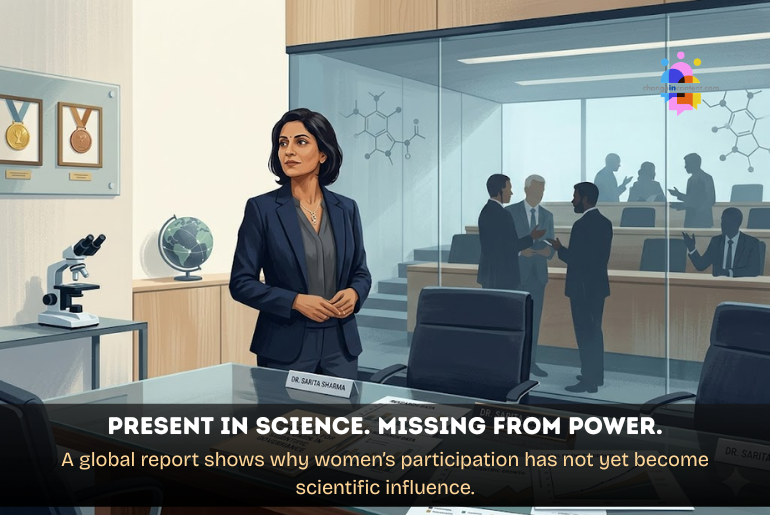
Women in science governance are not missing because of a lack of talent. They are missing because scientific institutions still rely on systems of recognition, nomination, leadership, and prestige that were built when women were largely kept outside them.
A 2026 global report by the International Science Council, the InterAcademy Partnership, and the Standing Committee for Gender Equality in Science has made this gap clearer. Women now account for 31.1% of researchers worldwide, according to UNESCO data from 2022. Yet, they remain underrepresented in scientific academies and unions. These are the very institutions that shape scientific agendas, recognise excellence, and advise policymakers.
What does the global report reveal about women in science governance?
The report examined more than 130 scientific academies and international scientific unions, as well as responses from nearly 600 scientists worldwide. Its finding is simple but uncomfortable: women are increasingly present in science, but that presence has not translated into equal power.
In national science academies, women represented an average of 19% of members in 2025. That is an improvement from 12% in 2015 and 16% in 2020. However, it still falls far below women’s share of the global research workforce. The global average also hides sharp inequalities. In some academies, women make up fewer than 5% of members, while in others, they approach 40%.
Women in leadership roles
The leadership picture is equally revealing. Women currently lead only one in five national academies. Nearly half of the national academies report no women serving as vice presidents or co-chairs. The report also found that having a woman at the top does not automatically create gender balance across the institution. (Source: International Science Council)
That is an important warning. Representation at the top can be symbolic if the deeper power structure remains unchanged.
Why does women’s exclusion from scientific power matter?
Scientific academies and unions are not ceremonial clubs. They influence what research is valued, whose expertise becomes visible, who receives awards, who enters elite networks, and what kind of advice reaches governments. When we exclude women from these spaces, science loses more than diversity. It loses perspective, legitimacy, and trust.
It matters because science is not neutral in how it is governed. People in positions of influence shape decisions about research funding, public health, climate action, artificial intelligence, agriculture, engineering, and medical priorities. If women are not present in those rooms, the questions science asks can become narrower.
UNESCO has warned that gender imbalance in science limits the diversity of ideas. At the same time, it introduces bias into research and risks overlooking key perspectives as the world faces major global challenges.
That is why this is not only a “women in STEM” issue. It is a governance issue.
The problem is not merit. It is gatekeeping.
The report makes one point particularly clear: women’s underrepresentation does not usually come from explicit bans or formal exclusion. Most scientific organisations describe their processes as open and merit-based. The problem sits earlier in the pipeline.
Existing members often drive nomination processes. Informal networks decide who is noticed, encouraged, recommended, and put forward. Women remain underrepresented in nomination pools compared with their presence in the wider scientific community. Once nominated, however, women are elected or awarded at rates slightly higher than their share of the nomination pool.
That changes the conversation.
If women lack nomination, the issue is not whether they are good enough. The issue is who gets seen as excellent in the first place.
Prestige often travels through closed networks:
- A senior scientist recommends someone
- A committee turns to familiar names
- An award nomination depends on who knows whom
- A leadership role goes to someone already visible in the academy’s inner circle.
These are not always deliberate acts of discrimination. But they produce discriminatory outcomes.
Why has women’s presence still not become power?
One of the most useful phrases from the global conversation around this report is “from presence to power”. It captures the problem well. Women can be in laboratories, universities, conferences, and research teams, yet remain outside the rooms that decide scientific priorities.
The InterAcademy Partnership summarised the issue sharply. Representation does not automatically translate into influence. Formal openness can coexist with informal gatekeeping. Women can participate in science but still face unequal experiences, missed opportunities, and care-related barriers to advancement.
It is familiar across sectors. Women are allowed entry, but not always authority.
- They are celebrated as participants, but not consistently recognised as decision-makers.
- They are visible in campaigns, but absent from committees.
- They have to inspire girls, but are not always trusted to shape institutions.
Science should be different. But the report shows that it is not different enough.
What must change for women in science governance?
The first step is to stop treating women’s inclusion as a pipeline problem alone. Encouraging girls to study science is necessary, but it cannot be the whole solution. If governance structures remain unchanged, the pipeline simply feeds women into institutions that still do not share power fairly.
Scientific academies and unions need transparent nomination systems. They need to track who is nominated, who is elected, who receives awards, who serves on committees, and who leads decision-making bodies. Without data, institutions can hide behind the language of merit.
They also need gender equality policies with resources, accountability, and institutional anchoring. A policy without budget, monitoring, leadership, ownership, or measurable targets does not shift power. It only decorates the status quo.
Recognising care responsibilities
Care responsibilities also deserve recognition as part of the scientific career structure. The IAP noted that women are more than three times as likely to report barriers to advancement and 4.5 times more likely to miss opportunities because of care responsibilities.
If science rewards uninterrupted availability, elite travel, informal networking, and late-career recognition, it will continue to favour those who are least burdened by unpaid care.
Methodology and editorial note
This article is based on the 2026 report, “Towards gender equality in scientific organisations: assessment and recommendations”, released by the International Science Council, the InterAcademy Partnership, and the Standing Committee for Gender Equality in Science. It also draws on Down To Earth’s analysis of the report and UNESCO’s publicly available material on gender equality in science.
The article does not claim that all scientific organisations operate in the same way. The report itself shows uneven progress across institutions, disciplines, and geographies.
Changeincontent perspective: Science cannot call itself objective while power remains unequal
Women in science governance are not asking for inclusion as a gesture. They are asking scientific institutions to recognise that we cannot fairly identify excellence through systems that keep looking in the same old rooms.
At Changeincontent, we believe this report offers a lesson far beyond science. Presence is not the same as power. Visibility is not the same as influence. Participation is not the same as governance. If women help produce knowledge but remain excluded from the bodies that define prestige, distribute recognition, and advise governments, then science still operates with a democratic deficit.
We cannot build the future of science on half-recognised talent. It needs women not only in laboratories, but in academies, councils, award committees, editorial boards, policy advisory groups, and leadership positions. Anything less is not progress. It is partial inclusion dressed as equality.