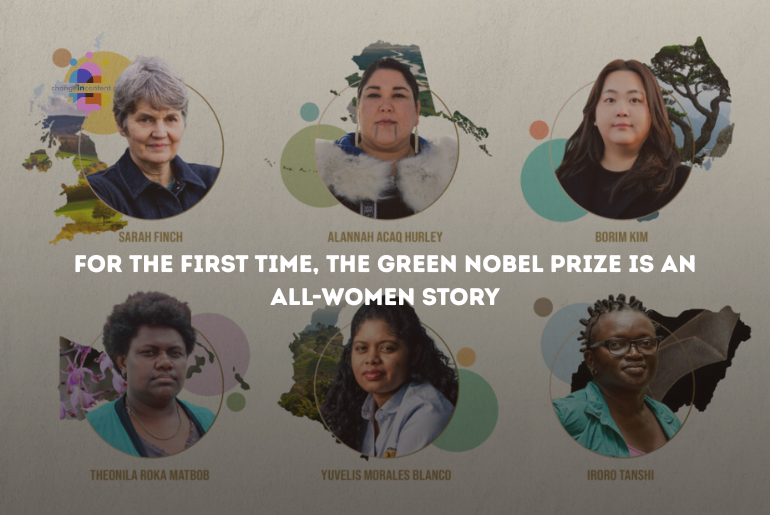
The 2026 Green Nobel Prize winners have made history for reasons that go beyond individual achievement. For the first time since the Goldman Environmental Prize was founded in 1989, every winner across its six regions is a woman. That makes this year’s cohort notable not only as a milestone for representation but also as a corrective to how environmental leadership is often imagined. Grassroots environmental defence has never been only male, even if public recognition has often made it look that way.
What makes this moment especially powerful is that these women are not being recognised for abstract climate rhetoric or symbolic advocacy. They are being honoured for highly local, difficult, and often risky work involving mining, oil drilling, wildfires, fracking, youth-led climate litigation, and Indigenous land protection.
In that sense, the 2026 Green Nobel Prize is not simply celebrating six women. It draws attention to the kind of environmental leadership that has too often been treated as peripheral, even as communities depend on it.
The Green Nobel Prize
Since its founding in 1989 by Richard and Rhoda Goldman, the prize has recognised 239 environmental leaders from 98 countries and awarded $33 million in prize funding. Of those winners, 112 have been women.
The work it honours often centres on climate justice, protecting biodiversity, defending Indigenous rights, and resisting projects that harm the environment. The prize looks at grassroots leaders as people who work closely with their own communities, where change grows through local action and collective effort.
While we continue to fight uphill to protect the environment and implement lifesaving climate policies, in the U.S. and globally, it is clear that true leaders can be found all around us.
John Goldman, vice president of the Goldman Environmental Foundation, said. He continued:
I am especially thrilled to honour our first-ever cohort of six women, as this is a powerful reflection of the absolutely central role that women play in the environmental community globally.
Meet the 6 women who won the 2026 Goldman Environmental Prize
The first all-women cohort of winners hail from Colombia, Nigeria, Papua New Guinea, South Korea, the UK and the US.
Iroro Tanshi – Nigeria
After finding the endangered short-tailed roundleaf bat again in Nigeria, Iroro Tanshi traced the biggest threat to human-caused wildfires. She then worked with local communities to protect the Afi Mountain Wildlife Sanctuary.
From early 2022 to May 2025, she helped set up community fire brigades that kept watch across thousands of farms and stepped in quickly whenever fires broke out. They responded to more than 70 outbreaks and stopped each one before it could spread.
Through her Zero Wildfire Campaign, Iroro and her team have kept the 24,700-acre sanctuary safe from major fires, protecting one of the last strongholds of the bat. At the same time, this work has helped secure crops and livelihoods for about 27,000 people living in 16 nearby communities.
Borim Kim – South Korea
Activist Borim Kim and her group, Youth 4 Climate Action, took the South Korean government to court and won the first youth-led climate case in Asia.
In August 2024, the Constitutional Court ruled that the country’s climate policy failed to protect the rights of future generations. The court ordered the government to set binding targets to cut emissions from 2031 to 2049, ensuring it can meet its net-zero goal by 2050. The decision marks an important moment for climate action in the region.
If the government follows through, these steps could prevent more than 1,500 million tons of carbon emissions over the next 25 years, an amount equivalent to the annual output of about 500 coal-fired power plants.
Sarah Finch – United Kingdom
Sarah Finch and the Weald Action Group spent years pushing back against oil drilling in southeast England. They kept going through long court fights over a project in Surrey and did not back down even as the case dragged on.
In June 2024, the UK Supreme Court ruled in their favour, bringing the project to a halt. The decision, now known as the Finch ruling, says officials must consider how fossil fuels will affect the climate after extraction before approving such projects. Since then, this has helped stop other oil and industrial plans in the UK and could influence policy in the EU as well.
She was named one of Time’s 100 Most Influential Climate Leaders in 2024 and received the Sheila McKechnie Foundation National Campaigner Award in 2025.
As Sarah notes:
When you have a chocolate cake, it is not the making of the cake but the eating of it that affects your waistline.” When it comes to oil, “the burning of it is far more harmful to the climate than getting it out of the ground.
Theonila Roka Matbob – Papua New Guinea
Theonila Roka Matbob led a campaign that pressured Rio Tinto, one of the world’s largest mining companies, to address the damage associated with the Panguna mine. The company had left the site decades ago after unrest, but the harm to land and communities remained.
In September 2020, Theonila stepped forward as the lead complainant in a major human rights case, supported by the Human Rights Law Centre and backed by 155 other Bougainville community members. The complaint drew global attention and accused Rio Tinto of serious environmental and human rights violations. That includes toxic waste that polluted water, damaged land and sacred sites, and put people’s health and livelihoods at risk.
After years of pressure, the company signed an agreement in November 2024 to address these impacts. It has now acknowledged the scale of the damage and begun working with local groups on cleanup efforts and long-term repair plans.
Alannah Acaq Hurley – United States
Yup’ik leader Alannah Acaq Hurley took up the fight on behalf of 15 tribal nations to stop the proposed Pebble Mine in Alaska’s Bristol Bay. As executive director of the United Tribes of Bristol Bay, she worked with a broad coalition and for years pushed back against the copper and gold project.
In January 2023, their efforts led to a rare EPA veto that blocked the mine. The decision protects Bristol Bay and its wider watershed, which spans about 25 million acres of rivers, wetlands, and wilderness, and supports the world’s largest wild salmon runs. Alannah and her team continue to guard the region as new threats keep coming.
For Alannah, this work connects closely to her Yup’ik way of life, where land and water hold deep meaning. She continues to practice the Yup’ik traditions of hunting, fishing, and gathering in her ancestral homelands, while staying active in efforts to stop the threat of mining and other forms of development to her people’s sacred lands and waters.
Yuvelis Morales Blanco – Colombia
As a young activist, Yuvelis Morales Blanco brought people in Puerto Wilches together to push back against two major drilling projects. She helped build local resistance that kept commercial fracking out of Colombia. By 2022, the issue had reached the national stage, and Ecopetrol paused its pilot fracking contracts. The projects remain on hold.
In August 2024, the Colombian Constitutional Court ruled that these plans had violated the rights of the Afro-Colombian community in Puerto Wilches because they were implemented without proper consent.
Women at the frontlines of the climate crisis and environmental protection
Women have long stood at the centre of efforts to protect land, water, and everyday life. In many communities, they manage food, water, and fuel, so when droughts, floods, or heatwaves hit, they bear the brunt of the impacts first. This everyday link with nature often pushes them to speak up and organise when their surroundings come under threat. What may look like a distant climate issue to others shows up as a direct problem in their homes and routines.
At the same time, the crisis affects them more harshly. UN Women points out that climate change does not impact everyone in the same way. Research shows women face higher risks to their health because of changing climate conditions, and during disasters, they are far more likely to lose their lives.
Even with these challenges, women continue to organise, share knowledge, and support each other. They lead local protests, protect forests and water sources, and build ways for their communities to cope with change. Their work often begins at a small, local level, but it shapes how communities survive and respond in the long run.
Read next: Women in the Green Economy: India’s climate future cannot run on missing women.
Conclusion: The Green Nobel Prize has finally caught up with the reality women have lived for years
Women have always carried much of this work, often quietly and without recognition. What stands out in these stories is not just the scale of impact, but the way it begins. It starts with people noticing changes in their own surroundings, speaking up, and bringing others together. It takes years of effort, repeated pushback, and a willingness to keep going even when nothing seems to move.
The 2026 Goldman Environmental Prize is a reminder that women have been leading many environmental campaigns at the local level for years, even if their work has not received much attention. In many communities, they organise people, protect natural resources, and stand up to projects that threaten their land and livelihoods. Yet, because they often work outside formal power structures or large institutions, their efforts remain less visible.
Recognition like this brings their work into focus, but it also points to how much has gone unnoticed for a long time.
Disclaimer: The views expressed in this article are based on the writer’s insights, supported by data and resources available both online and offline, as applicable. Changeincontent.com is committed to promoting inclusivity across all forms of content. We broadly define inclusivity in terms of media, policies, law, and history. It encompasses all elements that influence the lives of women and marginalised individuals. Our goal is to promote understanding and advocate for comprehensive inclusivity.