
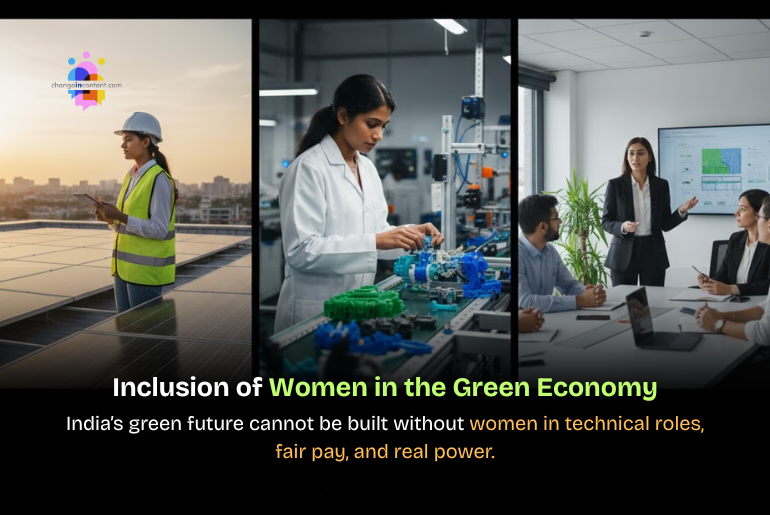
If you want a realistic picture of India’s climate transition, do not start with solar panels and net-zero targets. Start with who gets hired, who gets trained, who gets promoted, and who gets paid. The idea of having more women in the green economy is not just a “nice-to-have” idea. In reality, it is the difference between a green economy that expands opportunity and one that quietly widens inequality.
A recent report by the Council on Energy, Environment and Water (CEEW), Building a Green Economy for Viksit Bharat: New Opportunities for Jobs, Growth and Sustainability in India, flags a truth. Usually, in India, we keep postponing it. The truth is that women’s participation is proportional to productivity, growth, and resilience. Still, women remain structurally underrepresented in the workforce and boxed into the least powerful roles. The CEEW-backed data shows where women are present, where they are blocked, and what must change now.
This article draws from the chapter extract, “The inclusion of women in India’s green economy.” It explains what the data is really saying, why this pattern persists, and how employers and policymakers can stop calling it a pipeline problem and start fixing it like an infrastructure problem.
Why “Women in the Green Economy” is a growth question (not a charity question)
CEEW’s framing is blunt and useful. It says that women’s work is not an add-on to India’s development story. Instead, it is a growth constraint when we exclude women and a growth multiplier when we include women.
We already know the headline logic. Higher female participation correlates with more substantial economic returns. More diverse teams tend to be more productive. But the green economy raises the stakes. This transition will create new jobs, reshape old ones, and move labour across sectors and geographies.
If women enter late, enter informally, or enter only in “support roles”, they will inherit the lowest wages. At the same time, they will inherit the highest risk and the least bargaining power, while men inherit the ladders.
Let us not consider it as a climate transition. That is a rearrangement of privilege.
Women in the Green Economy: The two realities India is living in at once
When it comes to inclusion in India’s green economy, we are living in two realities.
Reality 1: India needs women’s labour to hit its ambitions
Most experts position the green economy as a jobs-and-growth engine for a “Viksit Bharat”. CEEW’s report places the green transition inside a bigger national employment and productivity story.
The uncomfortable part is that you cannot build a high-growth India with women sitting on the margins of work. A green economy that depends on new supply chains, decentralised energy, circularity, and better public systems cannot afford to exclude half the talent pool.
Reality 2: Women are present, but often in the least paid, least protected end of the chain
The chapter extract makes a recurring point across sectors. It shows that women’s participation is often stuck in administrative, informal, low-paid, or early-stage roles. In contrast, men dominate technical work, site work, aggregation, processing, and decision-making.
It would not be correct to consider it a lack of ambition on the part of women. It is about access to safety, mobility, networks, training, tools, and respectful workplaces. When those conditions are missing, “choice” becomes a polite word for constraint.
The energy transition sector: Women are entering, but not where the power sits
Globally, renewable energy employs a higher share of women than oil and gas, but women remain concentrated in non-technical roles. Reuters, citing IRENA, notes that women make up about 32% of the renewable energy workforce, versus 22% in oil and gas. At the same time, women are far more present in administrative roles than in science and engineering roles.
What the CEEW report shows
CEEW’s extract shows the same pattern in India’s clean energy ecosystem:
Women are more visible in office-based work such as business development, design coordination, documentation, and administration. They are far less visible in on-site phases such as construction, commissioning, operations, and maintenance.
The reasons are not mysterious. Remote locations, poor site infrastructure, weak safety systems, and workplace cultures that treat women as “exceptions” rather than core staff keep women away from the phases of work that build technical credibility and faster career progression.
The ‘Extra cost’ barrier
There is also a quieter barrier that employers rarely admit publicly. Many firms treat inclusion as an “extra cost”, especially when investors push for tight returns. The result is predictable. Budgets appear for machinery, logistics, and growth marketing. However, budgets disappear when the conversation shifts to safe accommodation at sites, secure transport, women-friendly sanitation, or robust anti-harassment systems.
Let us not call it a budget issue. That is a priority issue.
Why India’s data gap is not neutral
One of the most under-discussed problems in the extract is India’s missing, disaggregated data on women’s participation in renewables and allied green sectors. When categories do not exist in official classifications, undercounting becomes institutional. Women’s work disappears, and so does the pressure to build policies around it.
A country that cannot measure women’s position in the green economy cannot design fair skilling pipelines, cannot benchmark employers, and cannot even argue convincingly that the transition is inclusive.
Data is not just numbers here. It is visibility.
The circular economy: Women do the dirtiest work, then get paid the least
If clean energy shows women locked out of technical power, the circular economy shows women trapped in informal labour.
The extract describes women clustered in the earliest stage of the value chain: collection, picking, sorting, and segregation. These are the jobs that are the most physically punishing, the most unsafe, and the least protected. It is also where caste and gender often collide, because many women waste-pickers come from historically marginalised communities.
Even when women enter processing and recycling facilities, the work is often daily-wage and informal. At the same time, it is outside the protection of labour regulations. The clear pattern is that women are present where risk is highest and bargaining power is lowest.
There is also the equipment gap. In several value chains, men have access to better tools and transport, while women are left with sacks and manual carrying. That is not a small operational detail. Instead, that is the difference between earning more, covering more area, working fewer hours, and staying healthier.
This is what exclusion looks like when it is operationalised.
The barriers are structural, not personal
Across energy transition and circular economy value chains, the extract keeps returning to a set of barriers that show up in nearly every Indian workplace conversation about women:
- Safety and security, especially at remote sites and in late-night or early-morning work cycles.
- Mobility restrictions, both social and infrastructural, especially in roles that require travel.
- Workplace cultures that treat women’s needs as “special requests” rather than standard infrastructure.
- Childcare and care burdens that employers pretend are private problems.
- Weak HR systems that stop at legal compliance instead of building genuinely supportive environments.
A useful way to read this: if women’s participation is low in “high-growth green work”, the answer is not “women are not applying.” The answer is “the system is designed to make women drop out before they can even compete fairly.”
What must change: A practical inclusion blueprint for employers
If you are an employer in renewables, manufacturing, waste management, recycling, electric mobility, climate-tech, ESG, or any adjacent sector, you should know an uncomfortable truth. Remember, you cannot claim “green impact” while reproducing old inequities.
First, treat safety as core infrastructure, not a policy paragraph
Do not outsource safety to women’s courage. Build it into budgets and operations.
Site audits for lighting, sanitation, transport, secure accommodation, and emergency response protocols should be as routine as equipment checks. If a site is unsafe for women, it is unsafe, full stop.
Second, redesign roles so women can enter technical pathways early
Stop waiting for “senior women” to appear magically. Create apprenticeship and trainee pathways that move women through technical exposure: site rotations, shadowing, and certifications that translate into promotions.
Third, build childcare and flexibility into workforce planning
Not as a perk. As a retention strategy. A green economy needs stable talent. Stable talent needs predictable systems of care support.
Fourth, stop hiring women into only “support roles” and calling it progress
Track the distribution of women across job families: engineering, operations, fieldwork, compliance, leadership, procurement, and business roles. If you concentrate women in admin, you have not built inclusion. You have built a gendered clerical layer.
Fifth, pay equity is not optional in a sector that calls itself “future-facing”
Green jobs cannot come with old pay gaps. Do pay audits, publish ranges internally, and link leadership performance to closing gaps.
The changeincontent perspective
At changeincontent, we track inclusion where it actually lives: in policies, pay, promotions, language, and day-to-day power. We do not believe the green economy is automatically inclusive because it is new. New sectors can quickly inherit old biases.
If you are building a green workforce, this is where we can help without turning it into performative inclusion:
- We can run policy audits for safety, mobility support, and anti-harassment systems.
- We can help you design practical inclusion frameworks for remote sites and decentralised operations.
- We can support pay equity and role distribution audits to make inclusion measurable, not just rhetorical.
- We can conduct leadership and manager workshops focused on bias, sponsorship, and fair performance systems, especially in technical and field-heavy organisations.
Because a green economy that excludes women is not a transition. Instead, it is a missed future.
The final thoughts
The inclusion of women in the green economy is the kind of topic India likes to praise in panel discussions and postpone in budgets. But the data no longer allows that luxury.
The green economy will grow. The question is whether it will grow into a more equal India or a more efficient version of the same inequality.
Women are not asking to be included as a symbol. They are asking to be included as workers, leaders, technicians, decision-makers, and owners of economic value. If India wants a truly “Viksit Bharat”, it cannot build it while leaving women behind in the very economy meant to represent the future.
Also Read: This Environment Day, let’s ask: Where are women in green jobs?
Disclaimer: The views expressed in this article are based on the writer’s insights, supported by data and resources available both online and offline, as applicable. Changeincontent.com is committed to promoting inclusivity across all forms of content. We broadly define inclusivity as media, policies, law, and history. It encompasses all elements that influence the lives of women and marginalised individuals. Our goal is to promote understanding and advocate for comprehensive inclusivity.
