
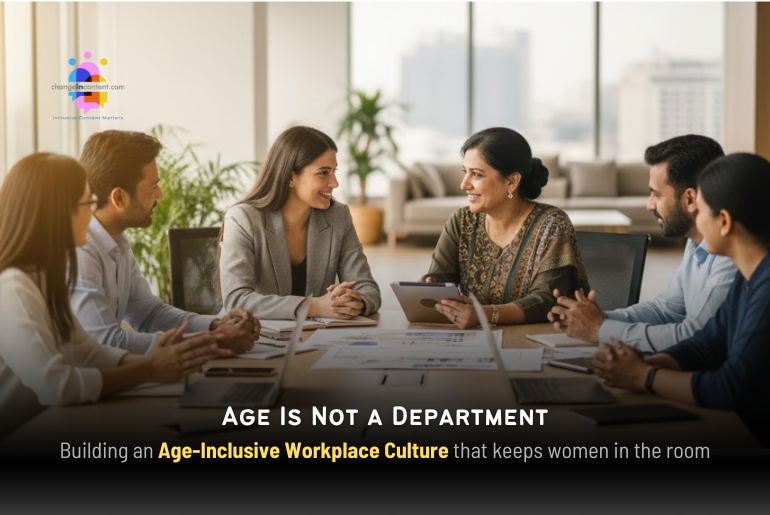
If your workplace has five generations under one roof, you already have generational diversity. The question is whether you have an age-inclusive workplace culture or a polite hierarchy in which the workplace takes some ages seriously and tolerates others.
Ageism does not announce itself with a policy. It shows up as who gets stretch projects and who gets time with leadership. At the same time, it shows up who is “high potential,” and who gets the quiet advice to “keep up”. For women, it is sharper. The penalty for ageing arrives earlier, louder, and with fewer second chances.
In India, we tend to speak about inclusion through the familiar frames of gender, caste, disability, and class. We should. But age sits in the room like an uninvited guest. Everyone can see it. Few name it. And because we do not name it, we keep repeating the same corporate tragedy: brilliant people being filtered out not for capability, but for date-of-birth assumptions.
What “Generational Equity” actually means
Generational equity is the practice of treating employees across age groups as equally “investable”. Not equal in life stage, not equal in needs, not equal in experience, but equal in access to dignity, learning, pay fairness, visibility, and mobility.
A good age-inclusive workplace culture does not romanticise experience or worship youth. It builds systems that do not dismiss a 24-year-old as “too green” and do not treat a 44-year-old like a “legacy cost”. It also accepts that you cannot build a future-ready company while quietly devaluing people the moment they become expensive, outspoken, or harder to stereotype.
The real roots of ‘Age Bias’
Age bias is rarely one villain. It is a bundle of lazy shortcuts that feel “practical” until they become costly.
Stereotypes
Most organisations assume older employees to be less adaptable. They consider the younger employees to be less serious. Both assumptions are convenient. Both are wrong.
Speed culture
Many workplaces treat fast responses, long hours, and constant availability as proof of ambition. That design often punishes people with care responsibilities. In India, that punishment disproportionately lands on women, especially mothers, daughters caring for parents, and women managing invisible domestic labour.
Technology panic
When organisations adopt new tools, they often confuse familiarity with competence. Technology is learnable. Bias is not, unless we do not confront it.
Unspoken economics
When cost-cutting begins, older employees become a spreadsheet problem instead of a human asset. Women then face a double bind: they are already underpaid over the long run, and later they are treated as “too costly” when they finally reach earning power.
The World Health Organisation has warned that ageism harms health, well-being, and human rights. It also says that ageism is embedded in institutions, not only in attitudes.
How ageism shows up in day-to-day work
Most ageism is not a dramatic HR case. It is an everyday design.
Job descriptions that flirt with coded language like “high-energy”, “digital native”, “young team”, or “freshers preferred”. Managers who assume a younger woman is “not ready” to lead and an older woman is “not hungry” to grow. Performance feedback that praises “maturity” in men but calls women “difficult” when they sound certain.
It also shows up in training budgets. When organisations offer learning opportunities only to “rising talent”, organisations create a self-fulfilling prophecy. The same people rise because the system only funds their rise.
And it shows up in visibility. The moment someone is not invited to a crucial meeting, they stop being part of the story. Over time, that absence gets justified as “they are not in the loop anymore”.
Why do women pay a steeper price for age bias?
Men often age into authority. Women often age into invisibility.
A woman’s competence is questioned early, then taxed heavily during caregiving years, and later questioned again through the lens of age. By mid-career, many women are doing two jobs: the one they are paid for, and the one that keeps everything else running. When workplaces penalise flexible work or treat caregiving as a lack of ambition, they create a pipeline leak that no leadership programme can fix.
Later, age bias intersects with other realities women face, but workplaces rarely plan for. These realities include menopause, chronic health issues, safety concerns, and the social expectation that women remain the default carers. In a genuinely age-inclusive workplace culture, these are not “personal issues”. They are workforce realities.
If you want a deeper lens on how ageism hits women in particular, especially Gen Z, Millennial women, and the pipeline impact, you can read through two of our previously published stories.
Ageism, women and how to get back to work after a hiatus.
The ageism impact: How it affects Gen Z and Millennial women more.
Building an age-inclusive workplace culture
Sometimes doing something beyond the stigma can seem challenging. However, building an age-inclusive workplace culture is not as complex. Here is how organisations can do it.
1. Start with an “age audit” that goes beyond headcount
Count age diversity across levels, functions, pay bands, and high-visibility roles. The headline number will always look acceptable if you only measure overall distribution. The truth sits in promotions, key projects, and leadership pipelines.
2. Fix hiring language and screening habits
Remove coded age signals from job descriptions. Move from “culture fit” to capability and outcomes. Use structured interviews. Track where candidates drop off and why.
3. Make learning non-negotiable at every age
A future-ready organisation treats learning as an operating system. Provide equal access to certifications, cross-functional gigs, and leadership skills. If your mid-career and late-career employees are not learning, your organisation is not learning.
4. Build cross-generational collaboration that is not performative
Mentorship is useful, but do not trap it in the old format where seniors teach, and juniors listen. Create two-way mentorship: younger employees bring emerging tools and market intuition, older employees bring judgement, stakeholder management, and strategic depth. The point is not bonding. The point is better decisions.
5. Redesign flexibility so it does not punish women
Flexibility must be outcome-based, not stigma-based. If remote or flexible workers quietly miss out on promotions, women pay the price. That is because women use flexibility more often due to the care load. Flexibility without promotion fairness is not a benefit. It is a trap.
6. Train managers, like it actually matters
One good manager can retain a high-performing employee for years. One biased manager can erase them in a matter of months. Train managers to spot age-coded assumptions, distribute opportunities fairly, and give feedback that is free of stereotypes.
7. Create “second-curve” roles, not exits
Many employees do not want to climb forever. Some want to pivot, specialise, consult, teach, or lead a project portfolio. Build pathways for lateral growth and second-curve careers. That is where women who took career breaks often re-enter with enormous value. You must stop treating their break as a gap and start treating it as context.
Age-inclusive workplace culture: What ‘Good’ looks like
A workplace with a strong age-inclusive workplace culture is easy to recognise. People stop whispering about age. Teams stop treating someone’s life stage as a limitation. Promotions start correlating with outcomes, not optics. And women do not have to choose between being respected and being “likeable”.
It would be totally inappropriate to consider this as idealism. It is an operational strength. The Lancet has highlighted how ageism carries serious societal and economic costs, including burdens that show up in health systems and institutions.
The final thoughts
Let us not mistake age inclusion as just about celebrating birthdays at work. It is about building a company that does not waste talent. When age bias is left unchecked, organisations lose institutional memory, weaken mentorship pipelines, and force women to rebuild credibility again and again across life stages.
The smartest companies in 2026 will not only ask, “How do we attract talent?” They will ask, “How do we stop excluding talent in ways we have normalised?” An age-inclusive workplace culture is one of the cleanest answers to that question.
Disclaimer: The views expressed in this article are based on the writer’s insights, supported by data and resources available both online and offline, as applicable. Changeincontent.com is committed to promoting inclusivity across all forms of content. We broadly define inclusivity as media, policies, law, and history. It encompasses all elements that influence the lives of women and marginalised individuals. Our goal is to promote understanding and advocate for comprehensive inclusivity.
