
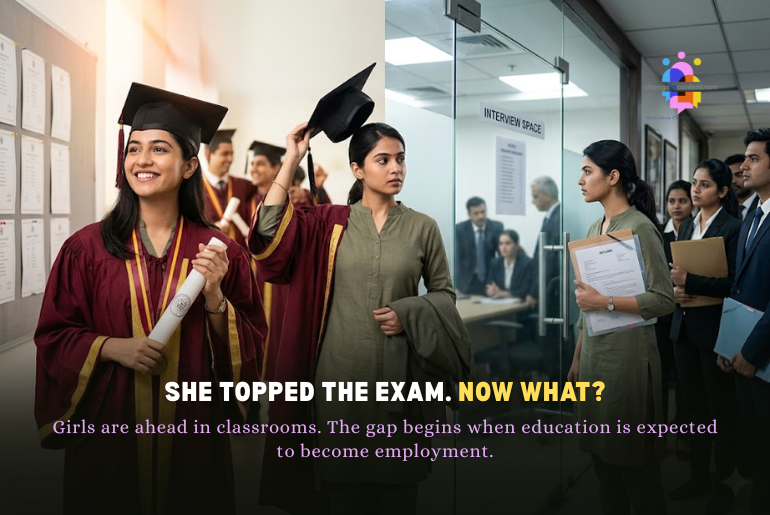
Every year, the country watches the same pattern with admiration. Girls top board exams; girls outperform in school; girls collect degrees, gold medals, and scholarships. Newspapers run their photos. Families celebrate them as proof that things are changing. And in many ways, they are. The latest official data confirms that girls are not only catching up in classrooms. In many parts of the education system, they are already ahead. That is what makes the education-to-employment gap for women such a difficult reality to ignore. The problem is no longer whether girls are studying. It is what happens after all that studying is done.
Because once the classroom ends, the story changes tone.
- Degrees do not guarantee stable work.
- Merit does not guarantee safety, pay, or progression.
- And educational success does not automatically dismantle the structures that continue to push women into precarious jobs, career breaks, lower-paying roles, or unpaid labour.
That is why it is not a simple education story. It is a story about what India does with the talent of its girls once they become women.
Literacy rate in India: A brief on the numbers
Female literacy remains one of the strongest indicators of women’s empowerment, but it is no longer the only story India needs to pay attention to.
According to the Periodic Labour Force Survey, 74.6% of women aged 7 and above are literate, compared with 87.2% of men. It indicates that historical exclusion has not fully disappeared. But within younger cohorts and current enrolment trends, the picture is changing much faster.
The latest data from the National Statistical Office points to an important shift in education. Across India, girls now outnumber boys at multiple stages of education, from school enrolment to higher studies.
Girls are outpacing boys in education, and the numbers are no longer small
Girls continue to record higher participation in higher education across India. According to 2025 data from the National Statistical Office, the Gross Enrolment Ratio (GER) for girls rose from 28.5% to 30.2%, while the GER for boys increased from 28.3% to 28.9%.
For consecutive years, female enrolment has remained higher than male enrolment, showing that more young women are entering colleges and universities. Overall, enrolment in higher education has also increased over time.
The female gross enrolment ratio exceeds the male GER across all school stages, and women account for 51.48% of total higher education pass-outs, even as the overall gender literacy gap remains at 14.4 percentage points. [TOI]
Girls are not just enrolling more. They are also performing strongly.
Girls are also moving ahead in academic performance across multiple stages of education.
- In Grade 3, girls scored around 65 in language, compared to 63 for boys.
- In mathematics, both girls and boys scored nearly the same, at around 60. This difference remains small but consistent in higher grades.
- At the university level, girls now make up more than half of all graduates and account for 76% of M.Phil pass-outs. It highlights their growing presence across academic milestones.
Where the education-to-employment gap for women becomes impossible to ignore
Even as girls and women show higher participation in education, this does not fully carry over into the labour market. Earning degrees does not automatically lead to equal access to high-skill, high-paying careers. For example, women now account for 43% of STEM graduates in India, meaning nearly half of the country’s science, technology, engineering, and mathematics talent is female. Yet fewer than 20% make it into core technology roles such as software engineering, product development, data science, or technical research.
Many educated women remain in vulnerable jobs. In 2025, 78.2% of working women in India remained in vulnerable employment, compared to 69% of men. Vulnerable employment often includes self-employment without income security, unpaid family work, informal labour, or jobs without contracts, insurance, pensions, or other social protection. It creates a difficult paradox: more women now complete school, college, and even technical education, but a large share still enter work that offers limited financial security or long-term career mobility.
Until education is more directly linked to quality jobs, leadership opportunities, and safer workplaces, higher enrolment alone will not close India’s gender gap in employment. The true measure of women’s empowerment is not only how many girls enter school, but how many women can turn education into financial independence, influence, and economic power.
The Changeincontent perspective
The most uncomfortable truth in this story is that India no longer has the excuse of saying girls are not studying enough. They are. They are enrolling, completing, graduating, and in many cases outperforming.
The Education-to-Employment Gap for Women persists not because women lack aspiration or qualifications, but because the labour market continues to convert male education into opportunity more efficiently than female education. That is a structural failure, not a personal one. (PIB, World Bank Data)
What happens after graduation is now the real gender test. If women’s degrees do not lead to secure work, career mobility, leadership tracks, and financial independence, then education alone cannot be treated as the final proof of empowerment. India has done important work in getting girls into classrooms. The next question is whether workplaces, industries, and public systems are prepared to meet them with the same seriousness.
That also connects to what we explored in our earlier piece on surviving unemployment as a woman in 2026, where the issue was not only whether women wanted work, but how often the labour market failed to hold them once education was over.
Conclusion: The education-to-employment gap for women begins where the classroom success story ends
India is producing one of its most educated generations of young women, but the labour market still fails to absorb that talent at the same pace. But education alone cannot deliver empowerment if workplaces continue to shut women out of stable jobs, leadership tracks, and high-growth sectors. What happens after graduation? That is where India’s gender progress begins to slow down.
Disclaimer: The views expressed in this article are based on the writer’s insights, supported by data and resources available both online and offline, as applicable. Changeincontent.com is committed to promoting inclusivity across all forms of content. We broadly define inclusivity in terms of media, policies, law, and history. It encompasses all elements that influence the lives of women and marginalised individuals. Our goal is to promote understanding and advocate for comprehensive inclusivity.
