
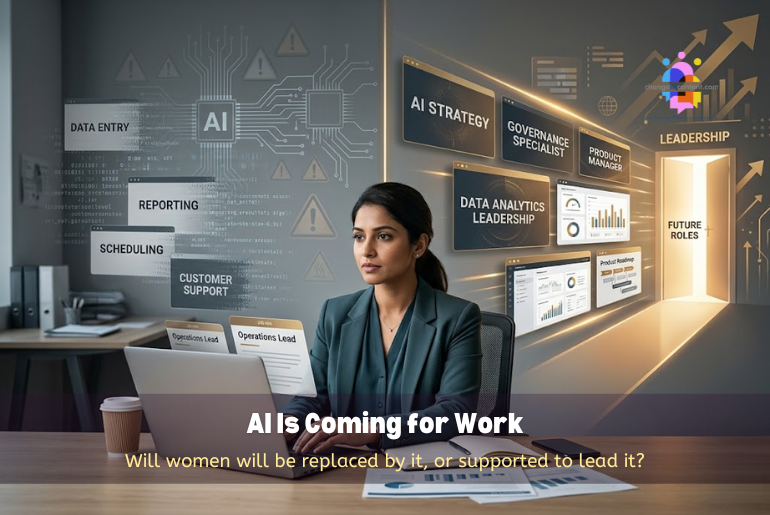
A woman working in a back-office role may not think of herself as being part of the artificial intelligence debate. She may spend her day preparing reports, scheduling meetings, updating customer records, processing invoices, answering queries, managing documentation, reviewing applications or coordinating between teams. Her work looks ordinary. It is also exactly the kind of structured, repeatable, information-heavy work that AI tools are learning to handle faster. That is where the ‘AI and employment risk for women’ discussion becomes more than a technology story.
The story of AI posing a bigger threat to women’s employment becomes a story about how work has historically been divided by gender. Organisations often concentrate women in roles that keep companies running. However, they do not always offer visibility, sponsorship, or rapid career mobility. Now, as AI enters those same roles, the question is not only whether jobs will disappear. The question is whether we will train, move, promote, and protect women before the disruption hits them.
AI and employment risk for women: An overview
The debate has been ongoing for a long time. However, recent reports make the warning hard to ignore. A study by the US-based National Partnership for Women & Families found that while women make up about 47% of the US workforce, they account for 83% of workers in the 15 occupations considered most vulnerable to AI. At the same time, the same findings note that many of these jobs involve office, clerical, and administrative work, in which women are heavily represented.
But there is another side to the story. A 2026 ANSR and Talent500 report found that nearly 90% women would consider transitioning into AI-focused roles if they had the right organisational support. The figure is even higher for Indian women, at around 95%.
So the real headline is not that women are afraid of AI. The real headline is that women are ready, but systems are not.
What do recent studies say about AI and employment risk for women?
The studies point to a clear pattern. AI does not affect all workers equally. Its impact depends on the tasks people perform, the control they have over their work, whether their roles are visible to leadership, and whether they receive reskilling support.
The National Partnership for Women & Families analysis focuses on the US workforce.
The report says that women make up the majority in the occupations most exposed to AI disruption. Women’s concentration in clerical and administrative jobs makes them more immediately vulnerable because these roles involve tasks that current AI tools can increasingly perform. These tasks involve documentation, scheduling, basic analysis, customer support, and office coordination.
The International Labour Organisation’s findings
The ILO warns that generative AI exposure is gendered because clerical work is an important source of female employment. The larger impact of generative AI is likely to be job augmentation rather than full automation. Still, ILO notes that clerical occupations face high exposure and that this has gendered consequences.
What these numbers mean for India
For India, the warning is especially relevant. The Economic Times reported on Avtar Career Creators’ research, which said AI could disproportionately undermine Indian women’s workforce participation. That is because women are concentrated in automatable service roles, and around 80% are into informal work. The report also pointed to India’s large female workforce in business process outsourcing, where many jobs are highly automatable.
That means AI risk is not only about coding jobs or technology companies. It is about office work, customer support, finance operations, HR coordination, data processing, admin roles, content moderation, compliance support, education support, healthcare administration and many other roles where women work in large numbers.
The risk is not just job loss. It is job shrinkage.
When we discuss AI, we often imagine one dramatic moment: a worker loses her job and software replaces her. But the more common risk may be quieter.
A woman’s role may not disappear. It may shrink.
- AI may automate some parts of her work.
- Her team may become smaller.
- Her targets may increase.
- Her manager may expect the same employee to do more with AI tools, but without salary growth, training or title change.
AI disruption in daily work life
Here is how AI disruption may look in everyday work.
- A customer support executive may now handle twice the number of queries because AI drafts the first response.
- The system may expect an HR coordinator to screen more applications because AI shortlists profiles.
- Organisations may ask a content writer to produce more drafts because AI “does the first cut”.
- Some may expect a finance executive to reconcile more data because automation cleans the sheets.
- An office administrator may find that calendar management, travel planning and documentation are no longer valued as much as before.
The role remains; the respect reduces, and the pressure increases.
That is why organisations must not measure AI’s impact solely by layoffs. They must also measure role compression, increased workload, pay stagnation, surveillance, deskilling, and loss of bargaining power.
Why are women more exposed to AI disruption?
Women’s greater exposure is not due to their being less skilled. It is because many labour markets have historically placed women in roles that are easier for companies to classify as support work. These roles are essential but often undervalued.
Here is a list of some of these roles:
- Administrative work.
- Clerical work.
- Documentation.
- Coordination.
- Basic customer support.
- Data entry.
- Scheduling.
- Records management.
- Back-office operations.
- Process follow-ups.
- Transcription.
- Routine reporting.
Many of these roles involve language, structure, repetition and rules. That makes them more visible to automation.
Career pathways make it worse.
The risk becomes worse when these jobs have limited career pathways. Imagine a woman working for years in admin or operations. She never got any training in analytics, product operations, AI governance, automation management or business strategy. In that case, AI disruption does not just affect her current job; it also narrows her next move.
That is the real danger. AI may automate the tasks that companies hired women to do, while organisations fail to train them for the tasks AI will create.
AI and Employment Risk for Women: What it means for India
India cannot copy the US numbers directly. The labour market is different. India has a much larger informal workforce, sectoral structures, and levels of digital access, and a lower female labour force participation rate.
But the pattern offers a warning.
The warning for Indian women
Indian women are present in IT services, GCCs, business process outsourcing, customer service, HR, finance operations, banking support, edtech support, healthcare coordination, retail operations, education, content work, sales support, admin roles and informal service work. AI, automation and algorithmic management are already reshaping many of these jobs.
The risks
The risk is twofold.
- First, women in automatable roles may face job loss or reduced bargaining power.
- Second, women may be excluded from new AI-enabled roles if organisations assume AI work is only for engineers, data scientists or already-visible technology talent.
That second risk is huge.
AI work is not only model building. It includes AI product operations, data governance, risk review, prompt design, user research, AI ethics, compliance, process redesign, content quality, customer experience, AI training design, domain testing, safety review, project management, AI adoption, change management and business transformation.
That is why Changeincontent’s earlier article on women moderators of AI matters. We argued there that “working in AI” should not be reduced to hidden, traumatic, low-paid moderation or data labelling work. We must push women into the invisible bottom of the AI economy while men dominate strategy, leadership, product and ownership. You can read that piece here.
The hopeful finding: Women are willing to move into AI roles
The ANSR and Talent500 report changes the tone of this conversation. It shows that many women are not resisting AI. They want to participate in it.
The report shows that 9 in 10 women would consider transitioning into AI-focused roles with the right organisational support. 6 in 10 women give a definitive yes. The survey covered around 2,500 women professionals across IT, GCCs, startups and product companies in India. The survey report states that 64% of respondents said AI adoption had accelerated their path to senior roles. At the same time, 69% feel AI has opened new career pathways.
Reports show that around 95% of Indian women would consider transitioning into AI-focused roles with the right organisational support. Today, India produces 43% of the world’s female STEM graduates. Still, women hold only 29% of entry-level tech roles and 14% of C-suite seats.
That is the part organisations must hear clearly.
- The talent is not absent.
- The willingness is not absent.
- The ambition is not absent.
- The missing piece is structure.
What “organisational support” should actually mean
Companies cannot limit organisational support to sending one motivational email about AI. It must be practical, funded and measurable.
Identification
Companies must identify which roles are exposed to AI before they restructure them. If admin, support, operations, finance, HR, customer service or documentation roles are likely to change, workers in those roles must be informed and trained early.
AI training for all
Do not limit AI training only to technical teams. Women in non-technical roles also need AI literacy. That is because many new AI-enabled jobs will sit at the intersection of technology and business.
Create transition pathways
A customer support executive could move into AI customer experience quality.
An HR coordinator could move into AI hiring governance.
A finance operations employee could move into automation testing or risk review.
A content worker could move into AI editorial strategy, quality control or prompt operations.
Accountability
Companies must hold managers accountable for reskilling women, not only for cutting costs through AI.
Inclusion
Companies must ensure that AI projects include women from the start. They must not invite women only after the tools are built. Women must be part of problem definition, testing, governance, adoption, ethics and leadership.
Protect women from bias.
Companies must protect women from algorithmic bias. AI-based hiring, productivity scoring, attendance tracking, performance management and automated screening tools can reproduce gender bias if not audited.
The OECD warns that AI can improve productivity and working conditions. Still, it also creates risks such as automation, loss of agency, bias and discrimination, privacy breaches and lack of transparency. It also notes that training and worker consultation result in better outcomes for workers.
That is the model organisations should follow: train, consult, transition, protect.
Why women must not be pushed into the lowest-paid AI work
There is a dangerous myth that any AI-related job is automatically a good job. That is not true.
Many women, especially from lower-income or smaller-town backgrounds, may be hired for data labelling, content moderation, tagging, transcription, dataset cleaning, or reviewing harmful content. Some of this work is necessary. But it can also be low-paid, invisible, emotionally damaging and poorly protected.
There are various reports on Indian women working as content moderators who screen violent and abusive material to train AI systems. It often happens under stressful conditions and without adequate support.
That is why the AI transition must be careful. If women are displaced from clerical work and then pushed into hidden AI labour without career mobility, the system has not solved inequality. It has simply moved it.
Good AI jobs for women must include growth, safety, fair pay, recognition, governance roles, leadership pathways and mental health support where needed.
Employment in AI cannot mean only cleaning up the internet for machines.
What can women do now?
As organisations and leaders, we must not ask women to solve a structural problem alone. But waiting for organisations to act is also risky.
The first step is AI literacy.
Every woman professional should understand what generative AI can do, how it affects her role, and which parts of her work are likely to change.
The second step is to map tasks, not job titles.
Ask: which parts of my work are repetitive, rules-based, language-heavy, data-heavy or easy to standardise? Those are more likely to be automated or assisted by AI.
The third step is to build human-plus-AI skills.
These skills include judgment, domain knowledge, communication, empathy, client understanding, ethical reasoning, problem framing, quality review, project management and decision-making.
The fourth step is to learn AI tools relevant to your field.
- A woman in HR should learn about AI recruitment tools and the risks of bias.
- A finance professional should learn automation and analytics tools.
- A teacher should learn AI-assisted lesson planning.
- A content professional should learn AI editing, fact-checking and prompt strategy.
- A customer support executive should learn AI chatbot supervision and experience design.
The fifth step is to document impact.
Women should record how they use AI to improve productivity, reduce errors, improve service quality, save time or solve problems. That makes AI skills visible during appraisals and hiring.
The sixth step is to ask for training formally.
Women should ask managers what AI tools are being introduced, what training is available, what roles may change and what transition support exists.
The seventh step is to network around AI.
Communities, webinars, LinkedIn learning circles, internal tech sessions and peer groups can help women move faster.
The goal is not to become a coder overnight. The goal is to stop being a passive recipient of AI change.
What skills matter most for women in the AI transition?
Not all women need the same skill path. The right path depends on industry, role and career stage.
But these skill clusters matter across sectors:
- AI literacy: Understanding what AI is, what it can and cannot do, where it fails, and how to use it responsibly.
- Prompting and workflow design: Knowing how to get useful outputs from AI tools and integrate them into daily work.
- Data confidence: Reading dashboards, understanding basic data quality, spotting errors and asking better questions.
- AI governance: Understanding privacy, bias, consent, fairness, audit trails, transparency and ethical use.
- Domain-plus-AI expertise: Combining existing work knowledge with AI tools. For example, HR plus AI, finance plus AI, education plus AI, healthcare plus AI or law plus AI.
- Communication and review: Checking AI-generated work, improving it, explaining it and deciding when human judgment matters.
- Cyber and privacy awareness: Protecting confidential data and knowing what should not be shared with AI tools.
These are not futuristic skills. They are workplace skills now.
What must policymakers and skilling bodies do?
If AI disruption is gendered, then skilling policy must be gender-responsive.
India needs AI-skilling programmes that reach women outside elite technology jobs. Training must include women in administration, BPO, education, healthcare support, banking operations, informal services, small businesses and career-break returners.
India must design skilling around women’s realities. It must consider:
- Flexible timing.
- Low-cost access.
- Regional languages.
- Mobile-friendly learning.
- Childcare support where possible.
- Recognition of prior experience.
- Returnship links.
- Employer partnerships.
- Safe online learning spaces.
- Certificates connected to real hiring.
We cannot leave the AI transition to those who already have time, money and confidence. If that happens, AI will reward the already privileged and push vulnerable women further out.
The leadership question: Who gets to shape AI?
The article should not stop at job protection. It would not be right to position women only as workers at risk. We must position them as leaders who can shape AI adoption.
If AI systems decide who is hired, who is promoted, who gets credit, who is monitored, who is flagged as low-performing and who receives customer support, then women must be present in AI governance.
Women should be in rooms where companies decide:
- Which tools to buy?
- Which tasks to automate.
- Which workers to reskill?
- Which data to use?
- Which bias tests to run.
- Which roles to protect?
- Which productivity metrics are fair?
- Which customer problems should AI solve?
- Which human decisions should never be automated?
Without women in these decisions, AI may repeat the same workplace inequalities in a faster, less visible form.
Changeincontent Perspective: Women are ready for AI. Workplaces must prove they are ready for women.
AI and employment risk for women is not a story of fear. It is a story of timing.
At Changeincontent, we believe the next few years will determine whether AI widens the employment gap for women or helps close it. The answer will not come from technology alone. It will come from who gets trained, who gets consulted, who gets moved into new roles, who gets protected from bias and who gets access to AI leadership.
Women are already saying they are willing to transition into AI-focused roles if organisations support them. That should end the lazy excuse that women are not ready.
The question is whether companies are willing to invest in them before AI replaces them.
Because we should not build the future of work on women doing the vulnerable jobs of yesterday while men occupy the AI-powered roles of tomorrow.
If AI is coming for work, women must not only be protected from it. They must help lead it.
Methodology and editorial note
This article takes inspiration from the reporting and research coverage from the National Partnership for Women & Families, Inc., The Economic Times, ETHRWorld, India Today, The Irish Times, the International Labour Organisation, and the OECD. The US-focused data is used as an early warning sign, not as a direct prediction for India. India’s labour market has its own structure, including lower female labour force participation, a large informal workforce, strong IT and BPO sectors and uneven access to reskilling.
This article is an explanatory Knowledge Hub piece. It does not argue that AI will only destroy jobs. It argues that AI will reshape work unevenly, and women may face greater risk unless organisations, policymakers and women workers act early.
Sources Used
- National Partnership for Women & Families report on AI and emerging risks for women workers.
- Inc. coverage of the NPWF findings on AI-vulnerable occupations.
- Economic Times coverage of the ANSR and Talent500 report on women transitioning into AI-focused roles.
- ETHRWorld coverage of Indian women’s readiness for AI-focused roles.
- Economic Times coverage of Avtar Career Creators’ research on AI and Indian women’s workforce participation.
- ILO report on generative AI and jobs.
- OECD overview on AI and work.
