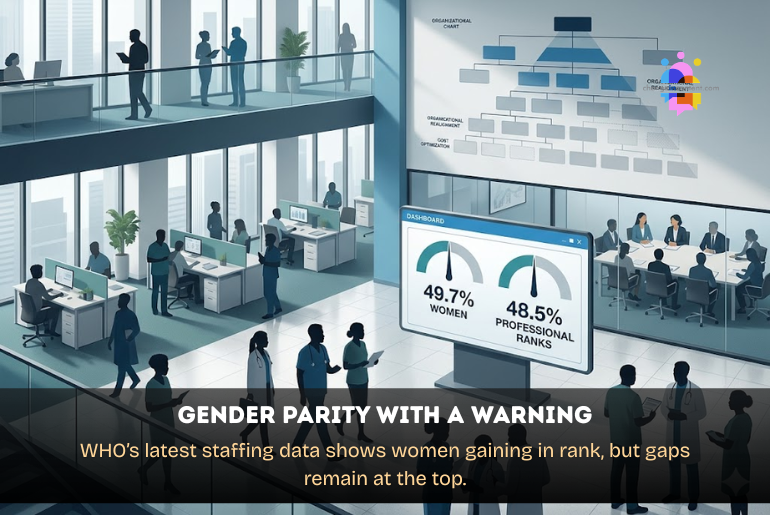
Gender parity at WHO has entered a complicated phase. At a time when the World Health Organisation is cutting staff and reshaping its workforce under severe financial pressure, women have lost a small share of overall representation but gained ground in some professional and leadership-linked categories.
According to the WHO’s latest human resources annual report for the 79th World Health Assembly, the organisation had 8,569 staff members as of the end of 2025. They have 49.7% women and 50.3% men. The report still describes this as gender parity. However, the number marks a dip from 2024, when women held a slight majority at 50.1%.
At the same time, the report records progress in the Professional and higher categories. Women’s representation in these categories increased from 47.9% in December 2024 to 48.5% in December 2025. WHO also reported notable gains at P3, P4, and P6/D1 levels, while acknowledging that the largest gaps remain at D2, where women account for only 24.5%, and P6/D1, where women account for 37.3%.
The result is a mixed picture. The WHO is closer to professional parity than before. But the top of the organisation remains far from equal.
WHO’s workforce is shrinking
The gender parity update comes in the middle of a major restructuring. WHO’s prioritisation and realignment process followed a reduction of the proposed 2026–2027 budget from US$5.3 billion to US$4.2 billion. That is a 21% cut from the original proposal. The Secretariat said the process was intended to align financial and human resources with the WHO’s core mandate.
The organisation’s regular staff count fell by 9.4%, from 9,463 at the end of 2024 to 8,569 by December 2025. WHO is moving towards a projected staff count of 7,283 by 30 June 2026. That is about 23% lower than the 9,401 staff employed on 1 January 2025.
The Guardian earlier reported that the WHO expected to lose 2,371 posts by June 2026. That is nearly a quarter of its workforce. It results from budget cuts linked to the United States’ withdrawal and other funding pressures. Experts warned that such cuts could weaken the WHO’s ability to support countries during outbreaks and health emergencies.
Why does it matter?
That matters because we cannot assess gender parity only as a percentage. In a shrinking organisation, percentages can improve even when absolute numbers fall. For women, the question is not only whether their share rises in a category. It is also whether enough roles, pathways, and senior opportunities remain.
The good news: Women are gaining in professional ranks
WHO’s human resources report does contain some positive signals. Female representation in Professional and higher categories rose to 48.5% by December 2025. It happened even as both male and female numbers declined. A larger number of male professionals are leaving the organisation during restructuring.
What does WHO say?
WHO says recruitment measures introduced in 2023 to improve women’s representation will remain in place until we achieve parity in grades where women face underrepresentation. These measures include reopening job openings if the applicant pool has less than 30% female representation or if shortlists do not include at least two women, according to Health Policy Watch’s summary of WHO policy.
The policy foundation is also clear.
WHO’s Gender Parity Policy 2023–2026 states that we must sustain overall gender parity across major offices. However, parity is also required at each professional level and across different categories of staff. The policy explicitly recognises that women face disproportionate underrepresentation in managerial and senior roles, especially at the country and regional levels.
That is why the latest gains matter. If women are moving upward in professional ranks, it suggests that recruitment and retention policies can work when they are specific and monitored.
The harder news: The glass ceiling remains
The same data also shows how far the World Health Organisation still has to go.
- The D2 level, one of the highest director-level bands, remains only 24.5% female.
- P6/D1 roles stand at 37.3% female.
We do not see them as marginal gaps. They show that women’s presence at the WHO still thins sharply at the highest levels of authority.
- The Western Pacific Region had 65.2% female representation overall
- Headquarters and global shared services follow it at 63.5%
- Europe is at 59.2%
In contrast, men remained the majority.
- In the South African Region, men accounted for 65.5% of staff.
- The Eastern Mediterranean Region has 59.2% men
- The South-East Asia Region has 57.4% men.
The leadership picture is equally uneven.
- The South-East Asia Region reportedly reached exact parity in heads of country offices, with women heading 50% roles.
- In the African Region, women head only 25.5% of country offices
- In the Eastern Mediterranean Region, the figure was 26.3%.
That is the story behind the headline. WHO may be near parity overall. But parity is not evenly distributed across levels, regions, or functions.
Why can overall parity hide internal inequality?
A headline number can look reassuring. But gender parity at an organisation as large and complex as WHO deserve careful examination.
One reason is job category. Health Policy Watch noted that female-majority offices can still be heavily shaped by women’s concentration in administrative and clerical roles. For example, women made up 79.5% of General Service staff at headquarters and 74.3% in the Western Pacific Region.
That matters because parity in total staff numbers does not automatically mean parity in power. An organisation can have many women in support roles and still have fewer women in senior decision-making roles. It can look balanced in aggregate while remaining unequal in authority.
It is a wider global problem. In Changeincontent’s previous analysis of The 2025 Gender Snapshot, we examined how global gender equality remains off track, even as some indicators show progress. You can read that article here: The 2025 Gender Snapshot on Gender Equality.
WHO’s internal staffing data reflects a similar lesson. Representation must be measured by where women are, not only how many women there are.
Gender parity at WHO: Why this matters for global health
WHO is not just another employer. It is the world’s leading global health agency. Its internal gender balance has symbolic and practical importance.
Women make up a large share of the global health and care workforce. Still, they remain underrepresented in many senior health leadership spaces. When global health institutions model gender-balanced leadership, they send a signal to governments, health systems, research bodies, and international agencies.
But if women are concentrated in lower or administrative categories while men dominate senior regional and director-level positions, the message becomes mixed.
Gender parity at WHO is therefore not only an HR milestone. It is part of the credibility of global health governance.
What comes next?
WHO’s latest report says the organisation will continue recruitment measures introduced in 2023 until gender parity is reached in underrepresented grades. Its Gender Parity Policy also places accountability on senior leadership. At the same time, it includes focus areas such as gender-sensitive recruitment, progression and development, an enabling environment, a workplace free of discrimination and harassment, and monitoring and evaluation.
The test now is whether these measures can survive a period of financial stress.
Staff cuts often reshape organisations for years. They decide who leaves, who stays, who rises, which functions are protected, and which pathways disappear. For women, the risk is that gains in professional representation may be celebrated while senior gaps remain unresolved.
The numbers show progress. They also show unfinished work.
The Changeincontent perspective
Gender parity at WHO shows why numbers need interpretation.
At Changeincontent, we believe near-equal representation in a workforce is important. But it is not the final test of equality. The real question is where women sit inside the organisation.
- Are they in administrative roles or decision-making roles?
- Are they entering the professional pipeline or shaping the top table?
- Are they present globally or clustered in a few regions?
WHO’s latest figures show both movement and limitation. Women are gaining slightly in professional ranks. That is encouraging. But the highest leadership levels and several regions still show clear gaps.
We cannot reduce parity to a headline percentage. It must be visible in power.
Methodology and editorial note
This news piece is based on WHO’s Human Resources Annual Report for the Seventy-ninth World Health Assembly, WHO workforce data as of 31 December 2025, WHO’s Gender Parity Policy 2023–2026, Health Policy Watch’s reporting on WHO gender parity and staff cuts, and The Guardian’s earlier coverage of WHO’s planned workforce reduction.
The analysis focuses on gender representation within the WHO’s workforce. It does not assess the technical impact of staff cuts on specific WHO programmes, nor does it evaluate individual hiring or separation decisions.
Sources Used
- WHO Human Resources Annual Report, Seventy-ninth World Health Assembly.
- WHO workforce data as of 31 December 2025.
- WHO Gender Parity Policy 2023–2026.
- Health Policy Watch report on WHO gender parity and staff cuts.
- The Guardian Report on WHO staff cuts.