
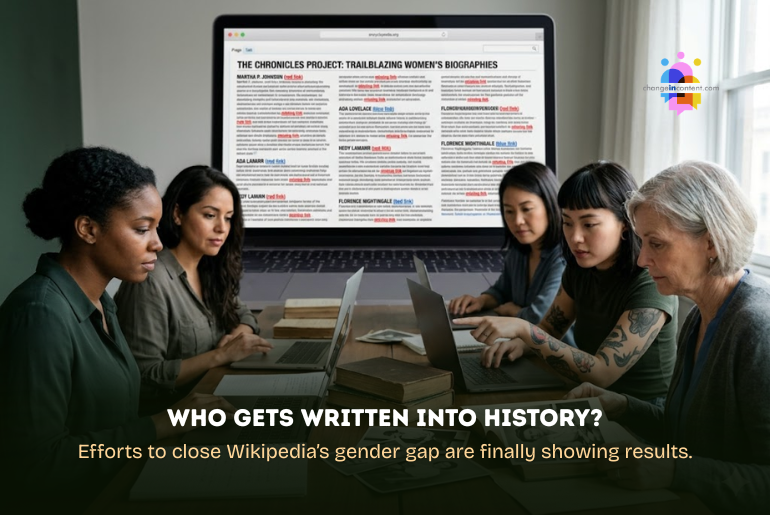
Wikipedia’s Gender Gap has long shaped what millions of people see, search, trust, and remember online. A widely cited academic article, First Women, Second Sex: Gender Bias in Wikipedia, found that only 15.5% of biographies on English Wikipedia were about women. At the same time, women made up roughly 16% of the contributor community. That means the world’s most-visited knowledge platform was missing not only women as subjects but also as the people writing and editing the record.
That gap matters because Wikipedia is not just another website. It is often the first place people go to understand a person, a profession, a discovery, a movement, or a moment in history. It is also one of the sources that shapes search visibility and the information ecosystem used by journalists, students, researchers, businesses, and now AI systems.
When women are missing from Wikipedia, they are not just missing from a page. They are missing from the way public memory is organised.
Key takeaway
Efforts to close Wikipedia’s gender gap are showing results, but the gap is far from closed. Projects such as Women in Red have helped add more than 200,000 biographies of women to English Wikipedia. That pushed women’s biography representation from around 15% to nearly 19.5%.
Recent research also suggests that among biology faculty at leading United States research universities, women are now more likely than men to have Wikipedia biographies. That is progress. But it also reminds us that representation changes only when people actively work to change it.
How WikiProjects are trying to close Wikipedia’s gender gap
An academic article titled First Women, Second Sex: Gender Bias in Wikipedia found that only 15.5% of biographies on the English version of Wikipedia were about women, while almost all the remaining biographies were about men. The paper also noted that women made up approximately 16% of Wikipedia’s contributor community. That means most of the platform’s content was being written and moderated by men.
A scoping review published in Profesional de la Información also highlighted the issue. It analysed scholarly research on Wikipedia’s gender gap from 2007 to 2022. The study shows that gender bias appears across multiple levels of Wikipedia, including content, editorial participation, readership, and representation. It pointed to the low number of biographies about women, unequal participation in editing, and wider gaps in women’s representation across the platform.
Why Wikipedia visibility matters beyond Wikipedia
The world often treats Wikipedia like neutral background infrastructure. That is where people go for quick context. But what appears there is shaped by who edits, which sources are available, whose work was documented historically, and whose achievements are considered notable enough to record.
That matters for women.
A woman missing from Wikipedia may also be less visible in search results. Her work may be harder for students, journalists, researchers, recruiters, investors, and the general public to find. In the age of AI search, where large language models and answer engines often learn from or reference widely available web knowledge, these gaps can travel even further.
That is why Wikipedia’s gender gap is not only a platform issue. It is a digital literacy issue, a visibility issue, and a knowledge equity issue. Changeincontent has explored this broader challenge earlier in our article on digital literacy for women in 2026, where we looked at why women must be active participants in digital knowledge spaces, not merely users.
The beginning of Women in Red
American Wikipedia editor Rosie Stephenson-Goodknight, known on the platform as Rosiestep, officially co-founded Women in Red in July 2015 during Wikimania, along with fellow volunteer Roger Bamkin. The initiative aimed to tackle Wikipedia’s gender gap and improve women’s representation across Wikimedia projects.
Women in Red brings together editors of all genders from around the world. Its main goal is to increase the number of biographies about women on Wikipedia, while also improving coverage of women’s work, achievements, and issues. At the time the project began, only around 15% of Wikipedia biographies were about women.
For Rosie Stephenson-Goodknight, the work became a personal passion. She has created thousands of Wikipedia articles herself. Reports in the Wikimedia Foundation note that she has created around 5,000 new articles.
Over the years, Women in Red has played a major role in reducing the gender gap on the platform. In eight years, the project helped add more than 200,000 new biographies about women to English Wikipedia. As a result, the share of women’s biographies increased from 15% to nearly 19.5%.
Before Women in Red, editors were already building the foundation
Even before the launch of Women in Red, Wikipedia editors had begun creating theme-based WikiProjects to improve articles related to women. These included projects such as:
- WikiProject Women’s History in 2011
- WikiProject Women scientists in 2012
- WikiProject Women artists in 2013
- WikiProject Women Writers in 2014
Together, these efforts helped bring more attention to women’s contributions and histories that had long been overlooked online. They also proved something important: Wikipedia’s gaps do not close automatically. They close when people search for what is missing, find reliable sources, write the entry, defend the entry, improve the entry, and keep the public record alive.
Women scientists are finally gaining more visibility on Wikipedia
The underrepresentation of women on Wikipedia is not new. It is a historical issue, especially concerning women in biographies and academic profiles. But new research suggests that this trend may be slowly changing in some areas of academia.
A paper published in Proceedings of the Royal Society B shows that women biology faculty members at leading United States research universities are now more likely than men to have Wikipedia biographies. Researchers suggest that this shift may partly reflect the impact of organised editing campaigns, including Women in Red, that focus on improving women’s representation on the platform.
The researchers examined 5,825 tenure-track and tenured faculty members working in biology departments across 146 universities in 2024. They manually searched for Wikipedia pages linked to each academic and collected information such as article length, number of edits, and yearly page views. Gender was identified using listed pronouns or photographs.
One academic field shows that we can reverse Wikipedia’s gender gap
The study found that 9.4% of women faculty members had Wikipedia biographies, compared with 7.5% of men. Women who were full professors were almost 7% more likely than male full professors to have a Wikipedia page.
The study also shows that biographies about women were generally longer than those about men. That stands true even after accounting for career stage and publication records. Considering those factors, women’s pages received a similar number of edits and page views as men’s pages.
Researchers believe that editing campaigns such as Women in Red may have played an important role in this shift. Editors connected to the project wrote about half of the biographies of women (post-2015). The aim was to begin addressing Wikipedia’s gender imbalance.
That is a powerful sign, but we should not misunderstand it as the ultimate solution to the problem. Biology faculty at leading United States research universities represent one specific academic group. The broader gender gap across Wikipedia’s biographies, editing community, languages, geographies, professions, and historically under-documented communities remains significant.
The lesson is more practical: Focused intervention works.
- When editors know what is missing and organise around it, representation can change.
- When we source, write, cite, and protect women’s achievements, public knowledge changes.
- When online visibility improves, the record becomes harder to erase.
Changeincontent perspective on closing Wikipedia’s gender gap
Wikipedia’s gender gap is not just about pages. It is about memory.
- Who gets a biography?
- Who gets cited?
- Who is considered notable?
- Who becomes searchable?
- Whose work becomes part of public knowledge?
- Whose absence goes unnoticed?
For years, women have continued to hear that they are not missing because they have not achieved enough. But the real issue has often been documentation. Writers wrote more about men, cited them more, archived men more, interviewed men more, published them more, and remembered men more formally. Wikipedia inherited that imbalance and then amplified it.
That is why projects like Women in Red matter. They do not simply add pages. They challenge the idea that history writes itself. It does not.
- People write it.
- People edit it.
- People cite it.
- People decide what deserves attention.
The reality of the recent progress
The recent progress in women’s biology faculty biographies shows that change is possible. But it also shows that inclusion requires labour. Someone has to review the red link and decide whether a woman’s life, work, research, art, leadership, or contribution deserves a blue link.
That also matters for businesses, universities, publishers, media houses, and institutions. If we do not document women’s achievements, they become harder to recognise. And if they are harder to recognise, they are easier to ignore. Visibility feeds opportunity. Absence feeds exclusion.
Wikipedia is often called the encyclopedia anyone can edit. But the deeper question is: who has been editing the world’s memory?
The answer is slowly changing. But it needs to change faster.
Editorial Note and Disclaimer
This article is part of Changeincontent’s DEI Insights section, where we examine gender, digital visibility, knowledge equity, representation, and public information systems through an evidence-led editorial lens.
The article draws on academic research on Wikipedia’s gender gap, Wikimedia Foundation reporting on Women in Red, published studies on Wikipedia representation, and recent research on biology faculty biographies. Changeincontent has preserved the research-backed framing of the story while interpreting its wider relevance for readers, businesses, institutions, and digital culture.
The article does not claim that Wikipedia’s gender gap is fully closed. It highlights evidence of progress while recognising that the wider imbalance in biographies, contributors, sources, language editions, and representation remains unresolved.
Sources
First Women, Second Sex: Gender Bias in Wikipedia: Academic paper on gender bias in Wikipedia, including women’s underrepresentation in biographies and among contributors.
Women in Red: All about the project and Wikimedia discussions.
Wikimedia Foundation: Closing the gender gap: Covers Women in Red, Rosie Stephenson-Goodknight, the 15.5% biography figure, and the project’s role in adding more than 200,000 biographies about women.
Profesional de la Información: Wikipedia gender gap scoping review: Analyses scholarly research on Wikipedia’s gender gap from 2007 to 2022.
University of Barcelona coverage of the scoping review: Provides context for the study tracing the gender gap in scholarly research on Wikipedia.
Proceedings of the Royal Society B: Recent paper on biology faculty members and Wikipedia biography coverage, showing women biology faculty at leading United States research universities are now more likely than men to have biographies.
