The Quick Read
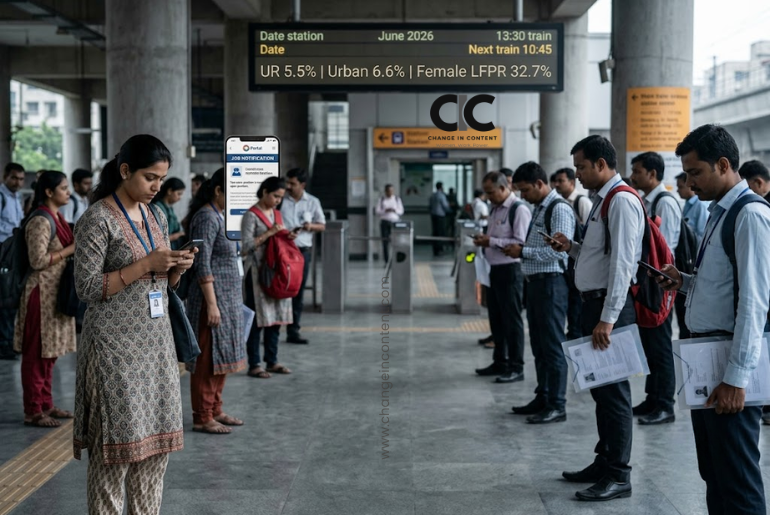
- India’s Unemployment Rate in June 2026 remained unchanged at 5.5% for people aged 15 years and above.
- Urban unemployment rose from 6.4% in May 2026 to 6.6% in June 2026, while rural unemployment eased from 5.1% to 5.0%.
- Overall female LFPR stood at 32.7%, almost unchanged from 32.8% in May 2026, and higher than 32.0% in June 2025.
- Rural female LFPR was 36.6%, while urban female LFPR remained at 24.8% month-on-month, down from 25.2% in June 2025.
- The data suggest stability at the national level, but women’s urban employment participation needs closer policy and workplace attention.
India’s unemployment rate in June 2026: The headline is stable, the detail is sharper
India’s unemployment rate in June 2026 stood at 5.5%, unchanged from May 2026. It was also broadly stable compared with the previous year, when the unemployment rate was 5.6%.
That makes the headline calm. But labour data rarely speaks through a single headline number.
The latest Periodic Labour Force Survey monthly bulletin from the National Statistics Office shows a split pattern. Rural unemployment softened slightly from 5.1% in May to 5.0% in June 2026. Urban unemployment, however, rose from 6.4% to 6.6% over the same period.
So the national number stayed still, but the urban labour market showed mild pressure.
For women, the picture is mixed. Participation is stable compared with May and better than last year at the all-India level. Yet the rural-urban gap remains large.
What the June 2026 PLFS data says
The overall Labour Force Participation Rate for people aged 15 years and above was 54.4% in June 2026, unchanged from May. It was marginally higher than 54.2% in June 2025.
The Worker Population Ratio also stayed unchanged at 51.4% in June 2026. Urban WPR improved slightly from 46.6% in May to 46.8% in June, while rural WPR held at 53.8%.
The urban labour market, therefore, showed two movements at once. More people participated, and more people were working. Yet unemployment also rose slightly. That may indicate more people entering or seeking work in urban areas, while job absorption did not fully keep pace in the month.
It is not a crisis signal. But it is a watch signal.
Women’s employment status: Stable, but still far from enough
The female LFPR for people aged 15 years and above stood at 32.7% in June 2026. That is almost unchanged from 32.8% in May 2026 and higher than 32.0% in June 2025.
Rural women continued to show stronger participation. Rural female LFPR stood at 36.6% in June 2026, compared with 36.7% in May and 35.2% in June 2025.
Urban female LFPR stayed at 24.8% month-on-month. Compared with June 2025, when it was 25.2%, it was 0.4 percentage points lower. This is the number to watch.
Urban India is where more formal jobs, service work, salaried employment and professional opportunities should be available. Yet urban women’s participation remains much lower than that of rural women.
Change in Content had earlier examined women’s labour force participation in the PLFS Oct-Dec 2025 update and the Q1 2026 PLFS reading on women and youth unemployment. The June 2026 data continues the same larger story: women’s participation is improving over longer periods, but the pace and quality of change need closer attention.
Why urban women’s participation needs attention
Urban women face a different set of barriers.
Jobs may exist, but not always in ways that women can enter or sustain. Commute, safety, care work, rigid office hours, lack of childcare, weak returnship systems, hiring bias and poor flexibility all influence women’s choices.
A monthly LFPR number cannot explain all of this by itself. It can only point towards where the questions should be asked.
- Why is the urban female LFPR still below 25%?
- Why did it soften compared with June 2025?
- Are women looking for work but not finding suitable jobs?
- Are available jobs too far, too unsafe, too low-paid or too rigid?
- Are women leaving after marriage due to motherhood or caregiving pressure?
- Are employers creating enough return pathways?
These are labour market questions. They also include questions on the workplace, transport, housing, care, and family.
India’s unemployment rate in June 2026: The Change in Content View
India’s Unemployment Rate in June 2026 remained unchanged. That stability is useful. But the sharper story sits below the headline.
Urban unemployment rose slightly. Rural unemployment eased. Women’s overall participation stayed stable and improved over the year, but urban women’s participation remains low and slightly weaker than a year ago.
For India, the task is not only to keep unemployment stable. The bigger task is to create jobs that women can actually take, continue and grow in. That means safer commutes, better childcare, fair hiring, flexible work without career penalty, returnship routes and quality jobs in cities.
The June 2026 data does not scream. It asks a quieter question: If the economy is stable, why are too many women still outside its working life?
FAQs
Q: What was India’s Unemployment Rate in June 2026?
A: India’s unemployment rate for people aged 15 years and above stood at 5.5% in June 2026, unchanged from May 2026.
Q: Did urban unemployment rise in June 2026?
A: Yes. Urban unemployment increased from 6.4% in May 2026 to 6.6% in June 2026. Rural unemployment eased from 5.1% to 5.0%.
Q: What was women’s labour force participation in June 2026?
A: Female LFPR stood at 32.7% in June 2026, nearly unchanged from 32.8% in May 2026 and higher than 32.0% in June 2025.
Q: What was the urban female LFPR in June 2026?
A: Urban female LFPR stood at 24.8% in June 2026, unchanged from May 2026 but lower than 25.2% in June 2025.
Q: Why does urban female LFPR matter?
A: Urban female LFPR matters because cities are expected to offer more formal, salaried and service-sector jobs. Low participation suggests barriers related to job quality, safety, care work, flexibility, and access to hiring.
Editorial Note and Sources
This article is based on the official Press Information Bureau release for the Periodic Labour Force Survey Monthly Bulletin, June 2026, issued by the Ministry of Statistics and Programme Implementation. It interprets the data through the Change in Content lens of women, work and labour-market participation. The article is intended for editorial and informational purposes only and should not be read as economic, policy, investment, legal or employment advice.