
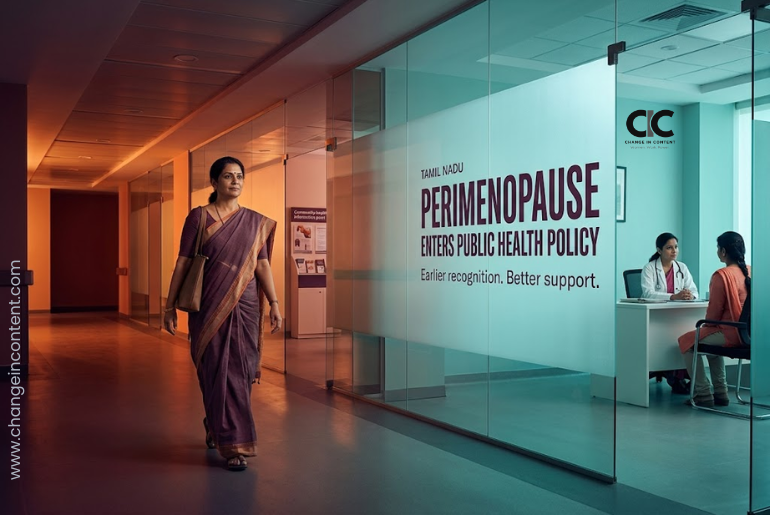
The Quick Read
- Tamil Nadu will formulate a dedicated Peri-Menopausal Care Policy to improve the early identification of women’s physical and mental health needs during the menopausal transition. Health Minister K.G. Arunraj announced this in the Legislative Assembly on 17 August 2026.
- The proposed Peri Menopausal Care Policy in Tamil Nadu is expected to include screening, counselling and treatment support rather than waiting until symptoms become severe or women seek specialist care themselves.
- WHO defines perimenopause as the period beginning when signs of the menopausal transition first appear and ending one year after the final menstrual period. It can last several years and affect sleep, mood, menstrual patterns, cognition and overall wellbeing.
- The State’s announcement follows earlier acknowledgement by the Health Minister that menopausal health receives inadequate attention and that women, particularly in rural areas, may live with symptoms without recognising their hormonal connection.
- For Change in Content, this is also a workplace story. Many women enter perimenopause during the years in which they hold substantial professional and family responsibilities.
Peri Menopausal Care Policy Tamil Nadu: A much needed Change in Content
A woman in her 40s develops poor sleep. Then irregular periods. Some days she struggles to concentrate. There may be joint pain, anxiety, sudden heat, exhaustion, mood changes or a general feeling that something is simply not right.
She sees each symptom separately. Sometimes healthcare does too. Tamil Nadu wants to change that.
The State government has announced it will formulate a dedicated Peri Menopausal Care Policy in Tamil Nadu, bringing the health needs of women undergoing this transition into a more structured public health framework. Health Minister K.G. Arunraj announced the move in the Legislative Assembly on 17 August.
The proposed policy is intended to help identify women’s physical and mental health needs earlier, with screening, counselling and treatment forming part of the planned response. That early-identification element may be its most useful feature.
What exactly is perimenopause?
Menopause does not usually arrive as a single event.
WHO describes perimenopause as the phase beginning when the first signs of the menopausal transition appear and continuing until one year after a woman’s final menstrual period. The transition can last several years.
Experiences vary considerably.
Some women have relatively few symptoms. Others can experience hot flushes, night sweats, disrupted sleep, changes in menstrual cycles, vaginal and urinary symptoms, mood changes and other physical or emotional effects capable of interfering with everyday life.
That variation can make recognition harder.
- A woman experiencing poor sleep may seek help for sleep.
- Someone experiencing anxiety may treat the anxiety.
- Joint or muscle pain can be considered an isolated problem.
- Changes in concentration may be blamed on stress.
The value of a policy framework is therefore partly in helping women and healthcare providers join the dots earlier.
Minister Arunraj had already flagged the gap
The announcement did not appear from nowhere.
Speaking about menopausal healthcare in July, Health Minister K.G. Arunraj said that while specific programmes exist for several major health conditions, menopausal health has lacked comparable focused attention.
He also drew on his experience as a medical officer in a government primary health centre, recalling women over 45 presenting with problems such as limb pain and cramps. Such complaints, he said, could be treated symptomatically even when hormonal changes might require a broader clinical approach.
He also pointed to another problem familiar to anyone working in women’s health:
silence.
Women may begin experiencing symptoms years before menopause but not know what is happening. Social discomfort around discussing menopause can delay seeking help. Rural women can face an additional information and healthcare-access gap.
That makes awareness an important part of whatever final policy Tamil Nadu develops.
Peri-Menopausal Care Policy Tamil Nadu: What could the policy change?
The complete policy is still to be formulated, so its final architecture should not be anticipated. But the Assembly announcement gives us the direction.
It is expected to create a more organised route around: early identification → screening → counselling → treatment for women within the peri-menopausal age group.
That represents a useful change in approach.
Instead of expecting women to independently recognise a complex hormonal transition, find the right specialist and seek care, public healthcare can begin identifying those needs proactively.
The details will now matter.
- How will women be screened?
- At what age?
- Will primary health centres become the first point of contact?
- How will doctors and frontline health workers be trained?
- What mental-health support will be available?
- How will rural women be reached?
- Will referrals include gynaecology, mental health, bone health and other relevant specialities?
- And how will the State ensure women know the service exists?
Those are questions for the policy formulation stage rather than criticisms of an announcement that has only just been made.
Tamil Nadu is recognising a life stage healthcare often overlooks
There is a broader significance here. Public health systems have traditionally built stronger structures around pregnancy, childbirth, and reproductive health.
Midlife women’s health has received less policy attention. Yet WHO points out that the menopausal transition can affect women’s physical, mental and social wellbeing for several years.
Change in Content has been closely following this gap. Our earlier analysis of menopause and working women looked at what happens when symptoms such as poor sleep, fatigue and brain fog arrive just as women are reaching some of the most experienced stages of their careers.
We have also argued that healthy workplaces for women need to think beyond maternity and include menstrual, menopausal and preventive healthcare.
Government policy and workplace policy are separate things. But they are beginning to meet around the same reality: women’s health changes across a lifetime. The systems around them need to recognise that.
There is a workplace connection that employers should notice
Many women encounter perimenopause somewhere in their 40s. That frequently coincides with a professionally important period.
They may be senior managers. Experienced specialists. Business owners. Teachers. Doctors. Factory workers. Government employees. Caregivers at home. Or, increasingly, members of the sandwich generation, simultaneously supporting children and ageing parents while maintaining a career.
Healthcare systems can diagnose and treat. Employers have a different job. They can build awareness. Train managers. Make appropriate health benefits accessible. Avoid turning symptoms into assumptions about competence. And create enough psychological safety for a woman to ask for support without fearing that colleagues will quietly begin questioning whether she can still handle responsibility.
That is why menopause policy is relevant to the world of work even when the policy itself sits inside the Health Department.
Closing thoughts: Midlife women should not have to guess what their bodies are telling them
Tamil Nadu’s announcement is still at the policy-formulation stage. That distinction matters.
We will know how ambitious the initiative really is when the details emerge, services are defined, healthcare workers are trained, and women can actually access the support. But the starting point deserves recognition.
Perimenopause has spent too long in an awkward gap.
- Common enough to affect millions of women.
- Personal enough to remain poorly discussed.
- Complex enough for symptoms to be mistaken for unrelated problems.
- And normal enough for suffering sometimes to be dismissed as something women simply have to endure.
A public-health policy can help change that. The strongest outcome would be quite ordinary.
A woman begins experiencing unfamiliar symptoms. She knows what perimenopause is. Her family understands it. Her doctor considers it. The healthcare system knows what to screen for. Her workplace does not mistake a health transition for a professional decline. And she receives appropriate help before years are lost wondering what is happening.
That is what good women’s health policy should eventually make possible.
Editorial Note and Disclaimer
This Policy Pulse article covers Tamil Nadu’s announcement to formulate a Peri-Menopausal Care Policy. The detailed policy framework had not been publicly released at the time of writing, and references to its future implementation should therefore be read as questions and areas to watch rather than confirmed programme features. Medical information has been checked against World Health Organisation guidance. The article is intended for editorial and informational purposes and is not a substitute for professional medical advice.
Sources
- Tamil Nadu Legislative Assembly announcement/The Hindu, 17–18 August 2026 — Policy announcement by Health Minister K.G. Arunraj.
- World Health Organisation — Menopause — Definition of perimenopause and health effects of the menopausal transition.
- WHO — Understanding the Diverse Realities of Menopause Worldwide, 2026.
- Tamil Nadu Health Minister’s July 2026 remarks on dedicated menopausal healthcare, reported following an Indian Menopause Society event.
