The Brief
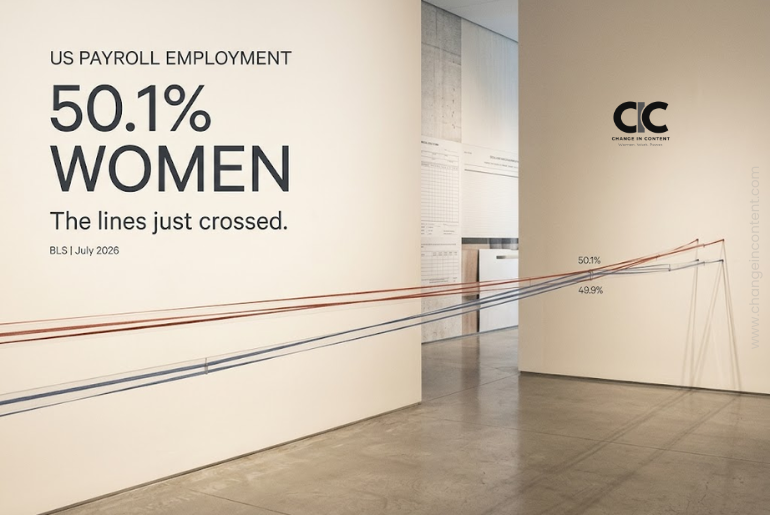
- Women held 50.1% of US nonfarm payroll jobs in July 2026, according to the US Bureau of Labour Statistics.
- That amounted to about 79.5 million payroll positions held by women. The figure counts payroll jobs, rather than unique workers, and excludes categories such as the self-employed.
- The shift is being helped by growth in sectors where women have traditionally had a stronger presence. Healthcare and social assistance alone is projected to add almost 2 million jobs between 2024 and 2034.
- Women have also moved ahead educationally on several measures. In 2024, 40.1% of US women aged 25 and above held a bachelor’s degree or higher, compared with 37.1% of men.
- The phrase “female breadwinner era” should still be treated with caution: men remain the larger group among employed people, and the most recent broad-based household research does not show women as the primary earners in most marriages.
The female breadwinner era is here. Is it?
Something unusual has happened in the American labour market. Women now hold slightly more than half of the country’s payroll jobs.
US Bureau of Labour Statistics data for July 2026 show that women account for 50.1% of total nonfarm payroll employment, with roughly 79.5 million positions. The proportion had also reached 50.1% in June.
It is a narrow majority. But after decades in which employment was overwhelmingly structured around male participation, even a narrow majority is worth noticing.
Some have already called this the Female Breadwinner Era. The phrase is bigger than the statistic, but the labour-market shift behind it is real.
What exactly has changed?
The figure comes from the BLS establishment survey, which measures jobs on employer payrolls. That distinction matters.
A person with two payroll jobs can appear twice. Self-employed workers are treated differently. And when the BLS surveys households separately, men still outnumber women among employed people.
In July 2026, the household survey counted approximately 85 million employed men and 77.2 million employed women aged 16 and above.
So this is not a story about women suddenly becoming the majority of every part of the workforce. It is a story about where payroll employment is moving. And that movement is increasingly favouring industries in which women already have a significant presence.
Follow the jobs, and healthcare appears quickly
The American economy is not adding jobs evenly across industries.
Healthcare and social assistance is expected to be the fastest-growing major sector between 2024 and 2034, according to BLS projections. Employment in the sector is forecast to rise by 8.4%, adding nearly 2 million jobs. That is more projected job growth than any other broad industry.
Several of the occupations expected to generate the most new jobs are in healthcare. Home health and personal care aides alone are projected to add almost 740,000 jobs by 2034. Registered nursing is also expected to add more than 166,000 positions.
These are labour markets in which women are already heavily represented.
In 2025, women made up more than 83% of healthcare support occupations in BLS occupational data. Women also dominate occupations such as licensed practical nursing, medical records work and home health care.
That creates a straightforward structural effect. When the economy creates more jobs in sectors where women are already concentrated, women’s share of payroll employment rises.
The education pipeline is changing too
The shift begins before anybody receives a payslip. Women now have higher levels of university attainment than men across the US adult population.
Census Bureau data for 2024 found 40.1% of women aged 25 and older had a bachelor’s degree or higher, compared with 37.1% of men. Women have also constituted the majority of American higher education enrolment for decades.
That does not guarantee equal outcomes across every occupation. Engineering, computing, construction, and several other high-paying technical fields remain considerably male-dominated. But it does mean that the pipeline feeding many professional, healthcare, education and service occupations has changed substantially.
And the economy is increasingly creating jobs in some of those same areas.
At the same time, men’s participation has been drifting down
Another part of the story is happening on the other side of the gender divide.
Male labour-force participation has been declining over the long term. BLS notes that men’s participation rate has generally trended down since reaching 86.6% in 1948.
By July 2026, participation among men aged 16 and above stood at 66.8% on a seasonally adjusted basis. For women, it was 56.4%. The gender gap therefore remains substantial, but it is dramatically narrower than it was across much of the twentieth century.
The recent discussion has focused particularly on younger men who are less connected to work or education. That story also needs care.
The latest BLS summer data does not show young women overtaking young men in employment. Among 16- to 24-year-olds in July 2026, the employment-population ratio remained higher for young men, at 55.7%, than for young women, at 51.8%.
So the emerging female majority in the workforce is better understood as the result of several long-running changes occurring together rather than a sudden withdrawal of young men.
Does this mean women are now the breadwinners?
Not necessarily. That is where the headline needs a footnote.
Payroll employment tells us who holds jobs. Breadwinning tells us who earns the largest share of household income.
Those are different measures.
The most widely cited recent analysis of opposite-sex US marriages from Pew Research found that 16% had a wife who was the sole or primary breadwinner. In comparison, another 29% had spouses contributing roughly equal amounts. Husbands remained the primary or sole breadwinner in 55% of marriages. The share of female breadwinners had nonetheless risen substantially from 5% in 1972.
So America has not suddenly become a country where most households are supported principally by women’s earnings.
What has changed is the economic architecture underneath those households. Women are working in enormous numbers. They are increasingly educated.
Some of the largest sources of future employment sit in female-heavy industries. And the old assumption that the typical payroll worker is male is no longer statistically safe.
A workforce milestone, not a finished story
Women holding 50.1% of payroll jobs does not erase occupational segregation.
It does not close the gender pay gap. It does not mean women dominate senior leadership. And it does not tell us how unpaid care is divided at home.
But those are separate questions.
The employment statistic deserves to be understood on its own terms.
A labour market that once had millions more male than female payroll jobs has reached something very close to numerical parity.
The interesting question now is whether that remains an occasional crossover or becomes the normal shape of American employment.
For the moment, the numbers are worth recording.
Change in Perspective: The Workforce Has Changed Shape
There are economic shifts that arrive with a dramatic announcement.
This one has been happening much more quietly.
- Women’s education rose.
- Women’s labour-force participation expanded over decades.
- Healthcare and care-related employment became larger parts of the economy.
- Male participation declined from historic highs.
- And eventually the payroll numbers met in the middle.
Calling it the Female Breadwinner Era may be premature if we mean household income. Calling it a significant change in who holds America’s jobs is much easier to defend.
Sometimes a statistic does not need a verdict attached to it. It simply tells us that the labour market no longer looks the way it once did.
Editorial Note & Sources
This DEI Insights article explains recent changes in US employment using Bureau of Labour Statistics and Census data. The term “Female Breadwinner Era” is used as the article’s search and editorial phrase, but payroll employment should not be confused with household breadwinning. The BLS establishment survey counts payroll jobs, while its household survey counts employed people using a different methodology.
Sources
- US Bureau of Labour Statistics — Employment Situation, July 2026: Women represented 50.1% of total nonfarm payroll employment in July 2026.
- US Bureau of Labour Statistics — Employment Status by Sex and Age, July 2026: Used to distinguish payroll jobs from the number of employed men and women and to report current labour-force participation.
- US Bureau of Labour Statistics — Employment Projections 2024–2034: Healthcare and social assistance is projected to add almost two million jobs over the decade.
- US Bureau of Labour Statistics — Employment by Detailed Occupation and Sex, 2025: Used for women’s representation in healthcare and related occupations.
- US Census Bureau — Educational Attainment in the United States, 2024: Women were more likely than men to hold a bachelor’s degree or higher.
- Pew Research Centre — Husbands and Wives Earn Similar Wages in a Growing Share of Marriages: Provides household-level context on female breadwinners and egalitarian marriages.