
The Brief
- India’s annual employment estimate counted 20 crore women aged 15 and above working in 2025, across salaried, casual and self-employed work, including unpaid work in household enterprises.
- Public procurement, credit and self-help group programmes are expanding routes to economic opportunity. Their success also needs to be judged through sustained earnings and viable businesses.
- Higher participation does not automatically mean an independent income. The quality of work and women’s authority over it deserve closer attention.
- Childcare, shared domestic responsibilities, safe travel and dependable payment are practical economic infrastructure.
- Women deserve access to growth on their own terms, including the choice of how large a business or career they want to build.
Women are reshaping the Indian economy: Here’s how
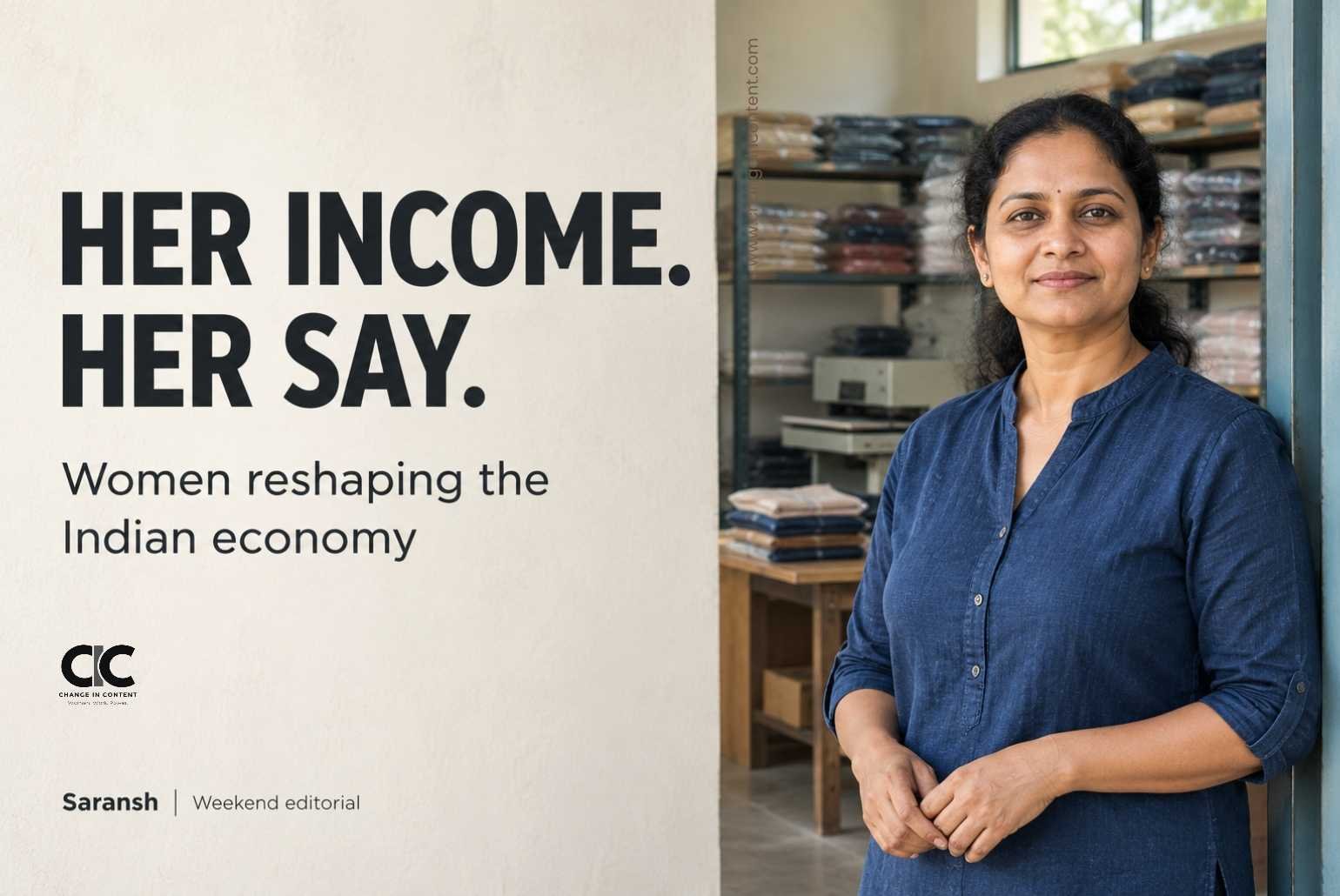
Women reshaping the Indian economy deserve better than having their earnings described as ‘extra’. A woman’s income can pay a school fee, keep a household afloat or finance an expansion, yet the language around it can still make her work sound optional. That language becomes consequential when a family must decide whose career can be interrupted, whose time is available and whose ambition merits investment.
India’s women have always worked. They have cultivated land, cared for families, made products, run shops and sustained enterprises, often without an individual wage. We should be wary of telling a story in which they suddenly became economically useful when a scheme, employer or statistical category noticed them.
What is changing is the scale of recorded participation and the routes through which women can reach customers, finance and formal institutions. That deserves recognition. It also creates a more demanding question: How much of the value women generate becomes income, security and authority of their own?
What has changed in women’s economic participation?
The earlier annual Periodic Labour Force Survey series recorded female labour force participation rising from 23.3% in 2017–18 to 41.7% in 2023–24, for people aged 15 and above. The rural increase was particularly pronounced: from 24.6% to 47.6%, against an urban movement from 20.4% to 28.0%.
The 2025 annual survey estimated 20 crore women workers aged 15 and above. Female labour force participation stood at 40%, while 38.8% of women in that age group were employed. Participation includes people working or seeking or available for work; employment is narrower. The survey design changed in January 2025, so these figures should not be stitched into a seamless growth chart with earlier July–June rounds.
This is a much broader economy than the one visible through board appointments and start-up funding announcements. Our detailed examination of India’s working women in 2026 explains the differences between employment, wages and security. Here, the point is what that breadth asks of us: An economic strategy must reach women in farms and family enterprises as seriously as it reaches professionals in cities.
A dependable wage brings purchasing power. A growing enterprise creates decisions about suppliers and hiring. Savings provide room to withstand an emergency or refuse an unsuitable offer. These are different forms of economic agency, and they need different support.
Government support becomes tangible when an order arrives
Public procurement offers a useful example. Under the Womaniya initiative, women-owned micro and small enterprises and self-help groups can connect with government buyers through the Government e-Marketplace. PIB reports that women-owned MSEs received contracts worth more than ₹28,000 crore through GeM in 2025–26. That is an increase of 27.6% over the previous year.
An institutional order can change the possibilities for a small enterprise. It can justify equipment, establish a commercial track record and create work for others. But the proprietor still has to finance production, meet specifications, deliver and collect payment. Contract value is therefore evidence of market access; it is not the same as profit or cash already received.
Other programmes address different stages of that journey. MUDRA expands access to business credit: women accounted for two-thirds of more than 57.79 crore loans sanctioned cumulatively by April 2026. Those are loans, including repeat borrowing, rather than that many separate women entrepreneurs. The Yashasvini campaign supports formal registration, while credit guarantees can help lenders serve businesses that face financing barriers.
These are useful foundations. A registration should lead to usable services; a loan should support a viable activity; access to a marketplace should lead to customers. Asking what happens after enrolment is how we improve a programme’s value.
For private companies, there is an opportunity here too. A supplier-development programme can help a woman-owned business meet quality standards, price an order and understand delivery requirements. A small, paid trial order may reveal more than another invitation to an entrepreneurship panel. CIC’s earlier coverage of women-owned enterprises and employment explores why growth beyond the proprietor’s own labour deserves attention.
Rural enterprise needs a market that lasts beyond the fair
The self-help group network under DAY-NRLM connects women with collective savings, finance and livelihood support. Its market-facing work is visible at the National SARAS Mela in Vijayawada, scheduled for 13–31 October 2026, with around 1,500 women entrepreneurs and Lakhpati Didis from 34 states and Union Territories.
A fair lets producers discover what sells and what customers will pay. Repeat orders, reliable logistics and timely payment can turn that encounter into sustained business.
The Lakhpati Didi initiative places sustainable income at the centre of the conversation. Its definition concerns an SHG member whose household earns at least ₹1 lakh annually on a sustainable basis. It should not be presented as a guaranteed personal salary or a cash transfer to every participant.
That household milestone can be meaningful while leaving further questions open.
- What does the woman herself receive? Does she help decide how earnings are used?
- Can the enterprise afford to pay for her time?
- A household’s progress and a woman’s financial independence should reinforce each other; measuring one does not establish the other.
What are we still failing to count?
The 2025 PLFS employment-status distribution classified 28.3% of female workers as unpaid helpers in household enterprises. This is productive work in a family enterprise, distinct from unpaid cooking, cleaning and care within one’s own household.
Calling all self-employed women entrepreneurs would hide that difference. So would assuming that employment always brings money a woman can independently access. Family enterprises need an honest discussion about roles, remuneration and decisions. A business cannot accurately assess its costs if someone’s labour is treated as permanently free.
There is also a constraint that no registration certificate can remove. In the 2024 Time Use Survey, women aged 15–59 participating in unpaid domestic services spent an average of 305 minutes a day on those activities; male participants spent 86 minutes. These are averages among participants in the activity, not all women and men.
For a household, sharing this work means taking responsibility for it, including the planning. For an employer, it means examining schedules, childcare access and opportunities to remain employed through changes in care responsibilities. Our article on women’s workforce re-entry makes the case for addressing avoidable exits before the resignation arrives.
Paid work also needs to be worth staying in. A woman should be able to see how her pay can improve, what skills lead to better assignments and how concerns will be handled. Flexible arrangements help only when they remain compatible with advancement. Safety measures should widen the work she can undertake; workplace safety must not become a reason to make her career smaller.
What should the next stage look like?
I would judge the next stage of women’s economic progress by what institutions can demonstrate after the announcement.
- For government departments, that means following businesses beyond registration and training: Repeat customers, survival, earnings and employment created.
- For lenders, it means examining whether suitable finance reaches a business when an order needs fulfilling, while keeping repayment demands realistic.
- For buyers, it means clear specifications, proportionate onboarding and dependable payment.
Employers should examine starting pay, retention, first promotions and access to roles with commercial responsibility. Families should examine whose work is routinely rearranged when care is needed. These are decisions people can change without waiting for a national indicator to move.
We also need ambition beyond the familiar occupations offered to women. Training should lead towards actual demand and paid opportunities, whether in a traditional craft or a technical field. A certificate has limited value if the next employer requires experience that nobody will give the trainee a chance to acquire.
A word to the women building this economy
Your work deserves a proper account of its value.
- If you run an enterprise, include your time when assessing what it earns. Know the price, the costs and the payment terms.
- If you work in a family business, seek clarity about your role and remuneration.
- If you are employed, ask how access to leadership is decided and whether the assignments needed to get there are available to you.
None of this means every barrier can be negotiated away. Women should not be handed sole responsibility for repairing the conditions around them. Nor must every woman turn a small enterprise into a large one, monetise every skill or justify a career through relentless expansion.
A stable livelihood can be a serious ambition. So can a larger business, a leadership role or a return after a break. The useful measure is whether the choice is genuinely available, with information, resources and support behind it.
Change the terms of growth
India has substantial progress to build on. Public programmes are opening routes that deserve to be used well, and women are doing the difficult work of turning opportunity into income. The next step should bring greater attention to the quality of that income, the conditions in which it is earned and the decisions it allows a woman to make.
An economy can welcome a woman’s production while remaining uncomfortable with her independence. We should be willing to notice when that happens: when her earnings are needed but her time is negotiable, when her business is celebrated, but her judgement is deferred to somebody else.
The women reshaping the Indian economy deserve a fair share of its returns and a greater say in its direction. That begins with treating their work, and the lives they want to build through it, as consequential.
Editorial note and sources
This is an editorial by Saransh, based on public data and programme information checked on 29 October 2026. It recognises the contribution of government initiatives while examining what participation and administrative reach can (and cannot) tell us about earnings, business viability and women’s economic agency. Recommendations are the author’s analysis, not claims of experimentally established programme effects.
Sources
- MoSPI/PIB, PLFS Annual Report 2023–24, 23 September 2024. Table 1: usual-status labour force participation, ages 15+, and rural–urban differences. Source.
- MoSPI/PIB, PLFS Annual Report 2025 release, 27 March 2026. Employment estimate of 20 crore women aged 15+, female LFPR of 40% and WPR of 38.8%. The headcount combines survey rates with projected population figures; it is an estimate, not an administrative employee register. Source.
- MoSPI, revised PLFS Annual Report 2025. Section 1.5 on sample redesign and Table 20/Statement 7 on employment status. The 28.3% figure refers to female workers classified as helpers in household enterprises. Report.
- PIB, Womaniya: Building Inclusive Market Access for Women Entrepreneurs, 10 April 2026. Programme function and FY2025–26 contract awards. Contract value is not profit, disbursement or independently verified income impact. Source.
- PIB, Women, Work and Enterprise: India’s Push for Better Livelihoods, 15 October 2026. MUDRA loan totals, Yashasvini and credit-guarantee support. Cumulative loans are not unique borrowers or evidence that the same proportion of loan value went to women. Source.
- PIB, SARAS Mela 2026: Taking Rural Women’s Enterprises to the National Markets, 21 October 2026. DAY-NRLM, Vijayawada event and Lakhpati Didi household-income definition. Source.
- MoSPI/PIB, Time Use in India 2024, detailed release, 28 March 2025. Table 2: daily unpaid domestic-service minutes per participant aged 15–59. These are not all-person averages and must not be added mechanically to a separate caregiving average. Source.
- PIB India, From Aspiration to Agency, 27 October 2026. Starting reference for the editorial; underlying statistical releases and programme notes were checked separately. Source.
