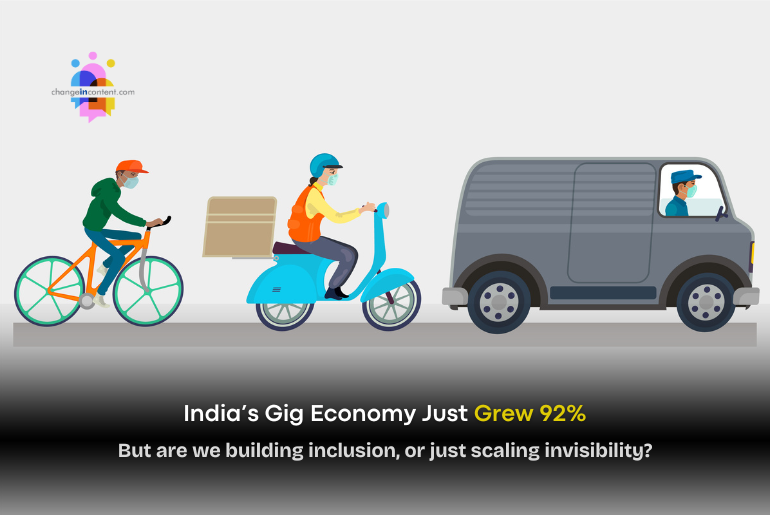
In 2024, India saw a seismic shift in its job economy, but it did not come from boardrooms or tech hubs. It came from delivery bags, e-commerce warehouses, and two-wheelers weaving through traffic. According to a new WorkIndia report, blue-collar gig jobs in India grew by a staggering 92% year-on-year. This progress is redefining how ambition, employment, and economic survival are being shaped.
Cities like Delhi, Ahmedabad, and Kolkata reported over 100% growth in last-mile delivery jobs. Gig job applications surged by 63%, with the highest spike coming from graduates. What was once considered “stopgap” work is now being embraced as stable, flexible, and, most importantly, viable. But as India rides this gig wave, the question is: What are we building: opportunity or exploitation?
Blue-collar gig jobs in India: What the data tells us
The WorkIndia report analyses 4.81 lakh job postings from 2023 and 2024, highlighting a structural shift in the nature of employment. E-commerce, food delivery, and ride-hailing platforms are not just creating demand; they are shaping job aspirations. Quick commerce, especially, is driving demand for delivery partners at unprecedented speeds.
Graduates, once hesitant, are entering the gig economy in increasing numbers. It is not because they lack qualifications. Instead, it is because traditional job security is being outpaced by flexible, fast-paying platforms that offer control over time, access to income, and minimal entry barriers.
The platformisation of ambition
WorkIndia CEO Nilesh Dungarwal puts it aptly: “What we’re seeing is the platformisation of ambition.” For millions, especially in Tier 2 and Tier 3 cities, gig roles are no longer a fallback; they are a conscious choice.
In many families, gig work has become the default first job. It offers immediate earnings, doesn’t require a resume, and comes with performance-based incentives. Most importantly, it carries social recognition today that it did not five years ago. You are no longer “just a delivery guy.” You are a provider, an earner, a contributor to India’s digital economy.
A DEI question few are asking
With a 92% growth in blue-collar gig jobs, inclusion must now be defined beyond gender and office diversity.
- Where are the policies protecting gig workers’ rights?
- Where are the platforms offering health insurance, maternity benefits, or paid leave?
- Where are the companies giving a seat at the table to the workforce that literally carries their brand?
India’s gig economy employs millions, but it still treats them as invisible. For all the talk of inclusion and equity, blue-collar workers continue to be locked out of social security and structural dignity.
A tale of three cities
Cities like Delhi, Ahmedabad, and Kolkata saw over 100% growth in gig job postings. These are not India’s startup capitals, but they are its delivery and logistics lifelines. Their rise marks a geographic decentralisation of employment. Platforms are going where the people are, and the people are responding.
It is time we shifted the narrative. The future of work in India does not just lie in AI, coding, or remote work. It lies in how we treat our delivery riders, warehouse loaders, and field workers who make up the invisible infrastructure of urban India.
Conclusion: The future of blue-collar gig jobs is not just tech—it must be human
The 92% rise in blue-collar gig jobs is not just a headline; it is a wake-up call. A new labour economy is taking shape. One that is fast, fluid, and undeniably informal. But without rights, protections, and inclusion, this growth will come at the cost of dignity.
The gig economy has validated millions of aspirations. It has shown us what scalability looks like. But now, it must also show us what fairness looks like.
For more on inclusive urban planning, read: Chennai launches India’s first-of-its-kind Rest Pod for gig workers.
Disclaimer: The views expressed in this article are based on the writer’s insights, supported by data and resources available both online and offline, as applicable. Changeincontent.com is committed to promoting inclusivity across all forms of content. We broadly define inclusivity as media, policies, law, and history, encompassing all elements that influence the lives of women and marginalised individuals. Our goal is to promote understanding and advocate for comprehensive inclusivity.