
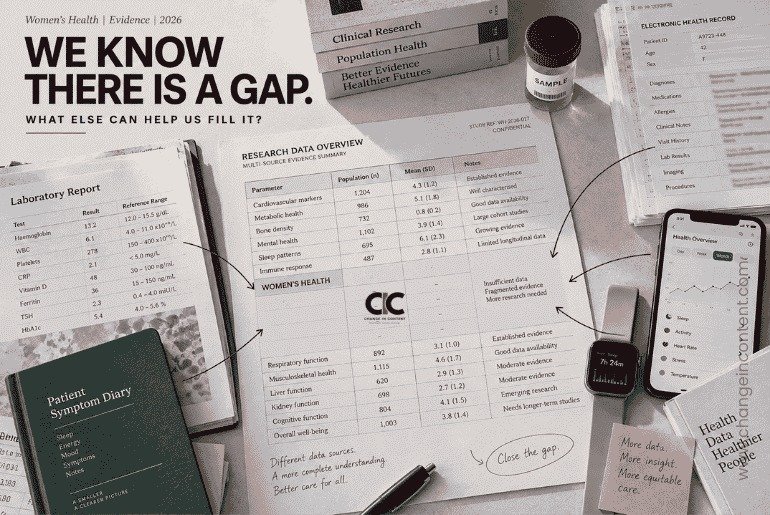
The evidence gap in women’s health deserves more than just attention
A woman sees a doctor because she cannot sleep.
Another has spent years trying to explain pelvic pain.
Someone else notices her medication affects her differently after menopause.
A pregnant woman wants to know whether a treatment is safe.
A worker keeps taking sick days without understanding whether a recurring symptom has a pattern.
Each encounter creates information. Yet remarkably little of what women experience in ordinary life becomes robust evidence quickly enough to change the care women receive. That is the uncomfortable centre of the evidence gap in women’s health.
We know part of its history. Women were underrepresented in sections of medical research. Female biology was sometimes treated as an inconvenient variable. Conditions affecting women specifically received insufficient attention. Pregnancy and breastfeeding often resulted in exclusion from research rather than better research design.
WHO still describes gender bias in research, data collection, service design and clinical practice as contributing to gaps in women’s health evidence and care.
We have written about that problem before. The more useful question now is what comes next.
We cannot wait for every missing trial
A new Nature Medicine editorial argues that randomised controlled trials must remain the strongest foundation for changing clinical practice. That is important.
Women’s health does not need weaker scientific standards simply because evidence is missing. But trials take years. They can be expensive. Participants often represent narrower populations than the women doctors eventually treat. And some women’s health questions have already waited far too long for serious attention.
Endometriosis. Pregnancy-related disorders. Menopause. Polycystic ovary syndrome. Drug effects across different female life stages.
The answer cannot be to shrug until the ideal trial eventually arrives.
Nature Medicine proposes using other forms of evidence alongside, rather than instead of, clinical trials. That difference matters.
Start with the women already inside the health system
Hospitals and clinics generate enormous amounts of information every day.
Lab results. Diagnoses. Prescriptions. Adverse reactions. Imaging. Hospital admissions. Treatment outcomes. Electronic health records.
Much of this information was created for individual care rather than research, but when analysed responsibly across very large populations, it can reveal patterns that conventional studies may have missed.
The Nature Medicine editorial gives a striking example.
Researchers analysing around 300 million laboratory tests from women’s electronic health records identified a sharp systemic metabolic change around the onset of menopause. The finding illustrates what becomes possible when routine clinical information is examined at a scale no conventional trial could easily reproduce.
That does not mean 300 million lab tests automatically equal truth.
Medical-record data can contain bias. Some women reach healthcare more easily than others. Some receive better tests. And some conditions are more likely to be diagnosed. Poorer women, rural women or people outside formal health systems may barely appear.
Real-world data reflects the real world, including its inequalities. But that is an argument for using it intelligently, not ignoring it.
WHO makes a related point: health systems need data separated by sex, age and other factors if they are to identify who experiences poorer outcomes and why.
Before we can close a gap, we have to be able to see it.
Ask women what researchers have not thought to ask
Another source of evidence sits outside hospital databases. Women themselves. That can sound obvious. Historically, it has not always been treated that way.
Nature Medicine points to the Isala project, a citizen-science initiative investigating the vaginal microbiome. Researchers originally hoped to recruit around 200 volunteers willing to collect their own vaginal, oral and skin samples. More than 6,000 people volunteered. There is something worth noticing in that response.
Women are sometimes described as difficult populations to recruit into research. Yet thousands will participate when the research question feels relevant, the process respects them, and they can see value in helping answer it.
Citizen science can do something formal research occasionally struggles to achieve. It can begin with: What are people actually experiencing?
Not every patient observation should become a clinical conclusion. But lived experience can tell researchers where to look.
Repeated reports of pain, side effects, cycle-related changes, diagnostic delays or treatment failures can generate better questions. And better questions are where better evidence begins.
The phone and the watch may become research instruments
Then there is the data many women generate without entering a hospital.
- Periods logged in an app.
- Heart rate from a watch.
- Sleep duration.
- Temperature.
- Exercise.
- Pregnancy information.
- Symptoms.
- Fertility patterns.
- Medication reminders.
Taken individually, these may simply help someone understand her own body. Carefully aggregated, longitudinal data could help researchers study women’s health over time and at a scale that traditional research struggles to achieve.
Nature Medicine specifically points to menstrual and fertility apps and wearables as potentially valuable sources for studying women’s health, including in lower- and middle-income countries.
That opportunity comes with a large warning label. Women’s reproductive-health data is deeply personal.
- Who owns it?
- Who can buy it?
- Can an insurer access it?
- Can an employer?
- How securely is it stored?
- Can a woman’s pregnancy, fertility or menstrual information be used to infer something she never intended to disclose?
Closing one evidence gap should not create a privacy problem. So the next generation of women’s health research needs better data governance at the same time as more data.
Quantity without trust will eventually undermine participation.
Femtech knows things conventional healthcare sometimes learns late
There is another interesting development.
Some of the strongest pressure to investigate overlooked women’s health problems has come from entrepreneurs. Not because startups are automatically better scientists. Because unmet need creates a market.
Women frustrated by diagnostic delays or poorly designed healthcare experiences have helped build businesses around menstrual health, fertility, pelvic health, menopause and conditions such as endometriosis.
Nature Medicine points to emerging technologies including blood tests aimed at predicting pre-eclampsia and approaches using menstrual blood collected at home to investigate endometriosis. Many such innovations still require rigorous validation and, where appropriate, regulatory approval.
That qualification is crucial. Innovation cannot become a shortcut around evidence.
A beautifully designed women’s health app with weak validation is still weak evidence. A startup saying “built for women” does not make its claims clinically sound.
The best outcome is when the two worlds meet:
- patients identify what healthcare is missing;
- innovators explore new ways to solve it;
- researchers test those solutions;
- regulators assess them;
- and reliable evidence eventually changes care.
But the missing evidence is larger than female biology
That is where the discussion has to leave the laboratory. Health is affected by what happens before a woman reaches a doctor.
- Can she take time off to attend an appointment?
- Does she control household spending?
- Is a specialist available where she lives?
- Has she learnt what symptoms deserve attention?
- Does she dismiss severe pain because everyone around her calls it normal?
- Can she privately use a health app?
- Does the workplace insurance plan cover what she needs?
- Does medical education teach the condition well enough for her clinician to recognise it?
WHO stresses that health evidence becomes more useful when it can be linked to factors such as education, income, employment, geography, age, and other social determinants.
That expands the meaning of the evidence gap. Take the same condition in 2 women.
One has private insurance, flexible work and a specialist within five kilometres. While the other works by the day and loses income every time she attends hospital.
Biology may be similar. The route to diagnosis will not be. We need evidence that can see both.
What workplaces don’t know can become a career problem
At Change in Content, we feel there is a very practical reason should care about health evidence. Workplaces make decisions based on what they understand.
- Menstruation.
- Endometriosis.
- Fertility treatment.
- Pregnancy loss.
- Menopause.
- Chronic pain.
- Mental health.
If a health condition is poorly researched, poorly recognised or poorly explained, its effects can become professionally invisible.
A manager sees absence. Reduced travel. Fatigue. A request for flexibility. Difficulty concentrating.
What they may not see is the health problem underneath.
Our recent analysis of working women’s health examined this collision: health eventually shows up in organisations as attendance, productivity, career continuity, and retention.
The workplace should never become the doctor’s clinic. But better evidence gives employers a stronger basis for designing benefits, occupational-health systems and policies around real needs rather than assumptions.
The launch of ISO 45010 for menstruation and menopause at work is a recent example of evidence moving into workplace practice.
That journey matters.
Research → understanding → clinical practice → public policy → workplace design.
Leave women out near the beginning, and the weakness can travel through the entire chain.
Medical education has to receive the new evidence too
Generating research is only half the job. Someone has to learn it.
A discovery sitting inside a specialist journal does little for a woman whose doctor was never trained to recognise how a condition presents in women.
Nature Medicine has previously argued for a broader life-course approach to women’s health rather than continuing to centre almost exclusively on sexual and reproductive health. Cardiovascular health, neurological conditions, cancer, mental health, metabolic disease and ageing all require attention to sex and gender differences.
That is where universities and professional education matter.
New evidence should flow into:
- medical curricula;
- clinical guidelines;
- continuing education;
- nursing education;
- public-health training;
- and eventually patient information.
Otherwise we close the research gap while leaving the knowledge gap intact.
So how do we build evidence faster without weakening it?
Perhaps this is the useful framework.
Keep clinical trials strong.
Recruit women properly. Analyse outcomes by sex where scientifically relevant. Include women across life stages. Do better research on conditions affecting women specifically. But don’t stop there.
Use the health data already being generated.
Electronic records, registries and population datasets can reveal patterns and generate hypotheses much faster.
Separate the data.
“Patients” can hide differences. Sex-disaggregated and age-disaggregated analysis can expose them.
Listen before deciding what deserves study.
Patients and citizen-science communities can identify questions researchers have underestimated.
Use wearables and digital health carefully.
They offer scale and longitudinal information, but privacy, consent, access, and algorithmic bias must be built into the research design.
Fund validation, not merely innovation.
Women’s health products should face rigorous evidence standards precisely because women have already lived with too much uncertainty.
Connect health with life outside healthcare.
Education, employment, geography, income and care responsibilities can determine whether scientific progress ever reaches the woman it was intended to help.
None of this replaces rigorous medicine. It makes rigorous medicine better informed about the people it intends to serve.
Change in Perspective: Women Cannot Remain the Missing Data While We Wait for Better Data
There is an understandable temptation when there is an evidence gap. Wait.
Wait for the larger trial. The better dataset. The longer follow-up. And the definitive paper.
Science needs caution. Medicine should demand proof. But waiting itself has consequences when the unanswered question affects millions of people.
That is why the Nature Medicine argument feels timely.
The choice is not between excellent clinical trials and unreliable alternatives. The opportunity is to build several streams of evidence that challenge, complement and eventually strengthen one another.
A laboratory result. A randomised trial. 10 years of health records. A registry. 6000 women volunteering samples. A pattern detected by a wearable. A patient community repeatedly asking why nobody has studied the problem.
Each can tell us something different. Then the harder work begins: validating it, connecting it and turning it into medicine people can trust.
We already know there is an evidence gap in women’s health. The next decade should be less interested in repeatedly proving that the gap exists. It should focus on filling it.
Editorial Note & Sources
Real-world evidence, citizen science, digital-health information and patient-reported data have important limitations and should not be presented as substitutes for appropriately designed randomised clinical trials. Their value lies in complementing clinical research, generating hypotheses, reflecting populations often missed by conventional studies and accelerating understanding where evidence is scarce. Health data must also be collected and used with robust safeguards around privacy, consent, bias and governance.
Nature Medicine — “To bridge the evidence gap in women’s health, look at the real world”, 9 September 2026. The principal editorial informing this article. It argues for combining clinical trials with real-world data, citizen science and patient-centred innovation.
World Health Organisation — Women’s Health. WHO identifies persistent bias in health research, data collection, service design and clinical practice, and advocates stronger sex- and age-disaggregated health evidence.
WHO/HRP — Inclusion of pregnant and breastfeeding women in clinical trials. Details the historical exclusion of these groups and resulting gaps in evidence on medicines and vaccines.
World Economic Forum and McKinsey Health Institute — Closing the Women’s Health Gap. Estimates that women spend around 25% more of their lives in poor health than men and argues that closing the health gap could create substantial health and economic benefits.
National Academies — Research Gaps in Women’s Health at NIH. Reviews persistent knowledge gaps across reproductive and gynaecological health, mental and behavioural health, cancer and other conditions.
