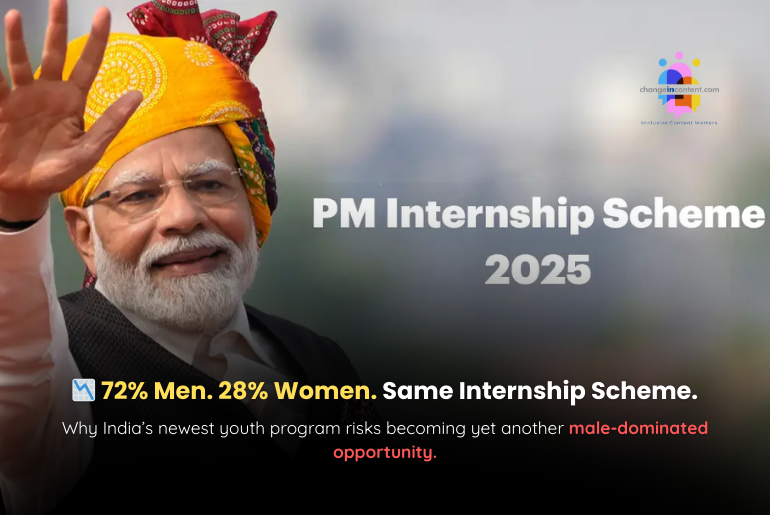
The PM Internship Scheme, launched by Union Finance Minister Nirmala Sitharaman, offers a 12-month internship opportunity for young individuals aged 21 to 24 years from low-income households. The scheme aims to connect them with India’s top 500 companies. In its pilot phase, the program plans to onboard 1.25 lakh young people. Over five years, the government aims to reach one crore beneficiaries.
However, early data from the PM Internship Scheme reveals major gender disparity. Male graduates make up the majority joining the scheme, while fewer than a third of the total beneficiaries are women graduates.
Gender disparity in pilot phase participation
Despite its potential, the scheme shows a wide gender gap. As of February, men made up 72% of the selected interns, while women formed only 28%. This trend points to a serious imbalance in gender representation during the pilot phase. Most interns chosen so far hold basic graduate degrees, and women remain significantly underrepresented in the program.
Officials say women’s participation will increase once the pilot phase ends and the scheme rolls out fully in the next 6-7 months. While this expectation shows optimism, it also raises important questions. If a large-scale national program sees such limited involvement from women at the pilot stage itself, what is preventing them from applying? Are there challenges related to safety, family responsibilities, lack of awareness, or even self-doubt?
Barriers limiting women’s participation in the PM Internship Scheme
The absence of secure accommodation is the main reason fewer women enrolled in the scheme during the pilot period. Most opportunities are available in large cities or industrial hubs, far from rural or semi-urban home districts. Without hostel facilities or safe, affordable housing, women often cannot accept internship offers, even if they qualify.
Families hesitate to send daughters to unfamiliar cities where they have no trusted support system. In many cases, these young women do not even apply, knowing that relocation without proper arrangements is not an option.
Internship placements outside a woman’s home district bring logistical and cultural challenges. Social norms often restrict women’s mobility, particularly in rural or conservative areas. Even with family support, issues like unsafe or unreliable public transport and lack of safe housing make it difficult for them to pursue these opportunities.
It is also worth considering whether women’s low participation is due to poor awareness of the scheme in certain areas.
Fix core issues before expanding
The PM Internship Scheme has already spent nearly ₹50 crore during its initial phase, and the government has raised its budget allocation to ₹10,831 crore for FY26. However, rolling out or scaling the whole program without understanding and fixing the reasons for low women interns’ participation might only widen the gap further.
The internship scheme can become a powerful tool for youth empowerment, but only if it works equally for everyone. That means collecting feedback from women who could not join, engaging with local communities to understand ground realities, and creating support systems like mentorship, flexible hours, and workplace safety.
Women indeed need more job opportunities. However, before launching a brand new internship scheme, the core problems, like a lack of safety and mobility, need to be addressed.
Closing thoughts on gender disparity in the PM Internship Scheme
The PM Internship Scheme carries great promise, but its impact depends on how inclusive its implementation becomes. If women face fundamental issues like housing, travel, and safety, they will continue to remain underrepresented.
It is essential to provide access to these opportunities to bring more women into the workforce. Failing to address the early-stage barriers will only widen the gender gap. Before expanding the program, it is crucial to resolve the challenges that are already pushing women out.
At Changeincontent, we are not celebrating women’s progress through selective success stories. We are questioning why systemic gaps still keep most women out. That is the #NoWomensDay we stand for.
Disclaimer: The views expressed in this article are based on the writer’s insights, supported by data and resources available both online and offline, as applicable. Changeincontent.com is committed to promoting inclusivity across all forms of content. We broadly define inclusivity as media, policies, law, and history, encompassing all elements that influence the lives of women and marginalised individuals. Our goal is to promote understanding and advocate for comprehensive inclusivity.