
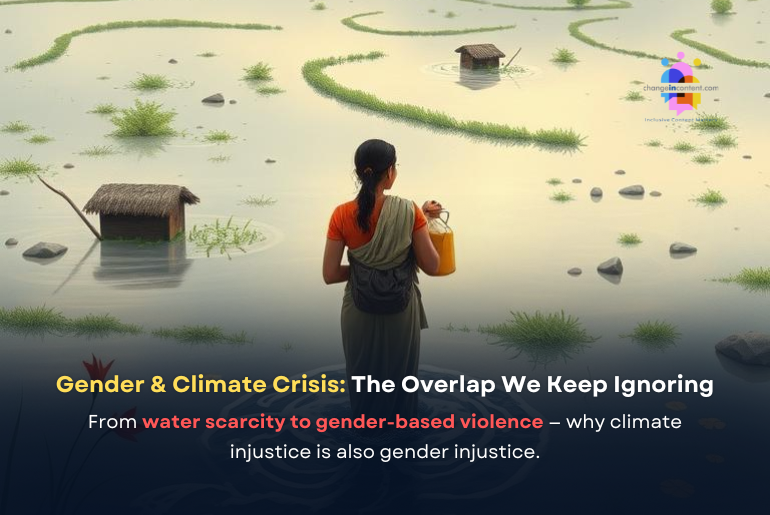
Some still ask, “What does gender have to do with the climate crisis and sustainability?” The answer to this question concerning gender and climate change is: Quite a lot. UN Women reports that women are disproportionately affected by many of the challenges outlined in the Sustainable Development Goals. As natural disasters become more frequent due to climate change, they tend to impact women, children, the elderly, and people with low incomes disproportionately.
Earlier, we shared how the water crisis places a heavier burden on women and girls. In many regions, women and girls walk long distances, sometimes several times a day, to fetch water from distant sources, a task that is both physically demanding and time-consuming. These hours are, in fact, time that could otherwise contribute to their education and skill development. The UN also estimates that 80% of those displaced by climate change are women. During these displacements, whether through climate-related disasters or migration for survival, women are exposed to gender-based violence and sexual exploitation.
So, how can we possibly claim there’s no overlap between gender inequality and the global climate crisis?
Why the climate crisis disproportionately impacts women and girls
The intersection of gender inequality and climate change continues to affect millions of women and girls worldwide. From unpaid care work to reduced access to education and resources, the consequences of climate-related stressors demand gender-responsive solutions.
Unpaid care work
To begin with, women around the world carry a heavy burden of unpaid care work. Across the globe, women perform over 75% of unpaid care work, which is 3.2 times more than men. This work includes cooking, cleaning, caring for children and elderly family members, and much more.
When climate-induced disasters, such as floods, droughts, or landslides, occur, the challenges for families and communities multiply. In such times, women, already responsible for a significant amount of household care, tend to take on even more duties. For example, they may need to care for injured family members, manage their emotional needs, collect water, or secure food and shelter, leaving little to no time for education or earning an income.
Gender-based violence
In addition to the added care burdens, climate disasters also expose women and girls to greater risks of gender-based violence. As communities struggle to recover, women are more vulnerable to exploitation, trafficking, and other forms of abuse. The breakdown of social support systems and the lack of security services also make them even more vulnerable.
Dependence on natural resources
In many regions, women rely on natural resources for their livelihoods but have less access to them. They are the primary providers of food, water, and fuel, especially in rural areas. Women in agriculture work harder to secure resources and income during droughts or irregular rainfall. It puts extra pressure on them, and often, girls are pulled from school to help manage these responsibilities.
Increased vulnerability
When disasters occur, women are more likely to be injured or even die in disasters due to long-standing gender inequalities that limit their access to resources, information, and decision-making power. In many societies, women have less mobility, meaning they may not be able to reach safety as quickly as men. They also often lack the necessary skills or training to respond to emergencies, as they have historically been excluded from training in areas like first aid, disaster preparedness, or survival techniques.
Health risks
Climate change and disasters put women’s and girls’ health at risk, particularly by restricting their access to essential healthcare services. When communities lose power, roads are blocked by fallen trees and flooding, and people evacuate to shelters, women often find themselves separated from their healthcare providers. Medical offices and pharmacies may close or reduce their hours, and transportation systems may be disrupted. During these times, pregnant and menstruating women struggle to access necessary care, as their family members and friends are also affected by the crisis and unable to assist.
Air pollution also increases the risk of various health issues for pregnant women, including hypertensive disorders, placental abruption, low birth weight, preterm birth, and lung and respiratory problems. Pregnancy naturally increases a woman’s respiratory rate. When she lives in areas with high levels of air pollution, such as smoke from wildfires, dust from droughts, or allergens, she breathes in even more harmful substances than usual.
Sustainability will remain a half-truth until it includes those who shoulder the silent burdens of the climate crisis. We cannot design climate resilience without centering women — not just as victims, but as decision-makers, leaders, and agents of change. — Saransh Jain, Founder, Changeincontent.com
Gender and climate change: The final thoughts
We need to stop treating gender and climate as two separate issues. They’re connected, and if we want real change, our solutions must reflect that. Climate action policies and conversations should make space for women’s voices, priorities, and challenges.
Climate crises target women twice. First as victims, then as caretakers in the aftermath. They’re the ones walking for hours to fetch water, holding families together in the face of loss, skipping meals so children can eat, and facing violence in crowded shelters or unsafe migration routes. These aren’t just stories from faraway places. They’re daily realities for millions in your own country.
So when somebody asks, “What does gender have to do with the climate crisis?” The answer is everything.
Disclaimer: The views expressed in this article are based on the writer’s insights, supported by data and resources available both online and offline, as applicable. Changeincontent.com is committed to promoting inclusivity across all forms of content. We broadly define inclusivity as media, policies, law, and history, encompassing all elements that influence the lives of women and marginalised individuals. Our goal is to promote understanding and advocate for comprehensive inclusivity.
