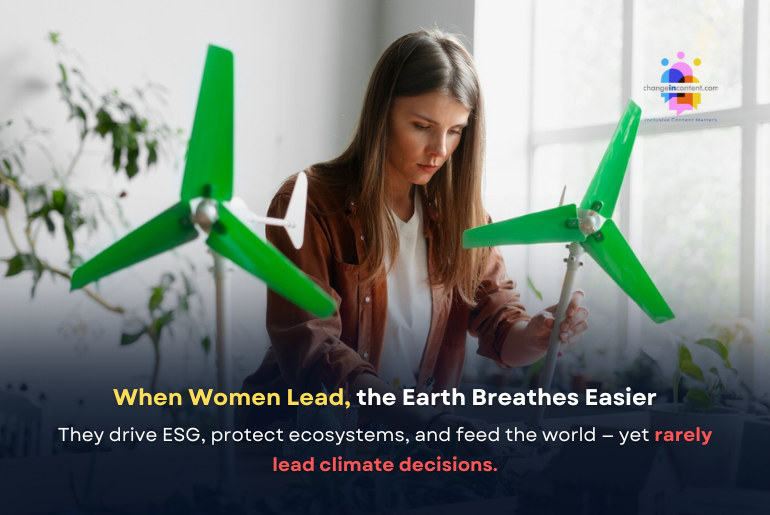
When it comes to women’s role in sustainability, the world often overlooks the changemakers who protect more than they consume. From farms to boardrooms, women’s role in sustainability is quietly rewriting the rules of resilience.
In our previous report, we addressed the ways in which the climate crisis disproportionately impacts women. The story, however, does not conclude there. While women are deeply affected by the climate crisis, they are also in a strong position to lead the way toward sustainability.
Whether in farming or corporate roles, women have always shown a strong commitment to sustainability. Over and over, we see that women are more aware of environmental issues and make choices that benefit the planet. That is what we call the eco-gender gap. Women, whether in their homes, communities, or businesses, tend to take actions that support a healthier environment.
Women’s role in sustainability: Women live and lead more
Women tend to make more climate-friendly choices in daily life. Reports show that women usually have smaller carbon footprints than men. They also show more concern for climate issues and a stronger desire to protect the environment.
The proof is already out there. Just look at Greta Thunberg, Medha Patkar, Jane Goodall, and so many others. In fact, studies show that countries with a high representation of women in parliament are more likely to sign and support international environmental treaties.
Indigenous women have also played a key role in protecting the environment. They know how to live in balance with nature and use their land wisely. Their deep understanding of local ecosystems can help us reduce greenhouse gas emissions and deal with the effects of climate change. Ignoring their knowledge is like throwing away a valuable survival guide.
Just as women make eco-conscious decisions in their daily routines, they bring the same mindset to their professional roles.
Organisations with women managers have lower carbon emissions
A study of 1,951 listed companies across 24 developed economies between 2009 and 2019 shows something worth noting. When the share of women managers increases by just one percentage point, the company’s carbon emissions drop by 0.5%. After the 2015 Paris Agreement, the difference became even clearer. Companies with more women in leadership positions (those above the median level) reduced their emissions by around 5% more than companies with fewer women managers.
But women’s role in sustainability doesn’t stop at lowering emissions. Companies with more women executives and board members tend to perform better in ESG and corporate social responsibility goals. Women also show stronger leadership during both stable periods and emergencies such as the COVID-19 crisis (in the U.S. and 91 countries), and data says the same leadership quality shows up in how women handle climate challenges.
Women in leadership and corporate sustainability
The Women as Levers of Change research by FP Analytics shows how women are making a difference in industries traditionally dominated by men, like construction, energy, mining, and utilities. The study found a strong link between having more women on corporate boards and better performance on Environmental, Social, and Governance (ESG) issues.
In fact, companies with more women on their boards were 60% more likely to reduce energy consumption, 39% more likely to cut greenhouse gas emissions, and 46% more likely to use less water. On top of that, these companies saw a 74% greater improvement in social responsibility, including better labour rights, gender equality, and support for local communities.
It is not to say that women are only promoting sustainability in 9-to-5 office jobs in urban areas. Women are also leading significant change in agriculture, a core pillar of India’s economy.
The sustainable role of women in agriculture
One of the clearest examples of women’s importance in sustainability is in agriculture. Across many developing countries, women carry out much of the farming work, especially as smallholder farmers. However, they often do this without equal access to land, tools, credit, or training.
Research shows that if women received the same resources as men, their farm yields would rise by 20 to 30%. This increase could feed 100 to 150 million more people and reduce world hunger by up to 17%. In addition, improved farming practices led by women could lower carbon dioxide emissions by as much as 2.1 gigatons by the year 2050. These are not small changes. They show that supporting women in agriculture is a necessary step toward a more sustainable future.
But the problem is, The Leadership Gap…
Despite the undeniable contributions women in corporate make to sustainability, they remain largely underrepresented in leadership roles, particularly in climate policy and decision-making. Today, only 8.4% of board chairs and just 6% of CEOs globally are women. At the current rate, Deloitte estimates that gender equality for board chairs will take until 2073. For CEOs, it could take until 2111.
The political space shows similar gaps. As of January 1, 2025, women hold only 22.9% of cabinet positions that lead ministries and oversee policies. Just nine countries have achieved gender balance in their top-level cabinets. In most nations, men still lead the majority of policy areas. Most importantly, women do not have enough representation in climate-related decisions.
Women’s voices, perspectives, and leadership must be included in climate strategies and sustainability goals at every level. Whether in politics, business, or agriculture, women have proven their commitment to sustainability. It is time that this dedication is reflected in the leadership roles they occupy, giving them the authority and influence needed to create systemic change.
Women’s role in sustainability: The closing thoughts
When women lead, climate action and sustainability improve. However, too often, their voices are missing from the conversations where it matters most. We cannot afford to ignore half of the world’s ideas, energy, and leadership. To build a sustainable future, climate strategies and sustainability goals must include women at every level.
At Changeincontent, we are done celebrating performative praise. We want real power, real presence, and real change because this is the #NoWomensDay we are fighting for.
Disclaimer: The views expressed in this article are based on the writer’s insights, supported by data and resources available both online and offline, as applicable. Changeincontent.com is committed to promoting inclusivity across all forms of content. We broadly define inclusivity as media, policies, law, and history, encompassing all elements that influence the lives of women and marginalised individuals. Our goal is to promote understanding and advocate for comprehensive inclusivity.