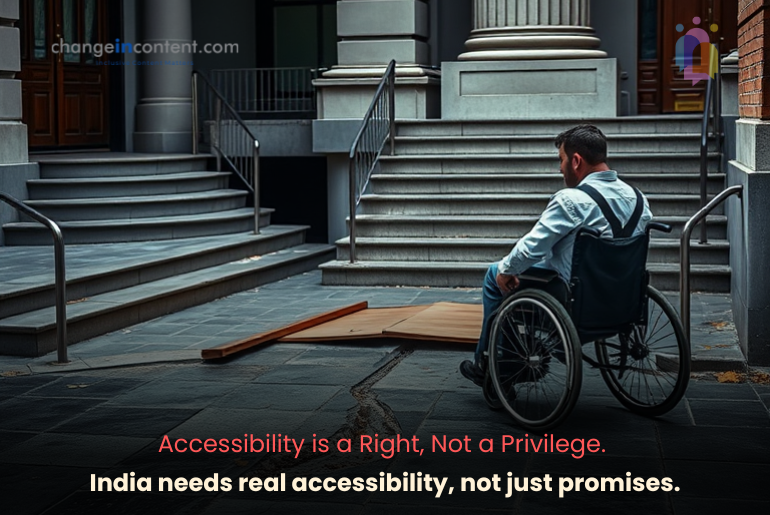
A recent ruling by the Supreme Court on Disability Rights has reaffirmed that accessibility is a fundamental right, not a privilege. The Supreme Court’s latest ruling not only demands urgent action on physical accessibility but also pushes for a much-needed shift in how society talks about disability. Is India finally ready to move beyond token inclusivity and create real change?
In November 2024, the Supreme Court affirmed that the right to access environments, services, and opportunities for persons with disabilities (PWDs) is a human and fundamental right. Although the right to accessibility is legally recognised, it has not led to any real change in daily life for PWDs. Basic facilities and services remain largely inaccessible. Policymakers have frequently overlooked the needs of PWDs, leaving them marginalised in development projects.
Governments have long made promises about inclusivity but failed to take meaningful action, resulting in minimal progress. The recent ruling, however, demands immediate action, starting at the grassroots level, to ensure PWDs can fully participate in all areas of public life, whether in education, work, transport, or more.
Setting a new standard for accessibility
Although the Persons with Disabilities Act of 1995 established the legal framework for disability rights in India, real progress took years. It wasn’t until December 2017 that the Supreme Court issued a ruling under the amended Rights of Persons with Disabilities Act, 2016, and the Accessible India Campaign, a national initiative aimed at improving accessibility for people with disabilities.
The ruling outlined 11 specific action points for all states and union territories to address. These points focused on improving accessibility in public spaces, such as government buildings, transport infrastructure, airports, railways, and the digital ICT ecosystem. The aim was to ensure that people with disabilities could fully participate in public life and access services without unnecessary barriers.
Despite these directives, many states and union territories failed to act. Accessibility improvements remained limited, and many public spaces still did not comply with the legal requirements. As a result, the Supreme Court has now called for the establishment of minimum mandatory accessibility standards. The ruling also introduces stricter accountability measures, including withholding completion certificates for non-compliant projects and imposing fines on those who fail to meet accessibility standards.
If fully implemented, it could be a much-needed progress toward building an inclusive society for people with disabilities. Most importantly, accessibility should not be limited to ramps and elevators but extend to the language we use.
Language matters just like accessibility does
India still struggles with deep prejudices, discrimination, and stigma towards people with disabilities. It often shows up in the use of harmful and ableist language. One example is the term “Divyangjan,” which the Indian government uses as an official label for people with disabilities. The term, meaning “persons with divine bodies,” has faced criticism from disability rights groups and activists. These organisations have voiced their concerns, pointing out that the term’s context is dehumanising and patronising, ultimately failing to reflect the lived reality of people with disabilities.
The Rights of Persons with Disabilities Act 2016 penalises offensive speech. However, the Act only targets speech made with offensive intent. This focus on intent leaves too much room for ambiguity. Words like “Langda” (lame), “Retard,” “Behra” (deaf), and “Andha” (blind) have gone from being medical terms to slurs. Over time, these words have lost their original meaning and now reinforce negative stereotypes, becoming insults used to mock and belittle people with disabilities.
Also Read: The Supreme Court’s Landmark Ruling on Toilets in Court Tribunals
Changing language, changing perspectives
Using the right language can help challenge negative views about people with disabilities and create a more inclusive and respectful society. That is why the Supreme Court of India released a “Handbook Concerning Persons with Disabilities.” The handbook gives clear instructions on how to avoid harmful stereotypes about disability and highlights the importance of using respectful language when discussing it. The main goal is to address the widespread linguistic issue in India, where people with disabilities are often referred to with derogatory terms.
The Supreme Court’s handbook highlights the importance of using respectful and thoughtful language. It advises judges and professionals to avoid terms like “crippled” or “differently-abled,” which often sound condescending or attempt to soften the reality of disability. Instead, the handbook encourages using a “people-first” approach, such as saying “persons with a disability” rather than labelling someone as a “disabled person.” It also recognises that some people may prefer “identity-first” language, like “disabled person,” which acknowledges disability as an important part of who they are.
Words influence how society sees and treats people, and the right language can either reinforce harmful stereotypes or promote greater understanding and inclusion.
Statement by the Supreme Court on Disability Rights: The final thoughts
It is 2025. We need to move beyond simply making promises about inclusivity and accessibility. India needs a future where accessibility is a reality in every sense of the word and where PWDs can live without barriers, whether physical, social, or linguistic. Laws for the rights and accessibility of people with disabilities are in place, and more are on the way. However, laws mean little if they aren’t properly implemented. The focus should be on turning promises into action.
Disclaimer: The views expressed in this article are based on the writer’s insights, supported by data and resources available both online and offline, as applicable. Changeincontent.com is committed to promoting inclusivity across all forms of content. We broadly define inclusivity as media, policies, law, and history—encompassing all elements that influence the lives of women and gender-queer individuals. Our goal is to promote understanding and advocate for comprehensive inclusivity.