
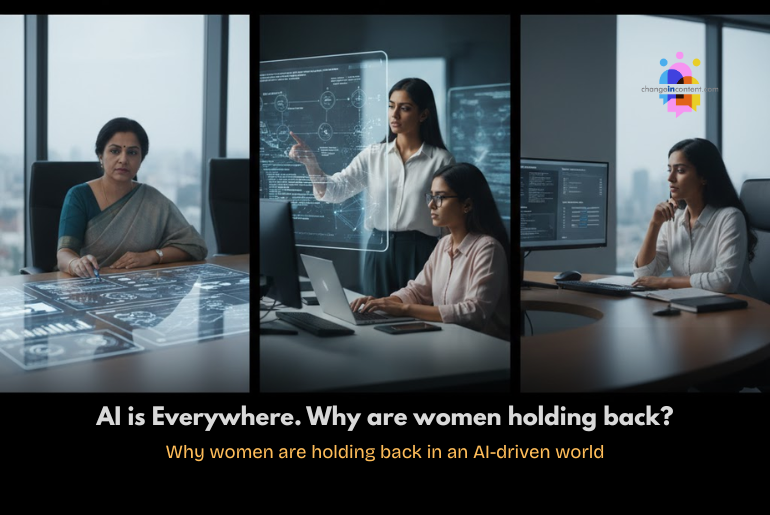
Artificial Intelligence tools are now an integral part of everyday work, learning, and communication. From writing and coding to research and decision-making, AI has quietly become a default layer of modern life. And yet, when it comes to Women and AI, a clear gap persists. Women remain significantly less likely than men to use AI tools regularly. Unfortunately, this remains a reality, despite women being equally capable and often more affected by the outcomes these technologies produce.
At changeincontent, we have constantly discussed the underrepresentation of Women in AI. Unfortunately, women constitute only one in five professionals in India’s artificial intelligence (AI) and machine learning (ML) workforce. Globally, women account for only 22% of AI talent, with less than 14% holding senior executive roles in the AI sector. These numbers reflect that women are more likely than men to avoid AI tools.
This hesitation does not result from a lack of technical ability or awareness. Instead, it reflects deeper concerns around trust, ethics, reputation, and accountability. These are issues that women are far more likely to confront directly when engaging with emerging technologies.
Women and AI Adoption: Who is actually using these tools?
Even with AI everywhere, women still use it far less than men. In early 2025, 64.32% of ChatGPT users were male, while 35.68% were female. A Harvard Business School meta-analysis of 18 studies found that women have 22% lower odds of using generative AI websites and apps, whether at work or in daily life.
Between 2022 and 2024, women accounted for approximately 42% of global users of ChatGPT and Perplexity, but only 31% of users on Anthropic’s platforms. Mobile apps often reflect how deeply technology has become part of everyday life.
People download apps when they plan to use something regularly, not just experiment with it once or twice. When only 27% of ChatGPT app downloads come from women, it suggests that far fewer women view AI as a daily tool for work, learning, or personal tasks.
Although the benefits of AI apply equally to men and women, women adopt AI tools at an average 25% lower rate than men.
Women don’t trust AI that easily (and honestly, they have a point)
Women tend to view AI more critically than the people developing it. While many designers focus on building fast, cool, and impressive tools, women focus more on how these tools might fail or cause harm. They notice issues such as biased responses, misuse of personal data, and AI-generated information that appears unreliable, sexist, or even dangerous.
Rather than being swayed by new features or hype, women ask practical questions. They want to know who owns their data, how companies store and use it, and who will be accountable when AI spreads wrong or harmful content. Take the recent Grok controversy as an example.
Women tend to worry more about data leaks and personal information when using AI. They hesitate to share work details, health questions, or individual thoughts with tools that store conversations and train on user data. With constant news about breaches and misuse, that fear doesn’t come out of nowhere. It feels risky to trust a system when companies rarely explain how they use your data.
When design and moderation fail women first
Now comes the bigger issue: misogynistic policies and design choices. Several AI platforms fail to actively address gender bias in training data or moderation rules. Women see how systems repeat stereotypes, dismiss women’s experiences, or generate deepfake content without consequences.
Do women think AI is cheating? The ethics gap
When it comes to using AI, many women don’t just think about what the tool can do. They think about whether they should use it in the first place. A big concern is that using AI feels like cheating, cutting corners, or crossing an ethical line.
The more seriously women take their work, the more cautious they are about using AI. A study at NHH found that female students use AI less frequently than male students, particularly among those with higher academic skills. The study also reports that men were less likely to see generative AI as cheating.
When policy changes behaviour
The same study showed that rules and policies can completely change AI use behaviour among men and women. When colleges or institutions banned AI, many male students still used AI tools anyway, even if it broke the rules.
Women, on the other hand, mostly chose not to use AI to comply with the policy and avoid wrongdoing. However, when institutions officially allowed AI, women felt more comfortable using the tools. The usage gap almost disappeared, with over 80% of men and women using AI.
Business leaders in a roundtable hosted by the Science of Diversity and Inclusion Initiative (SODI) said they see the same thing at work. Women often wait for clear approval before using AI tools, while men experiment freely. This shows that women prioritise using AI ethically and within the rules.
AI helps men. It hurts women’s reputation.
Women often worry that relying on generative AI will make them appear to lack skills, effort, or originality. A Harvard Business Review study found that women engineers who used AI to generate code received ratings 9% lower in competence than male engineers, even though both groups submitted the exact same outputs. The work looked identical, but evaluators judged women more harshly simply because they knew a woman used AI.
It creates a double standard. When men use AI, people perceive them as smart, efficient, and technologically proficient. When women use AI, people question their ability and credibility. So for women, using AI comes with a reputation risk.
Over time, this kind of bias discourages women from using AI at all. If the same tool earns praise for men but raises doubts for women, women may learn that avoiding AI feels safer than risking being seen as less capable or professional.
At the core, this comes down to ethics. Many women care deeply about doing things the right way. They don’t want shortcuts that feel dishonest, even if everyone else uses them. They think about fairness, rules, and long-term impact, not just speed and results. Thus, when women refrain from using AI, it isn’t due to fear of technology. It stems from a stronger commitment to ethical and responsible conduct.
Changeincontent perspective
At changeincontent, we do not see women’s hesitation around AI as a weakness. We see it as a signal. Women are responding rationally to systems that prioritise speed over safety, growth over governance, and disruption over responsibility.
The problem is not that women are holding back from AI. The problem is that AI ecosystems have failed to earn women’s trust. From data misuse to reputation penalties, women face higher risks for the same behaviour. Moreover, the society judges them more harshly when they participate.
If AI is to shape the future of work and society, it must be built in ways that reward ethical use, protect reputations, and centre accountability. Until then, women’s caution may be the most responsible response in the room.
Women and AI: The closing thoughts
Women’s relationship with AI reveals a deeper truth about technology itself. Innovation often celebrates speed, disruption, and experimentation. Women prioritise responsibility, fairness, and long-term impact. This clash explains the gap more than any skill issue ever could.
Disclaimer: The views expressed in this article are based on the writer’s insights, supported by data and resources available both online and offline, as applicable. Changeincontent.com is committed to promoting inclusivity across all forms of content. We broadly define inclusivity as media, policies, law, and history. It encompasses all elements that influence the lives of women and marginalised individuals. Our goal is to promote understanding and advocate for comprehensive inclusivity.
