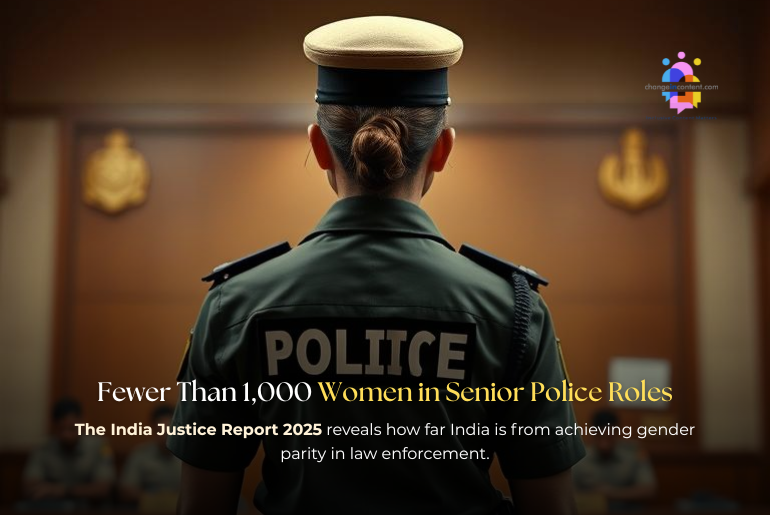
The India Justice Report 2025 shines a sharp light on the cracks within India’s law enforcement framework. Gender representation, especially in senior policing roles, remains a distant goal even after years of reform promises.
The India Justice Report (IJR) 2025 is the country’s only data-based index that ranks how well states and Union Territories support the core pillars of the Indian justice system. First introduced in 2019 with the support of Tata Trusts, the report continues to measure both progress and gaps in how states manage and invest in their justice systems.
IJR continues to track budgets, human resources, infrastructure, workload, and diversity across police, judiciary, prisons, legal aid, and Human Rights Commissions for all 36 states and UTs. The 2025 report shows that even with rising awareness of gender diversity in law enforcement, progress remains disappointing.
India Justice Report 2025: Gender disparity in the police force hierarchy
Among the report’s major findings is the noticeable lack of gender parity in the police force. Out of over 20 lakh police personnel across India, fewer than 1,000 women hold senior ranks like Director-General or Superintendent of Police. Instead, over 90% of women in the police serve at the constable level. This means that around 2.17 lakh women are at the constable level. Even more concerning, not a single state or Union Territory has met its target for the number of women in the police force.
The total authorised strength of the IPS stands at 5,047 officers. However, from the 2.4 lakh women currently serving in the police force, only 960 have reached the Indian Police Service (IPS) ranks. Another 24,322 women hold non-IPS officer roles such as Deputy Superintendent, Inspector, or Sub-Inspector.
States’ struggle to achieve 33% women’s representation in the police
The report also estimates how long it will take for each state to reach at least 33% representation of women in the police force. At the current rate of recruitment and promotion, Jharkhand would take 206 years to meet this goal, while Andhra Pradesh could achieve it in just 3 years. This wide gap highlights the uneven pace of progress across states.
Only three states have a notable share of women in their police forces, and even then, the numbers remain under 25%. Bihar has the highest share of women in the State police, at 23.7%. Following Bihar are Andhra Pradesh at 21.5% and Tamil Nadu at 20.7%. In contrast, states like Tripura and Meghalaya have a much lower share, with women making up just 5.7% and 5.8% of their total police staff, respectively. At this rate, India is estimated to take 24 years to achieve 33% women’s representation in the police force across the country.
Challenges for marginalised communities in the justice system
The India Justice Report (IJR) highlights significant challenges faced by marginalised communities, including persons with disabilities, Scheduled Tribes (STs), and Scheduled Castes (SCs), within India’s law and justice systems.
Underrepresentation of STs and SCs
The representation of Scheduled Tribes and Scheduled Castes in the judiciary and police force remains insufficient. In the district judiciary, the share of SCs and STs is only 14% and 5%, respectively. In the police force, SCs account for 17%, while STs make up 12%.
Decline in paralegal volunteers
Paralegal volunteers (PLVs), who mostly help members of marginalised communities access legal aid, have significantly decreased by 38% over the past five years. Currently, there are only 3 PLVs per lakh population, making it harder for people to access necessary legal services.
Human Rights Commissions and alternative dispute resolution
India’s prison population is projected to reach 6.8 lakh by 2030. The IJR warns that without urgent systemic reforms, the justice system will continue to disproportionately affect vulnerable and marginalised communities.
The India Justice Report (IJR) assessed the performance of 25 State Human Rights Commissions, stressing the urgent need for improved support for individuals with disabilities. The report also highlighted the potential of mediation as an alternative dispute resolution (ADR) method, which could ease the pressure on the formal justice system.
The India Justice Report (IJR) 2025 sourced information from official portals such as the National Crime Records Bureau (NCRB), the Ministry of Law and Justice, the National Judicial Data Grid (NJDG), and Prison Statistics India.
The final thoughts on the India Justice Report 2025
With fewer than 1,000 women out of over 20 lakh police personnel in senior roles, it becomes evident that while awareness around gender equality is growing, meaningful progress is still far behind. The IJR also brings attention to the struggles of marginalised communities, particularly Scheduled Tribes (STs) and Scheduled Castes (SCs), who continue to face exclusion in both the judiciary and police forces.
The alarming gap in representation, along with the declining number of paralegal volunteers who are essential for providing legal support, exposes how difficult it remains for these communities to access justice. Only by recognising these disparities and actively working towards inclusive reforms can we hope for a future where justice is genuinely accessible to all.
At Changeincontent, we believe these statistics are not just numbers; they reflect lived realities that demand urgent change. Read our related insight on the gender gap in India’s top bureaucracy to explore how deep-rooted the imbalance runs.
Disclaimer: The views expressed in this article are based on the writer’s insights, supported by data and resources available both online and offline, as applicable. Changeincontent.com is committed to promoting inclusivity across all forms of content. We broadly define inclusivity as media, policies, law, and history, encompassing all elements that influence the lives of women and marginalised individuals. Our goal is to promote understanding and advocate for comprehensive inclusivity.