
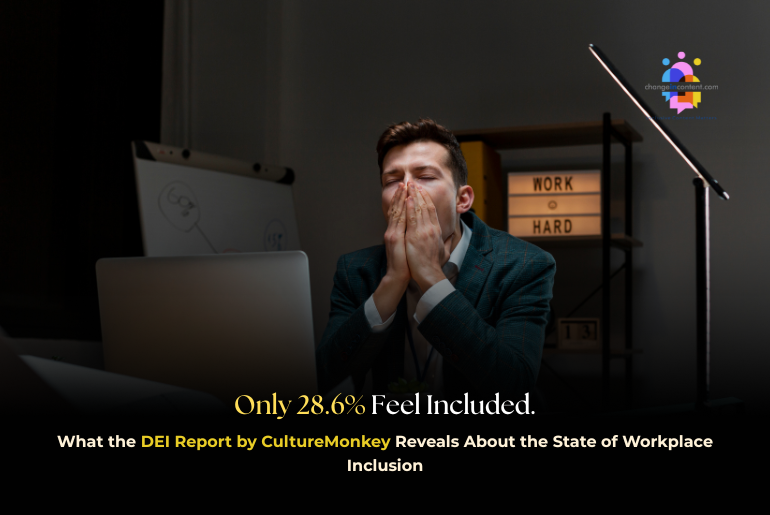
The DEI Report by CultureMonkey is a mirror, and the reflection is uncomfortable. The numbers do not lie, but they do reveal something deeper: that intention without impact is the biggest threat to inclusion.
CultureMonkey, an employee engagement and feedback platform, has published a new global report examining how Diversity, Equity, and Inclusion (DEI) is being implemented in workplaces. The findings suggest that even with a strong DEI focus, several organisations fall short in providing fair treatment and adequate support to all employees. There is a gap between what companies promise and what employees actually experience on the ground.
DEI Report by CultureMonkey: Survey findings across regions
The report includes feedback from over 10,000 employees across the US, Europe, India, and the broader Asia-Pacific region. It shows that 61.2% of employees believe their company’s DEI efforts contribute positively to their work experience. However, only 28.6% feel truly included at work.
Many respondents raised concerns about biased shift assignments, favouritism in promotions, and inaccessible workplace infrastructure for people with disabilities. Employees feel that inclusive values often remain at the surface level, without being fully integrated into everyday operations.
The findings reveal a gap between what companies say they are doing and what employees actually experience, especially when it comes to feeling included, treated fairly, and supported. Such a disconnect raises concerns about how well companies are practising DEI principles throughout the organisation, from top leadership to entry-level staff.
DEI Report by CultureMonkey shows structural gaps in implementation
Access to learning programs also remains unequal. While only 16.3% of employees appreciated the availability of diversity training and learning opportunities, many said access to these resources wasn’t evenly distributed.
While companies often promote DEI programs, the reality is that many employees do not have equal access to them. The uneven distribution of such resources is a significant issue that needs addressing. Employees in some departments or at certain levels may be given priority for these opportunities. Unfortunately, others are left out. That creates a sense of inequality. If diversity training programs are not accessible to everyone, the benefits of these initiatives cannot reach their full potential, and the overall workplace culture remains divided.
There is also the ‘Recognition Gap’ issue
In addition to unequal access to learning programs, only 10.2% of employees report feeling fairly recognised. Despite companies investing in DEI strategies, many workers still report pay gaps, biased recognition systems, and inconsistent promotion practices. Reports have shown that women are less likely to be recognised for their contributions compared to their male counterparts.
Only 15% of women receive recognition on a weekly basis, compared to 21% of men. Women often feel their work goes unnoticed, even when they perform at the same level as their male colleagues. Moreover, 17% of women report never being recognised for their efforts, while just 12% of men feel the same. Women with disabilities might experience even greater difficulty getting the recognition they deserve.
For a more inclusive workplace, companies must ensure that every employee, no matter their gender or ability, is regularly acknowledged for their work. It requires fair and consistent recognition practices that make all employees feel valued.
Is there pressure to be seen as “Inclusive”?
One primary reason why many employees still don’t feel truly included, despite companies’ various DEI (Diversity, Equity, and Inclusion) initiatives, is the pressure. It is the pressure that organisations face to be seen as inclusive rather than actually being inclusive. Many companies are eager to show that they are committed to DEI. It is often for the sake of reputation, public image, or meeting external expectations. It can lead to organisations focusing more on how things look rather than genuinely building an inclusive culture.
However, simply having the goal of becoming diverse and inclusive is not enough. For DEI to be truly effective, it is vital to be consistent. Moreover, it is crucial to have meaningful action from leadership at all levels. While the pressure to be seen as inclusive is understandable, it should not come at the cost of true inclusion.
As Senthil Kumar Muthamizhan, Founder & CEO of CultureMonkey, said, “The intent to build more diverse and inclusive workplaces is clearly there, and that’s encouraging. The real opportunity now is turning that intent into everyday impact, and that starts with consistent follow-through from leadership.”
DEI Report by CultureMonkey: Time to rewrite the playbook
Without fair and transparent systems in place, even the most well-intended DEI efforts lose their impact. Employees need to see evidence that DEI principles are part of how decisions are made. They must not feel that these are just words in a policy document.
As the report mentioned, we at ChangeinContent also believe organisations must move past superficial DEI efforts. Instead, we must focus on building workplaces where all employees, no matter where they are from, what they do, or who they are, feel truly respected, supported, and included.
At Changeincontent, we ask: How long will we measure inclusion through compliance instead of culture?
Explore our take on how a Diversity and Inclusion Policy should be the blueprint for actual change: Read the full article.
Disclaimer: The views expressed in this article are based on the writer’s insights, supported by data and resources available both online and offline, as applicable. Changeincontent.com is committed to promoting inclusivity across all forms of content. We broadly define inclusivity as media, policies, law, and history, encompassing all elements that influence the lives of women and marginalised individuals. Our goal is to promote understanding and advocate for comprehensive inclusivity.

1 comment
Hello there I am so delighted I found you blog, I really found you by error, while I was researching on Yahoo for sometbing else, Anyhow I am here now and would just like to say kudos for a incredible post aand a alll round exciting blog (I also love the theme/design), I don’t have tiome to read it all at the moment but I have bookmjarked it and also added your RSS feeds, sso when I have time I will be back to read more, Please do keep up the awesome job.