
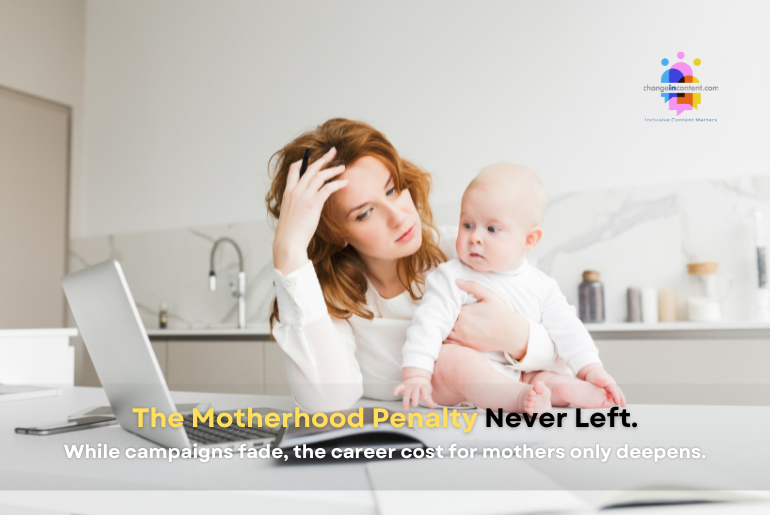
The motherhood penalty does not show up in ads. But it shows up in appraisals, in missed promotions, and in conversations that never happen. What if we told you that the real cost of being a mother in the workplace begins right after the flowers fade?
This year’s Mother’s Day came and went. Brands launched heartfelt campaigns. Emotional posts flooded WhatsApp and Instagram. Very similar to Women’s Day, many recycled messages made another round. But between all the praise and sentiment, we continue to ignore the harsh reality known as the motherhood penalty.
What is the Motherhood Penalty?
The “motherhood penalty” refers to the disadvantages that women face at work after becoming mothers. When a woman has a child, she often takes time off from work for childbirth and recovery. Many women either reduce their working hours or shift to flexible or part-time roles to manage childcare. Over time, this affects their ability to take on leadership roles, pursue promotions, or even stay in the workforce.
Studies show that women reduce their paid working hours by around 35% in the first five years after having a child. Their earnings drop by 55% compared to their pre-pregnancy income. This income gap has stayed wide for at least ten years. However, men see only a brief decline in work hours after becoming fathers, usually just for the first month.
The overlooked capabilities of working mothers
Many working mothers in India face bias both at home and at work. In fact, around 69% say they’ve been treated unfairly at work because of their family responsibilities. For example, some are judged for leaving their children at daycare, while others face pressure from relatives who believe mothers should stay at home.
It’s also strange how easily people overlook the skills that mothers use every day. A mother often manages everything at home, be it meals, school routines, doctor appointments, budgets, and more. She plans ahead, adapts quickly, and handles pressure without a break. These are the same qualities any company would value in a team member. Yet, when she returns to work, many assume she is less capable.
Instead of recognising the multitasking and leadership she shows at home, managers often reduce her workload or exclude her from big projects. They believe she won’t be able to put in long hours or meet tight deadlines.
What Indian working mothers face
In countries like the US and Western Europe, the motherhood wage penalty ranges from 3% to 16%. However, India’s issue is more serious. Many women never return to the workforce after becoming mothers. Data shows that 73% of Indian women leave their jobs after childbirth. Among them, 50% step away specifically to care for their children. Even for those who return to work, nearly half (about 48%) exit the workforce again within just four months.
According to Aon’s Voice of Women study of 24,000 women employees, one in six Indian women did not know if their job would still exist after their maternity break. Shockingly, half of them never had a proper career conversation before going on leave.
Many women returning to work reported lower performance ratings, missed promotions, smaller raises, or being moved to roles they didn’t prefer. Interestingly, women who had pre-maternity discussions with their managers experienced better outcomes on all these fronts.
It shows that open conversations matter, and good support makes a difference.
Why do so many mothers leave the workforce?
A report by IWWAGE at Krea University showed a drop in women’s participation in salaried jobs in both rural and urban India in 2017–18 and again in 2023–24. The top reasons are childcare and household work. Many women step back from their careers because they are expected to manage childcare and unpaid household work, often without adequate support from family, employers, or public services.
The situation becomes more difficult when a woman has a child she did not plan for. Data shows that when a woman has one more child than intended, her earnings fall by 2.9%, and her likelihood of staying employed drops by 8%. These effects are more severe in states outside southern India. In those regions, wages fall by 5%, and the chance of staying employed decreases by 1.2% after an unplanned parenthood.
Whether a woman works full-time or part-time, it does not matter. There is a deep-rooted expectation that women will handle caregiving responsibilities regardless of their job status. As a result, mothers often take on the double burden of work and home. Many workplaces still lack policies that support the long-term retention of working mothers. Without access to affordable childcare, clear return-to-work plans, or flexible schedules, women are forced to choose between caregiving and career.
The problem is that the workforce remains designed for people without caregiving responsibilities. Until that changes, women will continue to leave, not because they lack ambition but because the system makes it nearly impossible for them to stay. The goal is not to make mothers choose between work and family. It is to make sure they don’t have to.
The Motherhood Penalty will not end with platitudes
Appreciating mothers once a year is not enough. Companies must go beyond campaigns and start building workplaces where motherhood doesn’t come with a cost. Conversations and policies around flexibility, career planning, and re-entry support must become mandatory.
Let’s stop romanticising sacrifice and start building systems that respect and retain mothers at work. By the next Mother’s Day, let’s aim for real change, not recycled slogans.
At Changeincontent, we believe true inclusion means changing the system, not just the sentiment. Explore our article on why it is vital to break stereotypes and why we advocate for #NoWomensDay. Read here.
Disclaimer: The views expressed in this article are based on the writer’s insights, supported by data and resources available both online and offline, as applicable. Changeincontent.com is committed to promoting inclusivity across all forms of content. We broadly define inclusivity as media, policies, law, and history, encompassing all elements that influence the lives of women and marginalised individuals. Our goal is to promote understanding and advocate for comprehensive inclusivity.
