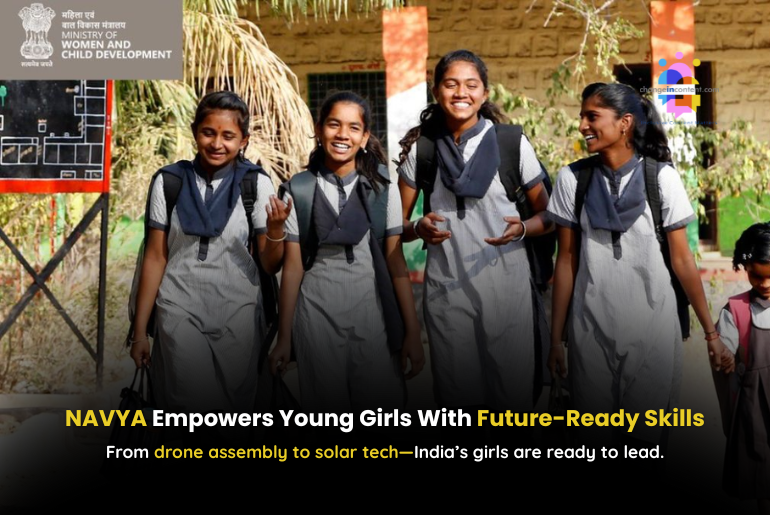
In a bold move echoing the Viksit Bharat @2047 vision, the Government launches NAVYA, a pilot initiative targeting adolescent girls aged 16–18 from vulnerable regions. Unveiled in Sonbhadra, Uttar Pradesh, NAVYA is a joint effort by the Ministry of Women & Child Development (MWCD) and the Ministry of Skill Development & Entrepreneurship (MSDE). The Government of India’s program offers vocational courses through the PMKVY and PM Vishwakarma schemes.
NAVYA aims to bridge the gender divide in non-traditional sectors, foster economic independence, and nurture the entrepreneurial spirit among young girls in tribal, aspirational, and North-Eastern districts. By positioning skill-building as a gateway to empowerment, NAVYA seeks to redefine the future of women-led development in India.
Government launches NAVYA: Aims, scope & strategic alignment
NAVYA, which stands for Nurturing Aspirations through Vocational Training for Young Adolescent Girls, focuses on girls with at least a Class 10 education in 27 districts across 19 states. It will prioritise aspirational and tribal areas.
By offering short-term, market-aligned courses in tech, design, solar PV, telecom, drone assembly, CCTV installation, and embroidery, NAVYA disrupts gendered job stereotypes. It formalises MWCD–MSDE convergence, aligning girl-specific training with PMKVY and PM Vishwakarma’s well-established frameworks.
NAVYA: Empowerment beyond employment
Minister Jayant Chaudhary describes NAVYA as a tool for “confidence, economic independence, and entrepreneurial spirit”, not just employment. In tribal regions where social norms often limit girls’ progression, NAVYA’s focus on self-reliance is transformative.
Minister Savitri Thakur called it a “milestone” for enabling dignity and self-belief among adolescent girls. NAVYA moves beyond training to holistic development by providing certificates, interactive mentorship, and entrepreneurial pathways.
Reaching the underserved: Pilot districts
NAVYA’s pilot includes 27 districts in aspirational and North-Eastern states, selected for being socially underserved. Sonbhadra, Uttar Pradesh, was chosen for its demographic mix and urgent skills needs.
Formalising collaboration between MWCD and MSDE ensures sustained focus and scalability. By leveraging existing schemes, NAVYA can scale quickly. It is crucial for achieving Viksit Bharat @2047 milestones.
Why NAVYA matters: A gender-responsive lens
Addressing gender disparity in vocational training is essential. National surveys show adolescent girls lack access to suitable skill-building opportunities compared to boys. Non-traditional roles remain inaccessible primarily to young women.
NAVYA tackles this head-on through:
- Redefining vocational roles beyond conventional expectations
- Creating economic pathways for girls in underserved regions
- Fostering self-belief in transferable, future-ready skill sets
For the Viksit Bharat agenda to be inclusive, empowering young girls with future-ready skills is the foundational step.
Challenges & considerations
The government launches NAVYA, and its vision is bold. However, realisation requires overcoming certain challenges:
- Infrastructure readiness: Rural centres must offer quality training and tools
- Cultural acceptance: Non-traditional job roles may face resistance in conservative areas
- Sustained mentorship: Post-training support is essential to ensure meaningful employment or entrepreneurship
- Monitoring & evaluation: Transparent metrics must track employment outcomes, entrepreneurship, and confidence levels
If not structurally supported, NAVYA risks becoming another token scheme. But with proper governance, it can serve as a model for gender-transformative policy.
Conclusion: Government launches Navya—A vision for inclusive skilling
By launching NAVYA, the Indian government has signalled a departure from generic skill schemes toward gender-sensitive, aspirational-focused programmes. NAVYA aligns with PMKVY and MSDE’s platforms. It offers a scalable launchpad for girls into future industries, all while building agency and confidence.
The pilot is a promising start, but the real test will be in execution, follow-through, and outcomes. Will these girls emerge as skilled technicians, entrepreneurs, and leaders? NAVYA’s impact hinges on sustained support, local engagement, and adaptive evaluation.
In the policy realm, NAVYA could serve as a blueprint for future gender-responsive initiatives—integrating skilling with dignity, representation, and empowerment as cornerstones of India’s next development wave.
For more on women-centric empowerment schemes, read: Palna Scheme under Mission Shakti: The government’s commitment to empower women and protect children.
Disclaimer: The views expressed in this article are based on the writer’s insights, supported by data and resources available both online and offline, as applicable. Changeincontent.com is committed to promoting inclusivity across all forms of content. We broadly define inclusivity as encompassing media, policies, law, and history, which collectively influence the lives of women and marginalised individuals. Our goal is to promote understanding and advocate for comprehensive inclusivity.