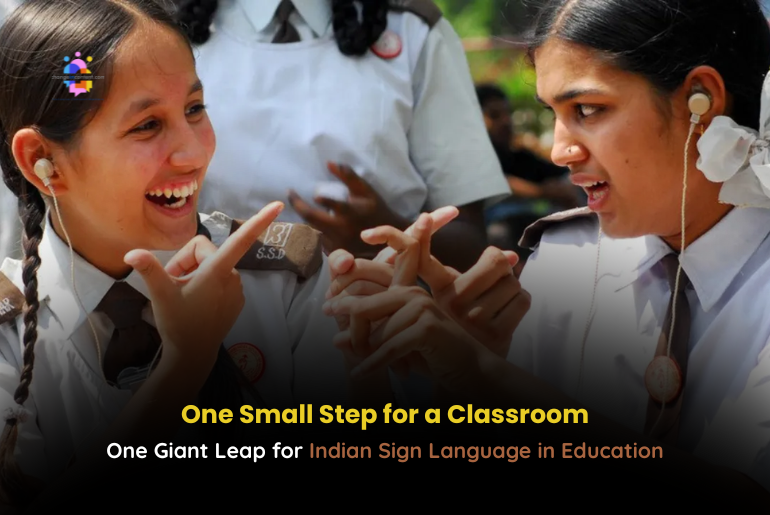
Indian Sign Language is finally making its way into India’s classrooms, not as a special module, but as a legitimate academic subject. In a significant move that could redefine inclusive education, Assam has become the first Indian state to introduce ISL as an elective for Class 11 students. This is more than just a curriculum update; it is a cultural shift.
Every time we talk about inclusion, someone jumps in to say we need to prioritise regional languages. The arguments are loud. Why can’t every Indian speak Hindi? Why should anyone in Bengaluru get by without Kannada? But through all this noise, we often forget one language that truly reveals whether we genuinely care about inclusion or not. Sign language.
Sign language doesn’t get the same attention. Not in classrooms, not in policy debates, and rarely in everyday conversations.
We talk about inclusive communication. But skip the most important language
Roughly 466 million people worldwide rely on sign language. In India, about 63 lakh people have hearing disabilities. However, less than 2% know Indian Sign Language (ISL). Most never even get the chance to learn it.
More than 90% of deaf children in India are born to hearing parents. The education system does little to close that communication gap. Only around 5% of children with hearing impairments receive even basic education. That’s where the problem begins. It is not a matter of infrastructure or technology, but rather a simple failure to speak the language these children understand. They sit in classrooms designed for people who can hear. They are taught by teachers who don’t know ISL. Eventually, many of them drop out.
Change doesn’t need to come from everywhere at once. Sometimes it just needs to start somewhere. Assam has taken that first step.
Assam brings Indian Sign Language into classrooms
Beginning in the 2025–26 academic year, Assam will offer Indian Sign Language as an elective subject in Class 11. With this move, the state becomes the first in India to include ISL alongside other electives, such as Artificial Intelligence and Financial Literacy. The decision was announced by Education Minister Dr. Ranoj Pegu and implemented through the Assam State School Education Board (ASSEB).
At a teacher training event held at IIT Guwahati, Dr. Pegu described the decision as a way to prepare students for the digital world while also building empathy. He noted that every voice, whether spoken or signed, matters. The education board has already begun developing training materials for teachers and has invited schools to express their interest in offering these subjects.
“This is a significant stride towards preparing our youth for the evolving demands of a digital economy, while also ensuring that every voice, spoken or signed, is valued,” said Dr. Pegu
Assam’s announcement comes at a moment when several Indian states are deeply involved in language-based identity politics. However, instead of entering that linguistic tug-of-war, Assam has focused on something far more important by prioritising accessibility and inclusive education.
Why is Indian Sign Language not “Official”?
Despite its importance, Indian Sign Language still doesn’t appear in the Eighth Schedule of the Indian Constitution, which lists the official languages of the country. ISL remains outside that framework, even though lakhs of people use it every day.
In India, the use of sign language has often been fragmented. Some schools used American or British Sign Language, depending on who established them. Others adopted local variations influenced by regional spoken languages. The lack of a standardised system made communication between deaf individuals from different states difficult.
To address this, the Indian Sign Language Research and Training Centre (ISLRTC), a government body, has been working to standardise ISL. The organisation has developed a dictionary with over 10,000 signs, as well as training materials for teachers and students. But recognition remains limited.
Until we treat sign language as a core part of our communication system and not a separate track meant only for disability-focused institutions, we will continue to fail a large section of our population.
Making Indian Sign Language a norm, not a novelty
India needs more of this. More policies that understand what accessibility and inclusion really mean. You can’t build an inclusive society if you ignore the way people communicate. You can’t ask people to participate fully in school, work, or social life unless they can understand and be understood by others.
Assam has started something important. More states need to follow. More schools must step up.
At ChangeinContent, we believe that true inclusion starts with the language we teach and the voices we recognise. Assam’s move is not only progressive but also necessary. Accessibility should not be optional.
Also Read: Inclusive Education Policy: Bridging the gap for a truly inclusive society.
Disclaimer: The views expressed in this article are based on the writer’s insights, supported by data and resources available both online and offline, as applicable. Changeincontent.com is committed to promoting inclusivity across all forms of content. We broadly define inclusivity as media, policies, law, and history, encompassing all elements that influence the lives of women and marginalised individuals. Our goal is to promote understanding and advocate for comprehensive inclusivity.