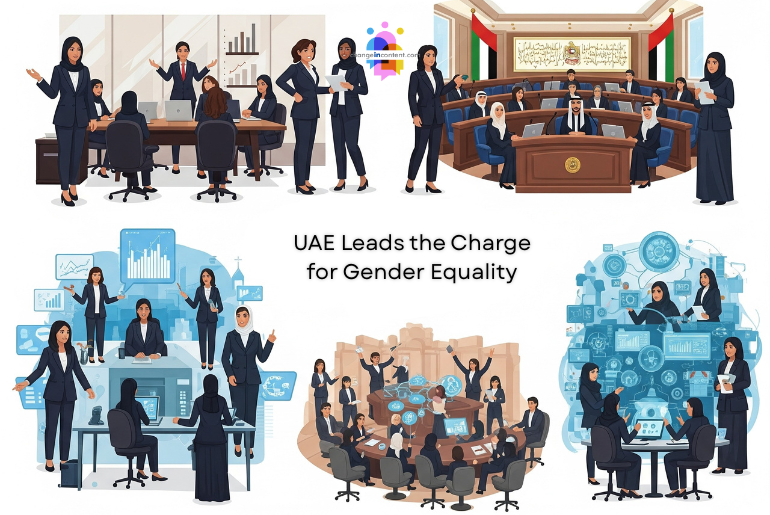
In a world where the gender gap persists across economies, politics, and boardrooms, one country is making unexpected strides. The UAE leads in empowering women, not just through symbolic representation, but with real, measurable structural change.
The United Arab Emirates has shown significant progress in improving gender equality. The latest Global Gender Gap Report 2025, released by the World Economic Forum (WEF), ranks the UAE 69th globally, up from 74th last year. This rise places the country ahead of all others in the Middle East and North Africa (MENA) region for the second consecutive year.
More importantly, the UAE stands out for its increase in women’s participation in leadership roles. Over the 19 editions of the Global Gender Gap Report, the UAE has consistently shown progress towards gender equality.
How the UAE leads in empowering women with the highest gender parity score
Data from LinkedIn’s Economic Graph in the report states that the UAE did not follow the global decline in hiring women for leadership roles. Instead, it continued to make progress. While most countries saw a drop in women hiring for such roles, the UAE recorded a 4.5% increase. The report states that this change stems from women in the UAE having more varied work experiences and a greater focus on acquiring new skills, particularly for AI-related roles.
The report identifies the UAE as one of the fastest-moving countries in narrowing the gender gap. It joins the ranks of Bangladesh, Chile, Ecuador, Ethiopia, Mexico, Nicaragua, and Saudi Arabia, nations that have made notable progress in economic, educational, health, and political indicators.
The UAE now holds a gender parity score of 0.724, the highest in the MENA region. Israel, Bahrain, Jordan, and Tunisia follow behind, while countries like Sudan and Iran remain near the bottom of the list.
UAE among the few nations with equal parliamentary representation for women
One of the most remarkable improvements came in the area of political empowerment. The UAE now ranks 32nd globally with a political parity score of 37.2%. It joins Mexico, Nicaragua, and Rwanda as the only countries to have achieved full parity in parliamentary representation.
The participation of women in the UAE Cabinet is among the highest in the world, with over a quarter of ministerial positions held by women. They currently have 50% of the seats in the UAE Federal National Council. This makes the UAE the only country in the MENA region to reach gender parity at the parliamentary level.
Political power and parity: UAE’s bold stance
The women in the UAE Cabinet also play roles in diplomacy, where women comprise 20% of the diplomatic corps. Seven Emirati women now serve as ambassadors or consuls general. These achievements have earned the UAE international recognition. The Georgetown Institute for Women, Peace and Security ranked the UAE 22nd out of 170 countries in its 2023 Women, Peace, and Security (WPS) Index. This ranking is based on a country’s performance in key areas, including financial inclusion, political participation, and access to justice.
Women prepare for the future of work
The World Economic Forum’s Global Gender Gap Report 2025 also highlights how women in the UAE are better equipped to meet the changing needs of today’s workplaces. Women in the UAE are 28% more likely than men to have professional experience across multiple domains. Additionally, women in the UAE are more likely to take the initiative to learn new skills. Surveys show they feel more confident about working with AI tools and technologies.
In 2021, the UAE Securities and Commodities Authority introduced a policy that requires all listed companies to appoint at least one woman to their board of directors. This move gave women a stronger voice in corporate governance and decision-making. In 2023, Emirati women held the highest number of spots on Forbes’ list of the 100 Most Powerful Arab Businesswomen. In 2024, they had the second-highest number, with 14 Emirati women making the list.
Women entrepreneurs in the UAE now account for 10% of the country’s private sector business owners. These women lead around 23,000 businesses, with a total value of over AED 50 billion. They also hold 15% of board positions in chambers of commerce and industry nationwide.
National laws also support women’s economic rights. Women in the UAE have equal access to property ownership, financial services, and natural resources. They are entitled to equal pay and have the legal right to inherit and control assets.
UAE leads in empowering women: The final thoughts
No country in the world has fully achieved gender equality. Not yet. There are still gaps in pay, leadership, access to resources, and more. The UAE is not perfect either. However, what sets the UAE apart is its approach. It’s not waiting for the gap to close on its own. The country is building inclusive systems, changing policies, investing in education, encouraging leadership at all levels, creating opportunities, and ensuring that women are equipped for future industries, such as AI and technology. It’s time others did, too.
ChangeinContent perspective
While the UAE’s leap is commendable, it also holds up a mirror to other nations, especially those that pride themselves on democracy and inclusivity but continue to neglect structural gender reform. From corporate boards to legislative bodies, the question is no longer “can we?” but “why haven’t we?” This is not just a win for the UAE. It is a wake-up call for everyone else.
Also Read: Global Gender Gap Index 2025: India slips again. What are we missing?
Disclaimer: The views expressed in this article are based on the writer’s insights, supported by data and resources available both online and offline, as applicable. Changeincontent.com is committed to promoting inclusivity across all forms of content. We broadly define inclusivity as media, policies, law, and history. It encompasses all elements that influence the lives of women and marginalised individuals. Our goal is to promote understanding and advocate for comprehensive inclusivity.