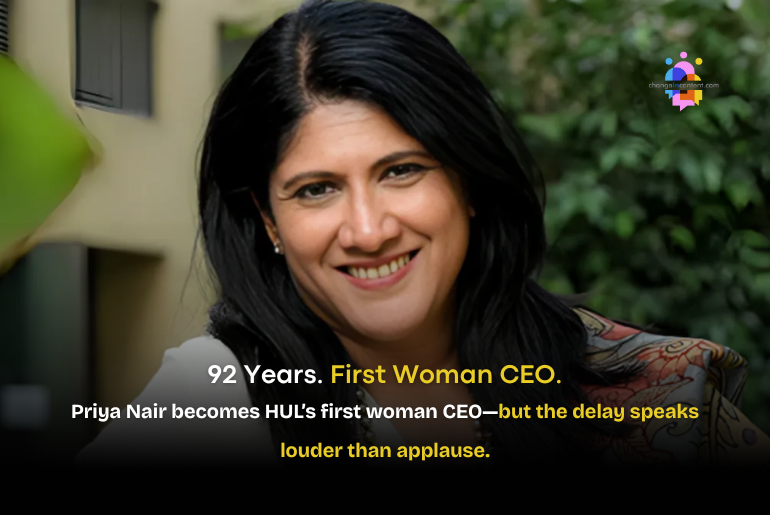
When Priya Nair was announced as Hindustan Unilever Limited’s first woman CEO, the corporate world applauded. But behind the applause lies an uncomfortable truth: it took 92 years. The focus is rightly on her achievement, but the delay forces us to examine the deeper systemic biases that have long kept capable women out of India Inc’s top positions.
Hindustan Unilever Ltd (HUL) has named Priya Nair as its next Chief Executive Officer and Managing Director. She will officially step into the role on August 1, 2025, succeeding Rohit Jawa, who will retire on July 31. With this announcement, Nair becomes the first woman to lead HUL as CEO and MD in HUL’s 92-year history.
Currently heading Unilever’s global Beauty and Wellbeing division, Nair oversees a business worth €13 billion, managing household brands such as Dove, Sunsilk, Clear, and Vaseline. Along with her new role as CEO and MD, she will also join the HUL Board, subject to necessary approvals, and continue serving on the Unilever Leadership Executive (ULE).
“Priya has had an outstanding career in HUL and Unilever. I am certain that with her deep understanding of the Indian market and excellent track record, Priya will take HUL to the next level of performance,” HUL Chairman Nitin Paranjpe said.
Priya Nair: A journey 30 years in the making
Priya Nair joined Hindustan Unilever in 1995. Over the past three decades, she has worked across various business areas, including home care, beauty, and personal care, starting in junior roles and progressing through the leadership chain.
But why did it take the country’s largest FMCG company so long to appoint a woman CEO?
Breaking the pattern, but why so late?
The company has never lacked capable women leaders. Ten years ago, Leena Nair, another HUL veteran, nearly became the company’s first woman CEO. However, she was instead offered a global role at Unilever’s headquarters in London. In 2016, the company named her its youngest-ever, first woman, and first Asian Chief Human Resources Officer. Today, Leena Nair leads Chanel as its global CEO, a role that brought her international recognition, including the Commander of the British Empire (CBE) honour from Prince William.
Women have long contributed to HUL’s growth. Still, the CEO role stayed out of reach for them.
HUL’s gender gap: Progress or perception?
Unilever has made progress in improving gender diversity at different levels of the organisation. Today, women hold 55% of managerial roles globally within the company. At HUL, women account for 36% of senior management, a number that, while still lower, remains noteworthy. However, at the highest leadership level, the Unilever Leadership Executive comprises only 15% women. Across its entire workforce of 128,000, women make up just 37%.
Despite its numerous programs regarding gender equality, such as Project Ahilya and Project Samavesh, which help women take on sales and shopfloor roles, HUL had never appointed a woman to lead the organisation.
Priya Nair finally breaks that pattern, but it took nearly a century to happen.
HUL shares jump nearly 5% after Priya Nair named CEO and MD
HUL’s performance in recent years has remained steady, though not exceptional. Volume growth has hovered below 5% over the past six years. The company faces growing competition from startups, especially in the beauty and personal care segment. In FY2025, HUL reported a turnover of ₹61,469 crore and a net profit of ₹10,644 crore. Its overall market capitalisation before the announcement stood at ₹5.66 lakh crore.
Investors responded quickly to the news of Priya Nair’s promotion. On the day the company made the announcement, HUL’s shares rose nearly 5%. The stock climbed 4.61% on the BSE, closing at ₹2,520.10, with an intraday peak of ₹2,530. On the NSE, shares ended at ₹2,520, rising 4.63%.
This rise came on a day when overall markets were falling. The BSE Sensex dropped by 689.81 points, and the NSE Nifty fell by 205.40 points that day. HUL, however, became the top gainer on both indices. The company’s market value increased by ₹26,092 crore, bringing its total to ₹5.92 lakh crore. It shows strong market support for Priya Nair’s appointment.
It is a big step for HUL, but won’t fix the leadership gender gap in India Inc
While Nair’s appointment is a significant milestone for HUL, it also underscores the scarcity of women in top positions within Indian companies. As of July 10, only nine out of the Nifty 200 companies have women CEOs or MDs. Within the Nifty 50, just two companies are led by women. In the Nifty 100, the number stands at three. Among the top 500 NSE-listed companies, only 24 have women serving as board chairpersons.
In the past decade, the share of women CEOs and MDs in the Nifty 200 has stayed between 3.5% and 6%. The highest point came in FY2016, when only twelve companies had women in charge.
A recent report from Prime Database reveals that women comprise 23% of the total workforce in NSE-listed companies. However, that number drops to 13% when it comes to key management roles and falls further to just 10% at the executive director level.
Even though women start out in large numbers, they often don’t make it into senior leadership. Somewhere between entry-level and leadership, the corporate environment loses them.
The final thoughts: What Priya Nair’s appointment really tells us
Women have long been integral to the workforce. They’ve led teams, delivered results, and driven growth. What they haven’t consistently been given is the chance to lead at the senior or leadership level.
ChangeinContent congratulates Priya Nair and wishes her the very best as she takes on this role. A well-deserved moment, long overdue. Let this not be the exception, but the start of fairer leadership.
Changeincontent perspective
At ChangeinContent, we believe that celebrating individual milestones must go hand in hand with critiquing the systems that delay them. Priya Nair’s appointment is a proud moment, but it also highlights how long it can take, even for progressive companies, to correct historical imbalances. Let us not forget that equality delayed is dignity denied. It is time for India Inc. to normalise diverse leadership, not just applaud it when it finally happens.
Also Read: The Marching Sheep Inclusion Index: 63% of Indian companies still have no women leaders.
Disclaimer: The views expressed in this article are based on the writer’s insights, supported by data and resources available both online and offline, as applicable. Changeincontent.com is committed to promoting inclusivity across all forms of content. We broadly define inclusivity as media, policies, law, and history. It encompasses all elements that influence the lives of women and marginalised individuals. Our goal is to promote understanding and advocate for comprehensive inclusivity.